



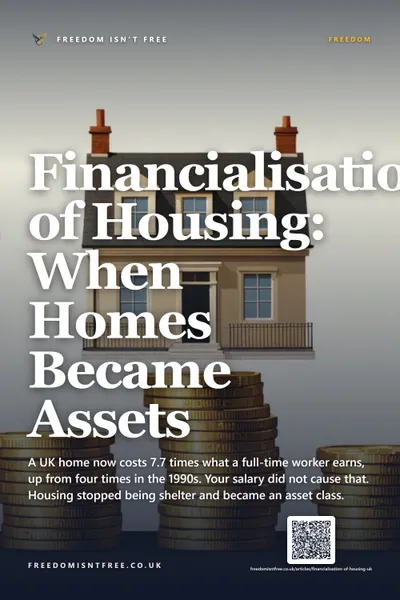



Financialisation of Housing: When Homes Became Assets
A UK home now costs 7.6 times what a full-time worker earns, up from four times in the 1990s. Your salary did not cause that. Housing stopped being shelter and became an asset class.
Cite this article
Freedom Isn't Free (2026) Financialisation of Housing: When Homes Became Assets. Available at: https://freedomisntfree.co.uk/articles/financialisation-of-housing-uk (Accessed: 21 September 2026).
Italicise the article title in your bibliography. Accessed date set to today.
TLDR
- Financialisation of housing means homes came to be priced and traded as financial assets to hold for gain, rather than as shelter to live in.
- Right to Buy from 1980 sold around 2 million council homes without replacing them, and the buy-to-let mortgage arrived in 1996, opening housing to leveraged investors.
- Private renting has doubled since the early 2000s to 19% of households (4.7 million homes), and the average English home now costs 7.6 times median full-time earnings.
- When houses are priced like assets, they detach from wages, which is why the average first-time buyer in England is now 34 and why owning is the dividing line in modern British wealth.
How UK housing became an asset class
| Moment | What changed |
|---|---|
| Right to Buy, from 1980 | Around 2 million council homes sold off and never replaced; 40%+ are now owned by private landlords |
| Buy-to-let mortgage, 1996 | For the first time, ordinary investors could borrow to buy homes as an income asset |
| The 2000s onward | Private renting doubled from about 10% of households to 19%, some 4.7 million homes |
| Today | The average English home costs 7.6x median earnings, up from around 4x in the late 1990s |
Each step treated housing a little more like a financial asset and a little less like shelter. Prices followed credit and investment demand, not wages.
Financialisation of Housing: When Homes Became Assets
The financialisation of housing is the process by which a British home stopped being mainly a place to live and became mainly a financial asset: something to buy, hold, leverage and trade for gain. It is the single biggest reason a home in England now costs about 7.6 times what a full-time worker earns, up from roughly four times in the late 1990s. Your salary did not cause that gap. The house did not get better. The nature of what a house is changed, and the price followed.
This is a story about policy choices rather than greedy individuals: four decades of decisions that slowly rewired housing from shelter into an asset class. Once you see the wiring, the modern misery of trying to buy a first home makes a lot more sense.
What financialisation of housing means
An asset is something you own to make money from. Shelter is something you use to keep the rain off. For most of the twentieth century a house was overwhelmingly the second thing, bought to live in, paid off over a working life, and valued at roughly what local wages could support.
Financialisation is what happens when the first meaning takes over. A house becomes a bet on future price growth, a vehicle for borrowing against, a line on an investor's balance sheet, a product that pension funds and overseas buyers and small landlords all compete to hold. When that happens, the price stops being anchored to what a nurse in that town earns and starts being set by credit availability, investment demand and tax incentives. The economist Josh Ryan-Collins made exactly this case in Why Can't You Afford a Home?, arguing that the deep link between cheap credit and land values is the engine that pulls housing away from wages and keeps it there.
How a home became an asset class
Three moments turned British housing into an asset class, and none of them was inevitable.
The first was Right to Buy, from 1980. Around two million council homes were sold to their tenants at deep discounts, and, crucially, they were never replaced. A home that had been a permanent piece of social infrastructure became a private asset that could later be sold on or rented out at market rates. The New Economics Foundation found that more than four in ten of those ex-council homes are now owned by private landlords. The public built the stock; private landlords trouser the rent on it today.
The second was the buy-to-let mortgage, launched in 1996. Before it, you could not easily borrow money to buy a house as an investment. After it, an ordinary person with some equity could borrow against it and buy homes as an income-producing asset, competing directly with first-time buyers for the same properties. Housing was now something you could build a small financial portfolio out of, and hundreds of thousands of people did exactly that.
The third was everything that followed: years of cheap credit, quantitative easing that lifted asset prices across the board, and chronic undersupply of new homes. Private renting doubled from about 10% of households in the early 2000s to 19% today, roughly 4.7 million homes, according to the English Housing Survey. A whole generation that would once have owned now rents from the generation and the investors who bought earlier. Brett Christophers gave his book on the wider trend the title Our Lives in Their Portfolios, and the phrase is exact: for millions of renters, the roof over their head is quite literally a line in someone else's investment portfolio.
What happens when houses are priced like assets
Once housing is an asset class, its price obeys asset logic, and asset logic is brutal for anyone who does not already own.
Prices detach from local wages, because the marginal buyer is no longer a family stretching to their salary limit. It is an investor comparing yields, a cash buyer, or an existing owner trading up with decades of accumulated equity. The ONS figure of 7.6 times earnings is a national average that hides much worse: in Kensington and Chelsea the ratio is above 27. When a home costs that many years of income, no normal saver can bridge the gap from wages alone, which is why the average first-time buyer in England is now 34, and why so many only get there with family money behind them. The brutal deposit maths facing Gen Z is the direct downstream effect.
It also changes what a house does to the people who own one versus the people who do not. For owners, financialisation has been a quiet windfall: paper wealth rising year after year with no work involved, exactly the kind of unearned gain that defines rentier capitalism. For renters, the same process is a headwind, because rising prices mean rising rents and a receding deposit target. Housing has become the main dividing line in British wealth, and increasingly the main reason boomers had it easier than the workers who came after them. The old promise that a steady job would eventually buy a stable home has quietly stopped being true for large parts of the country.
Who wins, who pays, and the fixes nobody uses
Whoever owned before the detachment came out ahead: earlier generations, landlords, and holders of land and property generally. The people who pay are younger workers, renters, and anyone whose wealth is tied up in a wage rather than a deed. Government has mostly nudged the problem sideways. Schemes like Help to Buy poured demand into a supply-constrained market and, predictably, helped push prices up rather than down. Attempts to cool investor demand, such as the extra stamp duty surcharge on additional properties (introduced at 3% in 2016 and raised to 5% in 2024) and the tapering of landlord mortgage-interest relief from 2017, trimmed the edges without touching the core dynamic.
The genuine fixes are well understood and politically radioactive. Build far more homes. Tax the unearned uplift in land values through a land value tax, so that public investment stops flowing straight into private windfalls. Stop treating a primary residence as a tax-free speculative asset. Each of these would create visible losers among existing owners, who vote, which is the same reason Britain will not tax wealth more broadly. So the financialised system persists, not because anyone defends it on the merits, but because unwinding it would cost the people who benefit most.
Frequently Asked Questions
Is the financialisation of housing the same as a housing bubble?
No. A bubble is a temporary run-up in prices that eventually pops back toward fair value. Financialisation is a permanent structural change in what housing is and how its price is set. It can persist for decades without correcting, because it is driven by the ongoing treatment of homes as investment assets rather than by a one-off wave of speculation. A bubble bursts; financialisation just carries on.
When did UK housing become financialised?
There is no single date, but the key steps run from 1980 onward. Right to Buy from 1980 turned social housing into private assets, the buy-to-let mortgage in 1996 let ordinary investors borrow their way into the market, and the cheap-credit years after 2000, capped by post-2008 quantitative easing, pushed asset prices well ahead of wages. The process is cumulative rather than a single event.
Does financialisation mean I should not buy a home?
Not at all, and if anything it argues the opposite. In an economy that rewards owning over earning, becoming an owner is how you stop being purely on the paying side of the deal. The point is to buy a home to live in and hold for the long term, not to treat it as a leveraged speculation, and to weigh the decision honestly against renting and investing using the rent versus buy maths rather than the assumption that prices only ever rise.
How is this different from buy-to-let being a good investment?
They are two sides of one coin. Buy-to-let is the individual expression of financialised housing: treating homes as an income-yielding asset class you can build a portfolio from. What looks like a sensible personal investment in aggregate helps drive the very price detachment that locks first-time buyers out. Recent tax changes have made buy-to-let far less attractive than it was, which is policy quietly trying, and mostly failing, to push housing back toward being shelter.
Disclosure: This article is general commentary and education, not financial, investment, mortgage, or property advice. House-price, affordability, tenure and first-time-buyer figures are drawn from the Office for National Statistics, the English Housing Survey, and the New Economics Foundation, and are accurate as of those published sources. The stamp duty surcharge (3% from 2016, 5% from 2024) and mortgage-interest relief changes are summarised for context; tax and property rules change and depend on your circumstances. Property and investments can fall as well as rise in value, and buying a home is a major decision you should weigh against your own situation.
Sources
Prefer to watch?
We turn these money breakdowns into short videos
A few a week, plain-English UK money. If you would sooner watch than read, follow along:
Enjoying the content?
If this site has been useful, a coffee goes a long way.
Browse more articles
Browse all