








Who Gets Your Service Charge? The Tipping Con
That 12.5% 'service charge' on your bill wasn't legally a tip until October 2024. It was the restaurant's money, and staff often never saw it. The fix took nine years to arrive.
Cite this article
Freedom Isn't Free (2026) Who Gets Your Service Charge? The Tipping Con. Available at: https://freedomisntfree.co.uk/articles/who-gets-your-service-charge-uk (Accessed: 21 September 2026).
Italicise the article title in your bibliography. Accessed date set to today.
TLDR
- Until 1 October 2024, the service charge on your bill was legally the business's money. Adding 12.5% "for service" and keeping some or all of it was lawful, and the government estimated workers lost around £200 million a year to it.
- The Employment (Allocation of Tips) Act 2023 now requires 100% of tips, gratuities and service charges to reach workers with no deductions, allocated fairly, and paid by the end of the following month.
- Workers can demand the written tipping policy, request their tipping records once every three months, and take an employer to an employment tribunal if the money does not arrive.
- Tips still count as taxable income, but tips shared through a genuinely independent tronc escape National Insurance entirely - worth more to a worker than most pay rises of the same size.
| Cash tip in hand | Always the worker (taxable income) |
| Card tip, pre-Oct 2024 | Employer could skim or keep it |
| Service charge, pre-Oct 2024 | Legally the business, not the staff |
| All of it, from 1 Oct 2024 | 100% to workers, no deductions |
Who legally kept your tip, before and after the Tipping Act
Who Gets Your Service Charge? The Tipping Con
The service charge at the bottom of your restaurant bill looks like a tip. For most of its history it was nothing of the sort. Until 1 October 2024, that 12.5% "discretionary service charge" was, in law, the restaurant's money. Not the waiter's, not the kitchen's. The company's. It could pass it on, skim it, or trouser the lot, and for years a minority of employers did exactly that, to the tune of around £200 million a year by the government's own estimate.
That is the tipping con in one sentence: a payment you made because a human being looked after you, collected by a business that was under no legal duty to give it to them. It has now been fixed, mostly. But the fix took nine years from scandal to statute, and the fine print of the new law is worth knowing whether you earn tips or leave them.
Contents
- Who got your service charge before October 2024
- What the Tipping Act actually requires
- The tronc: the tax quirk worth knowing
- Your rights if you work for tips
- What to do as the customer
Who got your service charge before October 2024
The old legal position surprises almost everyone. A cash tip pressed into a waiter's hand was always the waiter's property. But the moment the payment routed through the till - a card tip, or a service charge added to the bill - it belonged to the employer. The service charge was never legally a gift to staff at all. It was a payment to the business, dressed up with a word that made you think otherwise.
What employers did with that money varied from "passed on every penny" to practices that, when they surfaced, caused a public outcry. The best-known example: in 2015, Pizza Express was charging an 8% admin fee on tips paid by card, keeping a slice of every gratuity before staff saw the rest. A Unite union campaign and a petition of nearly 10,000 signatures later, the chain scrapped the fee. Other chains were found deducting similar amounts, and the then Business Secretary Sajid Javid launched an investigation into tipping practices that same year.
And this was the second scandal, not the first. Before 1 October 2009, employers could legally count tips paid through payroll towards the National Minimum Wage - meaning the tip you left simply replaced wages the employer would otherwise have had to fund. It took a change to the minimum wage regulations to stop tips subsidising the payroll.
Track the timeline and the pattern is familiar from every corner of Rip-Off Britain - it is the same arc as the loyalty penalty: the extraction runs quietly for years, a scandal names it, an investigation is announced, and the actual law lands the better part of a decade later. Javid's investigation opened in 2015. The Employment (Allocation of Tips) Act came into force in October 2024. Nine years, at roughly £200 million a year of workers' money in between. Nobody was ever made to hand back the money collected while Westminster deliberated.
What the Tipping Act actually requires
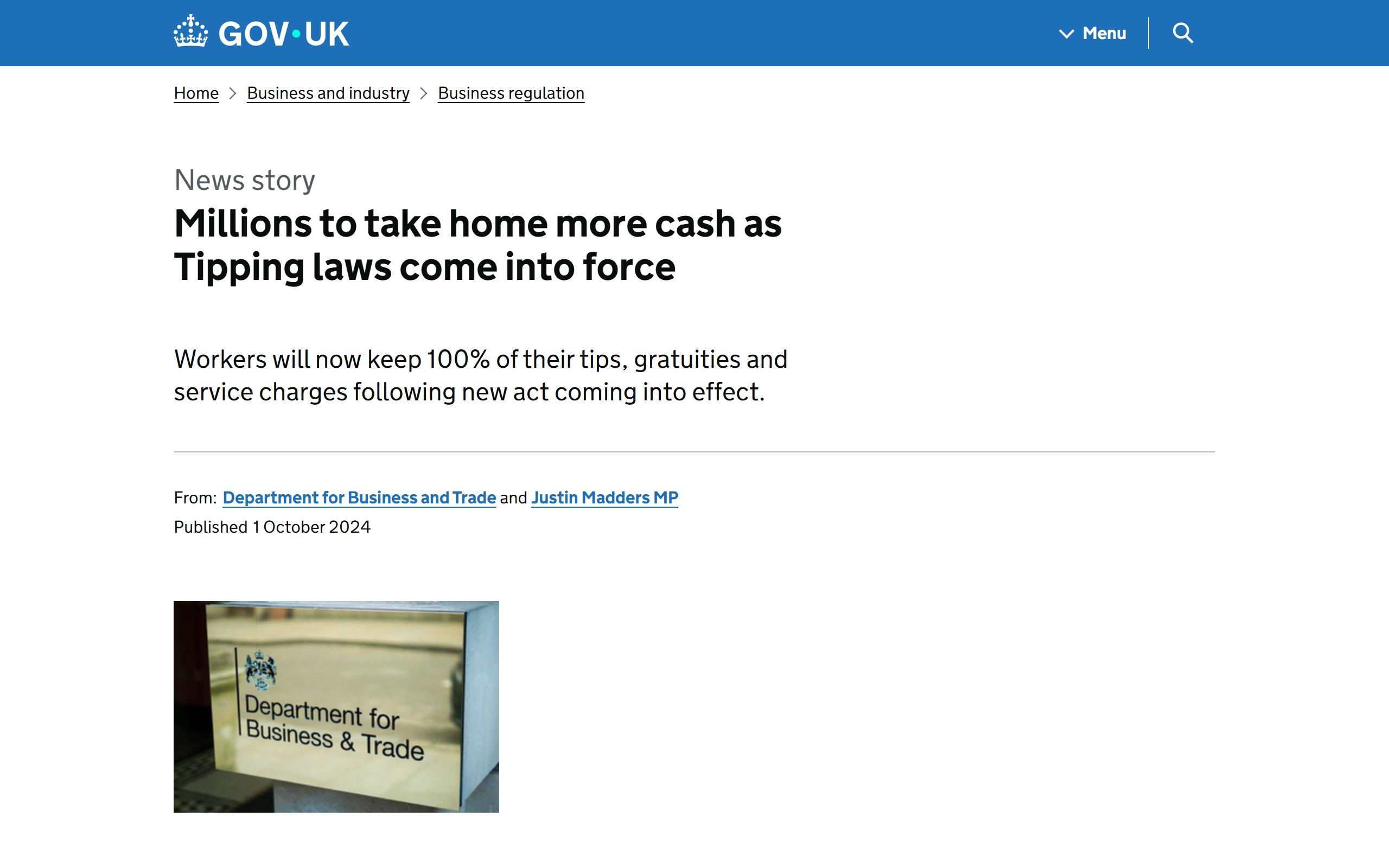
The Employment (Allocation of Tips) Act 2023, in force across England, Scotland and Wales since 1 October 2024, is blunt where the old law was vague. If a tip, gratuity or service charge is received by the employer or is under the employer's control - which covers every card tip and every service charge on a bill - then:
- 100% must go to workers. No deductions except income tax. No admin fees, no card-processing haircut, no "breakage" charge. The Pizza Express 8% would be illegal today.
- It must be allocated fairly. A statutory Code of Practice sets out the factors employers can use - role, hours worked, performance, seniority - so a fair split does not have to be an equal split, but it does have to be justifiable and transparent.
- Payment must land by the end of the month after the customer paid: a tip left on 23 June has to reach the worker by 31 July at the latest, with no holding the pot back for a quarterly morale ceremony.
- And the allocation happens at the place of business where the money was earned, so head office cannot pool the London restaurant's service charges and spread them across the group.
The government's estimate is that this moves around £200 million a year from employers who were retaining tips back to the roughly two million people who work in pubs, cafes and restaurants. For a worker on the minimum wage in a busy venue, the service charge share can be worth thousands of pounds a year - a bigger uplift than most annual pay rises, and a real mover on what counts as a good salary in a sector where the headline pay is low.
One honest caveat: most employers were already passing tips on before the law forced the issue. The Act exists because of the minority who were not, and because "most employers behave" has never been a good reason to leave the money legally unprotected.
The tronc: the tax quirk worth knowing
Most hospitality venues distribute tips through a tronc - a pooling arrangement run by a "troncmaster" who decides the split. This is not just tradition. It carries a genuinely valuable tax quirk.
Tips are always taxable income, whoever handles them. But under HMRC's E24 rules, tips distributed through a tronc that is genuinely independent of the employer - the employer neither pays the money to staff directly nor decides who gets what - are exempt from National Insurance entirely. No employee NI, no employer NI. Income tax still applies through PAYE, but the NI saving means £100 of tronc tips puts more in a worker's pocket than £100 of wages ever could - run your own numbers through the take-home pay calculator to see what NI normally takes.
The catch sits in the word "independent". If the employer is quietly steering the allocation, the NI exemption fails and the tips should be taxed like ordinary pay. The tronc's independence is what makes the exemption lawful, and it is exactly what HMRC looks at when it checks one.
Your rights if you work for tips
The Act is only worth anything if the people it protects use it. If you work in hospitality, or your kid does, these are the levers:
- Ask for the written tipping policy. Any employer where tips are paid more than occasionally must have one, in plain language, available to every worker. No policy is itself a breach.
- Request your tipping records. You are entitled, once every three months, to see the total qualifying tips taken at your place of business and the amount allocated to you, going back up to three years. If the venue took £40,000 in service charges last quarter and your share reads like a rounding error, you now have the number in writing.
- Do the arithmetic on timing. The end-of-following-month rule means the June service charges must be in your July pay, and a tip pot that arrives "when things settle down" is a breach the tribunal recognises.
- Tribunal, if it comes to it. Workers can enforce the Act through an employment tribunal, which can order the employer to redistribute tips properly and award compensation - and a tribunal can fix the allocation for the whole team, not just the person who complained. ACAS early conciliation is the free first step.
None of this requires a lawyer to start. The policy request and the records request are emails.
What to do as the customer
The pre-2024 folk wisdom was "always tip in cash, it's the only way the staff see it". That advice is now mostly obsolete. A card tip and a service charge are both legally protected, must reach staff in full, and (through a tronc) are often worth more per pound than a cash tip once National Insurance is factored in - and unlike the crumpled fiver, they leave an audit trail HMRC and a tribunal can check.
Two things are still worth knowing. First, a discretionary service charge is exactly that: you can ask for it to be removed if the service was poor, because it is your money until you agree to pay it. Second, the one question that still cuts through: ask the staff whether they get the service charge. Since October 2024 the answer should always be yes. If someone who works there tells you otherwise, you have just heard about a breach of the law, and the tip you leave in cash that night will be the least of the venue's problems.
The tipping con is one of the rare corners of Rip-Off Britain that actually got fixed. It is worth noticing what fixing it required: not competition, not consumer pressure, but a scandal, a nine-year legislative grind, and a statutory code with a tribunal behind it. The lesson generalises. When money quietly flows from the people who earned it to the people who merely handle it, the market rarely corrects it on its own - and why the UK won't tax wealth follows that same logic all the way to the top of the system.
Frequently Asked Questions
Do waiters actually get the service charge now?
Yes, by law. Since 1 October 2024, the Employment (Allocation of Tips) Act requires 100% of service charges, card tips and cash tips handled by the employer to be passed to workers with no deductions other than income tax, allocated fairly under a statutory Code of Practice, and paid by the end of the month after the customer paid. A restaurant that keeps any of it is breaking the law, and workers can enforce that through an employment tribunal.
Do you still tip if there is already a service charge?
There is no need. The service charge is now legally the staff's money in full, so adding a cash tip on top is pure generosity rather than a way of making sure the workers get something. If you have asked for a poor-service charge to be removed but one person looked after you well, a direct cash tip to them still works exactly as it always did.
Is it better to tip in cash or by card in the UK?
Since October 2024 it makes far less difference. Card tips and service charges are legally protected and must reach staff in full, and tips distributed through an independent tronc escape National Insurance, so a pound tipped on card can be worth more than a pound tipped in cash. Cash still works, and it remains the worker's property from the moment it is handed over.
Do you legally have to pay a service charge in a restaurant?
A discretionary service charge is optional: you can ask for it to be taken off the bill, in the same way you are never obliged to leave a tip. A compulsory service charge is only enforceable if it was clearly brought to your attention before you ordered, on the menu or at booking. If a charge labelled discretionary is treated as mandatory, challenge it on the spot.
Are tips taxable in the UK?
Yes. All tips are taxable income, whether cash, card or service charge. Tips paid through the employer or a tronc are taxed through PAYE automatically; cash tips received directly from customers should be declared to HMRC like any other untaxed income. The National Insurance exemption for independent tronc payments reduces the total tax take, but the income tax is always due.
This article is general information, not legal or financial advice. The rules described apply in England, Scotland and Wales; employment law is devolved in Northern Ireland. Tax and employment rules can change. Figures are accurate as of July 2026 with sources listed above.
Sources
- GOV.UK - Millions to take home more cash as Tipping laws come into force (1 October 2024)
- GOV.UK - Code of practice on fair and transparent distribution of tips
- GOV.UK / HMRC - E24 guidance on tips, gratuities, service charges and troncs
- Legislation.gov.uk - National Minimum Wage Regulations 1999 (Amendment) Regulations 2009
- ITV News (2015) - Pizza Express to remove 8% admin fee on tips paid by card
Prefer to watch?
We turn these money breakdowns into short videos
A few a week, plain-English UK money. If you would sooner watch than read, follow along:
Enjoying the content?
If this site has been useful, a coffee goes a long way.
Browse more articles
Browse all