








Should You Tell People Your Salary?
Your employer knows every salary in the building. You know one. That asymmetry is worth thousands at every pay review, and the salary taboo is what keeps it in place.
Cite this article
Freedom Isn't Free (2026) Should You Tell People Your Salary?. Available at: https://freedomisntfree.co.uk/articles/should-you-tell-people-your-salary-uk (Accessed: 21 September 2026).
Italicise the article title in your bibliography. Accessed date set to today.
TLDR
- Pay secrecy has one consistent beneficiary: your employer, who knows every salary in the negotiation while you know exactly one.
- The Equality Act 2010 makes contract gag clauses unenforceable when you discuss pay to find out whether discrimination is happening, and punishing you for it counts as victimisation.
- Most workers cannot even place their own salary: the UK top 10% starts at about £67,400, tens of thousands lower than most people guess.
- Tell colleagues, deliberately and in ranges. Treat friends and family as a separate, optional question. The taboo is not politeness; it is unpaid enforcement of the payroll department's information advantage.
| Gag clauses on discrimination-related pay talk | Unenforceable (Equality Act 2010) | Salary NDAs banned outright |
| Right to ask what comparable colleagues earn | No | Yes, on request |
| Salary history questions in hiring | Allowed | Banned |
| Pay gap reporting | 250+ employees, gender only | 100+ employees, phased from 2027 |
Pay transparency rules: the UK vs the EU (2026)
Should You Tell People Your Salary?
Should you tell people your salary? Yes. More often, more deliberately, and with less embarrassment than you have been trained to feel. The British consensus says pay talk is vulgar, that a decent person changes the subject, that what you earn is between you, HMRC and payroll. That consensus has one consistent beneficiary, and it is not you. Your employer knows every salary in the building. You know one. Every pay rise you have ever negotiated happened across that information gap, and the salary taboo is what keeps the gap open.
But this is a genuine fork, not a strawman, because "people" covers two very different audiences. Telling a colleague what you earn is a negotiating decision. Telling your brother-in-law at Sunday lunch is a social one. The cases for and against are different for each, so let us take them properly, and then I will tell you where I land.
Contents
- The salary taboo is not politeness
- The law is more on your side than you think
- What staying quiet actually costs you
- The case for keeping it to yourself
- Where I land on telling people your salary
- How to talk about pay without making it weird
The salary taboo is not politeness
Start with the reframe, because everything else follows from it. The salary taboo is not really a rule of manners. It is the cheapest wage-suppression tool ever invented, and workers enforce it on the employer's behalf, for free.
Think about what a pay negotiation actually is. Two parties agree a price for your labour. One party, the employer, has perfect information: every salary on the team, every band, every offer made to every candidate this year, and exactly how little the last person accepted for the same job. The other party, you, has one data point and a feeling. In any other market we would call that an information asymmetry and expect the informed side to win. In the labour market we call it discretion and congratulate ourselves for it.
Secrecy does not keep your number private from anyone who can act on it. Payroll knows. Your manager knows. HR benchmarks it against market data they bought precisely so they would know more than you. The only people the taboo keeps in the dark are the people on your side of the table: the colleague paid £6,000 more for the same work, or paid £6,000 less. Silence quietly transfers money from whoever is underpaid to the payroll budget, year after year, and the underpaid person is the last to find out.
The law is more on your side than you think
Plenty of UK employment contracts still contain a pay-confidentiality clause, and plenty of managers still imply that discussing salaries is a disciplinary matter. Here is what the law actually says.
Section 77 of the Equality Act 2010 makes those gag clauses unenforceable when you discuss pay for the purpose of finding out whether pay is connected to a protected characteristic - sex, race, age, disability and the rest. That covers the classic case: two colleagues comparing numbers to check whether the women on the team are paid less than the men. The Act calls this a "relevant pay disclosure", it protects asking as well as telling, it covers former colleagues too, and punishing anyone for it counts as victimisation, which is its own claim. The clause in your contract does not trump the statute.
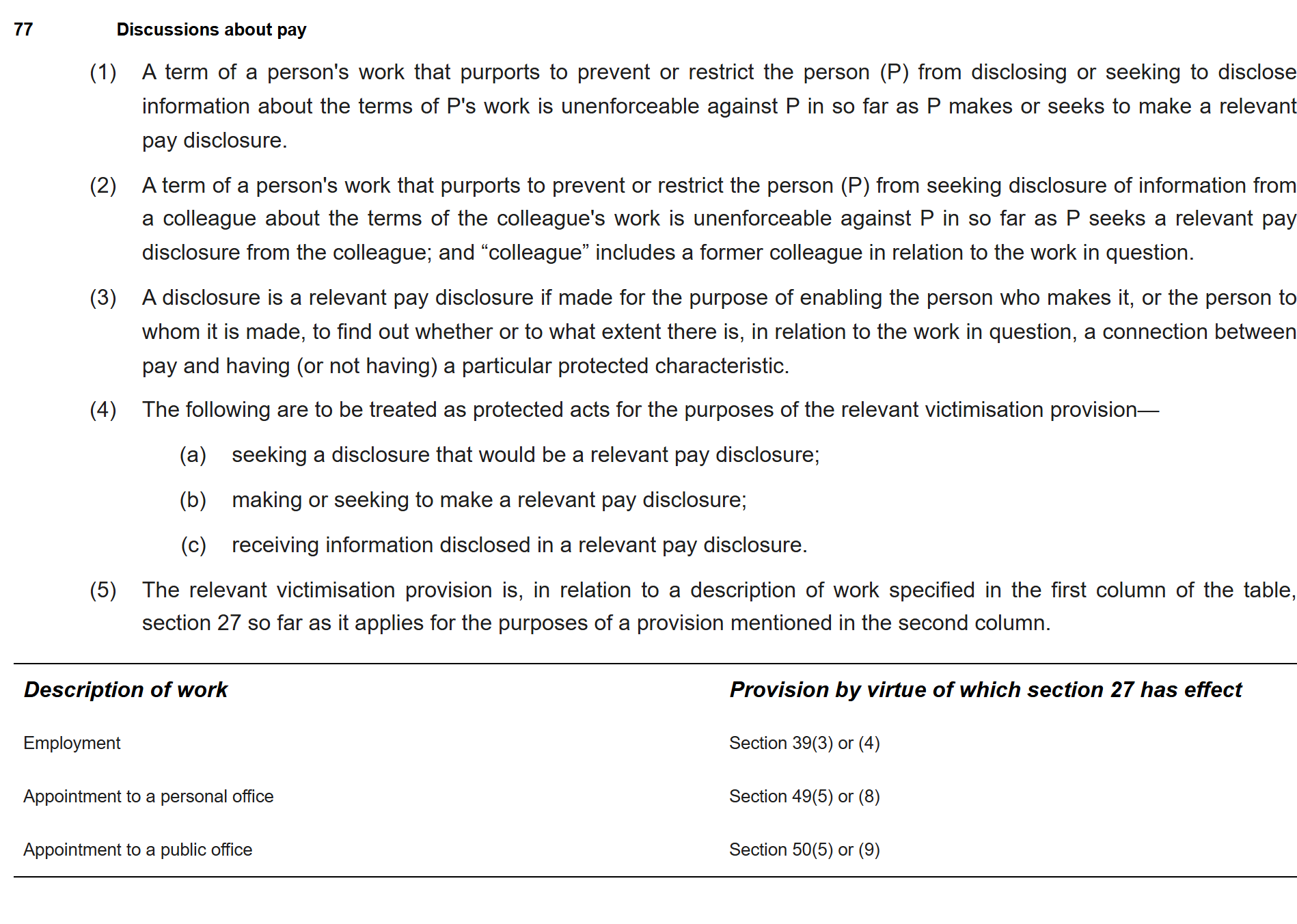
Two caveats. First, the protection is tied to that discrimination purpose; a pay conversation with no connection to a protected characteristic sits outside section 77, so a contractual clause can still technically bite there. In practice the line is blurry and employers know it, which is why disciplinary action over pay chat between colleagues is rare. Second, having a right and feeling safe using it are different things, especially in a small firm. Know the law, and pick your moments.
The rest of the UK's transparency architecture is thin. Employers with 250 or more employees must publish gender pay gap figures each year, and that is roughly where it ends. Compare the EU's Pay Transparency Directive, which member states must apply from June 2026: salary NDAs banned, salary-history questions banned in hiring, workers given the right to ask what colleagues doing equal work are paid on average, and pay gap reporting rolling out to firms of 100+ employees (phased in from 2027). Brussels has concluded that pay secrecy is a discrimination technology. Westminster, so far, has not. British workers are being left to build transparency themselves, one awkward conversation at a time.
What staying quiet actually costs you
The costs of pay secrecy are concrete, and they compound.
You cannot negotiate against a number you cannot see. If the market rate for your role has moved £8,000 since you joined and nobody around you talks, the first you hear of it is when a new starter lets it slip three years later. Recruiters and employers share salary data with each other constantly, through benchmarking surveys and market-rate reports. Workers refusing to do the same is unilateral disarmament.
You probably cannot even place yourself. Most people's sense of where they sit in the UK income distribution is wrong by a comic margin. The top 10% of UK taxpayers starts at about £67,400 of total income, and the median across all taxpayers is roughly £29,700 (HMRC Survey of Personal Incomes, 2023/24). The median full-time salary is £39,039 (ONS, April 2025). People routinely guess the top 10% line at £90,000 or higher. If your sense of "normal pay" is built from headlines and guesswork rather than real numbers from real people, every anchor in your next negotiation is off.
Discrimination hides in the silence. The gender pay gap does not primarily survive because someone in HR is twirling a moustache. It survives because pay is invisible, so nobody can see the pattern in time to challenge it - and the pattern is expensive, as the numbers in the motherhood penalty show. It is no accident that section 77 exists at all: Parliament recognised that the only reliable way unequal pay gets discovered is workers comparing notes. Every pay conversation that does not happen is a data point the pattern gets to keep.
The case for keeping it to yourself
Now the other side, because it is real and it deserves better than a strawman.
Outside work, a salary number lands on a relationship with weight. Tell a friend who earns half what you do, and you have changed something between you, however maturely you both handle it. Money envy is not a character flaw that other, lesser people have; it is a near-universal human response, and it runs in both directions. The friend who earns double can make you feel you are failing at a game you did not know you had entered. There is a reason the dinner-party version of this conversation makes everyone's shoulders tense.
A number without context also misleads. £70,000 as a contractor with no pension, no sick pay and four months of bench time is not £70,000 as a permanent employee with a 10% employer pension contribution. A London salary is not a Sunderland salary once housing has taken its cut, as we cost out in what a "good" salary means by region. Shared as a bare number, your salary can make your life look easier or harder than it is, and you do not control the story the other person builds around it.
And disclosure is a one-way door. You can always tell someone later. You cannot untell them.
Notice, though, what all of these arguments have in common: they are about friends and family. They are social arguments, and they are legitimate. What they are not is a reason to keep your salary from the colleague doing your job on different money. The strongest case for secrecy defends your dinner table, not your employer's pay structure. Treating the two as one question is exactly the confusion the taboo relies on.
Where I land on telling people your salary
At work: talk. Deliberately, not performatively. My honest take is that pay transparency between colleagues is negotiating infrastructure - the labour-market equivalent of a price tag, and the only counterweight ordinary workers have against an employer who benchmarks everything. I have worked in UK tech for a decade, a sector that leans more transparent than most, with salary bands increasingly published and market data a Google search away. The sky has not fallen. The winners from that norm are workers; the discomfort is mostly management's. Share your band with the colleague who asks. Ask the trusted colleague when it matters. If you are a manager, push for published bands so nobody has to whisper at all.
With friends and family: your call, and ranges are your friend. "Mid five figures" or "about the median for my field" carries most of the useful information with a fraction of the social payload. I think the case for openness is weaker here and I hold it loosely - the stakes are relational, not financial, and you know your own family's dynamics better than I do.
The one position I will argue against outright is reflexive secrecy: staying silent everywhere because the culture told you to. That silence was never designed for your benefit. Decide who you tell. Do not let the taboo decide for you.
That is my side of it. The floor is yours.
How to talk about pay without making it weird
A few mechanics that make the conversation easier in practice.
Trade, don't extract. Offer your number or your range first. Reciprocity does most of the social work, and it signals the conversation is mutual aid rather than nosiness.
Use ranges and bands at work. "I'm in the low 50s, where did they land you?" gets 95% of the negotiating value of an exact figure with less sting. If your employer has bands, naming the band is often enough.
Anchor on the role, not the person. "What does this role pay here?" and "what would I need to show to reach the next band?" are questions a manager can answer without anyone feeling ambushed.
Check the public data first. Job adverts with published ranges, salary surveys for your industry and the big review sites give you a floor of knowledge before you spend any social capital. Ten minutes of shopping around beats guessing, and colleague conversations then confirm or correct what you found.
If you hit a gag clause, know what it is worth. A contractual pay-secrecy term cannot be enforced against a discrimination-related pay conversation, and action taken against you for one is victimisation under the Equality Act. If that situation turns real, document everything and get advice from Acas or a union rep before it escalates.
The Trading Game - Gary Stevenson - Stevenson's account of a Citibank trading floor where pay was the scoreboard everyone obsessed over, and of what learning the real numbers did to his own negotiating hand. The sharpest case for knowing your market rate you will read. (Affiliate link - we may earn a small commission at no extra cost to you.)
Frequently Asked Questions
Is it illegal to discuss your salary with colleagues in the UK?
No. There is no UK law against discussing your own salary. The Equality Act 2010 goes further: contract clauses that try to stop pay discussions are unenforceable where the conversation is about uncovering possible pay discrimination, and punishing a worker for such a conversation counts as victimisation.
Can my employer stop me from telling people what I earn?
Your employer can put a confidentiality clause about pay in your contract, but section 77 of the Equality Act 2010 makes it unenforceable against discrimination-related pay disclosures. Outside that purpose the clause may technically apply, though enforcement against ordinary pay chat between colleagues is rare. Disciplinary action for a protected pay discussion can itself be unlawful.
Should you tell friends and family how much you earn?
That is a social decision rather than a financial one, and it is fine to answer it differently from the workplace question. A bare number can strain relationships in both directions, and it carries no context about pensions, security or cost of living. Ranges give most of the honesty with less of the friction. There is no obligation either way.
Is £30k a good salary in the UK?
It depends on the yardstick. Around £30,000 sits close to the median total income across all UK taxpayers (roughly £29,700 on HMRC's 2023/24 figures), but below the £39,039 median for full-time employees (ONS, April 2025). Against the full-time workforce it is below average; against the whole income distribution, including part-timers and pensioners, it is about the middle.
Do UK job adverts have to show a salary?
No. The UK has no legal requirement to publish salary or salary ranges in job adverts. From June 2026, EU member states must ban salary-history questions and give applicants pay information under the Pay Transparency Directive, but the UK has no equivalent rule, so transparency in British hiring remains voluntary.
This article is general information, not legal advice. How the Equality Act 2010 applies depends on the facts of your situation. If you are facing action over a pay conversation at work, get advice from Acas, a union rep, or an employment solicitor.
Sources
Prefer to watch?
We turn these money breakdowns into short videos
A few a week, plain-English UK money. If you would sooner watch than read, follow along:
Enjoying the content?
If this site has been useful, a coffee goes a long way.
Browse more articles
Browse all