






Mid-Contract Price Rises: The Hike Nobody Agreed To
In April 2023 your broadband bill went up by 14.4% in the middle of a fixed contract, and the small print said you agreed. Ofcom banned the formula. The replacement still stings.
Cite this article
Freedom Isn't Free (2026) Mid-Contract Price Rises: The Hike Nobody Agreed To. Available at: https://freedomisntfree.co.uk/articles/mid-contract-price-rise-uk (Accessed: 21 September 2026).
Italicise the article title in your bibliography. Accessed date set to today.
TLDR
- For years, UK broadband and mobile contracts included an annual April rise of CPI or RPI inflation plus 3.9%, which peaked at 14.4% to 17.3% in April 2023 - in the middle of a fixed term you could not leave without exit fees.
- Ofcom found around six in ten broadband and mobile customers were on inflation-linked contracts, and banned the practice: from 17 January 2025, any rise in a new contract must be stated in pounds and pence up front.
- Providers adapted immediately. The formula became a flat £3 to £4 a month, which is a bigger percentage rise on a cheap plan than the old inflation formula ever was, and the flat amounts are creeping up with each contract generation.
- Check which side of the 17 January 2025 line your contract sits on, diarise your end date, and if you are on Universal Credit or Pension Credit, social tariffs from £10 a month come with no mid-contract rises and no exit fees.
| Before the ban | CPI + 3.9% every April, up to 17.3% in 2023 |
| 17 January 2025 | New contracts: rises must be in pounds and pence |
| After the ban | Flat £3-£4/month rises, hitting cheap plans hardest |
| Legacy contracts | Signed before 2025? The old formula can still apply |
The mid-contract price rise, before and after the Ofcom ban
Mid-Contract Price Rises: The Hike Nobody Agreed To
A fixed-term contract is supposed to be a simple deal: you promise to stay, they promise a price. For most of the last decade, UK broadband and mobile contracts kept only half of that bargain. You were locked in for 18 or 24 months with exit fees guarding the door, while the provider reserved the right to raise the price every April by inflation plus 3.9%. In April 2023, with inflation raging, that meant bills jumping by 14.4% - and up to 17.3% for customers whose provider used the higher RPI measure - in the middle of a term they could not leave.
Nobody meaningfully agreed to that. The formula sat in the small print of a contract you could not negotiate, referencing an inflation number that did not exist yet when you signed. Ofcom eventually reached the same conclusion and banned the practice. What happened next is the interesting part, because the replacement has a sting of its own.
Contents
- How your bill went up in the middle of a fixed deal
- Why "plus 3.9%" was never about costs
- The ban, and how providers adapted
- Which side of the line is your contract on?
How your bill went up in the middle of a fixed deal
The mechanism was the inflation-linked mid-contract price rise. From around 2020, the big providers wrote a standard clause into their terms: every April, your monthly price rises by a published inflation rate plus a fixed premium, typically 3.9%. Vodafone, EE, BT and Plusnet used the December Consumer Prices Index; O2 used the January Retail Prices Index, which runs higher.
In normal times the clause added a few percent and nobody looked up from their phone. Then inflation stopped being normal. December 2022's CPI reading pushed the April 2023 rise to 14.4% for the CPI-plus-3.9% crowd, and O2's RPI-based formula produced rises of up to 17.3%. A £30 broadband bill became £34.32 overnight, mid-contract, with exit fees still standing between you and a better deal.
The scale is what made this a national issue rather than a niche grumble. Ofcom found that as of April 2024, around six in ten broadband and mobile customers were on contracts with inflation-linked rise terms. That is tens of millions of bills rising by a formula most of the people paying them had never consciously read.
Why "plus 3.9%" was never about costs
Providers defended inflation-linked rises as covering rising input costs. Fine, as far as it goes: inflation is, by definition, the rate at which costs rise. Which invites the obvious question about the other bit. If CPI covers the cost pressure, what is the 3.9% for?
No provider ever offered a persuasive answer, because the honest one is "margin, collected annually, from customers who cannot leave". The premium was near-identical across the big providers, unrelated to any published cost line, and applied to customers mid-term - exactly the people with no bargaining power. A price rise you can refuse is a negotiation. A price rise you cannot refuse, at a rate unknowable when you signed, is just a levy with paperwork.
Ofcom's objection was the unknowability. Its ban announcement was built on the finding that customers could not know what they would actually pay over the life of an inflation-linked contract, and so could not compare deals or budget properly at the point of sale. The regulator's fix followed directly: whatever rise a provider wants must be stated in pounds and pence, up front, prominently, when you sign.
The ban, and how providers adapted
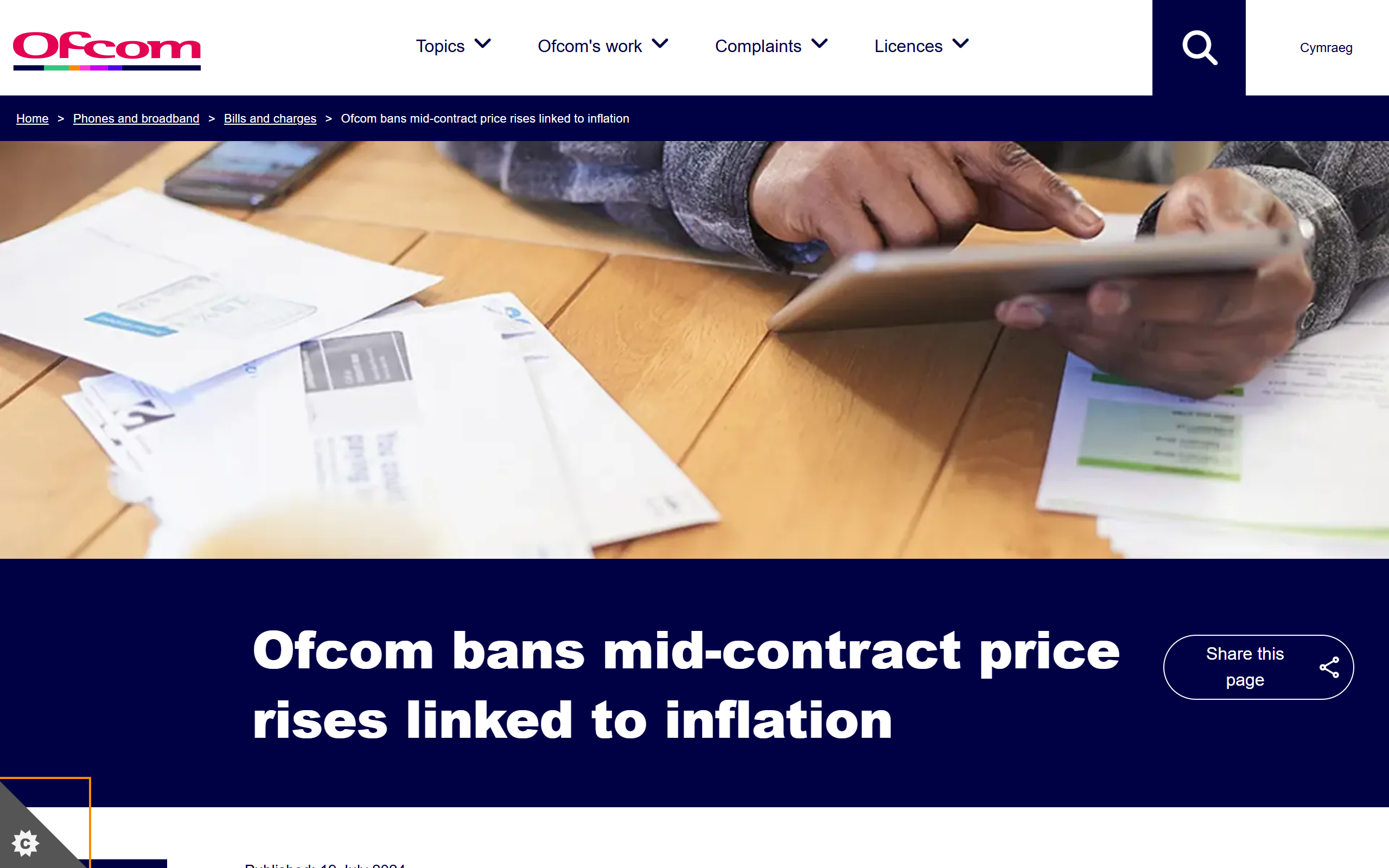
From 17 January 2025, phone, broadband and pay-TV providers are banned from writing inflation-linked or percentage-based price rises into any new contract. Any future rise has to appear in the contract as a concrete cash amount with its timing spelled out. On its own terms the rule works: sign a new deal today and you can read, in actual money, what your bill will be in year two.
But watch what the providers did with it, because the adaptation is the tell. The industry did not abandon the annual April rise. It simply re-priced it as a flat amount, and the flat amounts are not small. By 2026, the standard mid-contract rise across the major broadband providers is £3 to £4 a month, with BT, EE and Plusnet at £4 for their most recent contract generations.
Run the maths on who that flat structure actually favours:
- On a £75 full-fibre package, £4 a month is a 5.3% rise - roughly what the old formula produced in a normal-inflation year.
- On a £25 entry-level deal, the same £4 is a 16% rise - worse than the CPI+3.9% formula delivered even in the horror year of 2023.
- The pensioner on the cheap legacy broadband deal and the student on the budget SIM pay the highest percentage increase in the market, by construction.
A flat rise is regressive: the less you pay, the harder it hits. And the amounts are creeping. Providers who set their pounds-and-pence rise at £3 for contracts signed in 2024 moved to £4 for contracts signed in late 2025 - a 33% escalation in the rise itself, decided at the provider's discretion, with no inflation index to answer to at all. The old formula at least had a ceiling built from a published statistic. The new one is a number a pricing team picks.
So score the reform on its results: transparency genuinely improved, and that matters. The extraction survived the transparency. This is the recurring lesson of the loyalty penalty across every UK bill: regulate one mechanism and the business model reappears wearing the compliant version of the same trick, the way drip pricing resurfaced as "fees" the moment headline-price games were policed.
Which side of the line is your contract on?
Your counter-moves depend on one date. Contracts signed from 17 January 2025 must state any rise in pounds and pence; contracts signed before that can still carry the old inflation-plus formula until they expire. If you have not re-contracted since early 2025, go and read your terms - you may still be exposed to a percentage rise this coming April on a formula the regulator has already condemned.
Then work the system:
- Diarise your contract end date. The mid-contract rise is annoying; the out-of-contract price you roll onto afterwards is usually worse, powered by the same inertia as the subscription trap. The end date is your one moment of genuine bargaining power - use it to haggle or leave, never to drift.
- If a provider imposes a rise that was not clearly set out in the contract you signed, Ofcom's rules give you the right to exit penalty-free within 30 days of being notified. Providers must tell you this when they notify you of the rise; read that letter instead of binning it.
- Price up the whole market at renewal, not just your provider's "loyalty offer". A 20-minute shop around at end of term reliably beats any in-contract complaint.
- If you receive Universal Credit, Pension Credit or certain other benefits, social tariffs run from £10 to £24 a month, and Ofcom's own listing confirms the two features that matter here: the price cannot rise mid-contract, and there is no fee to leave. They are the only corner of the telecoms market where the fixed price actually stays fixed.
The mid-contract price rise is a small line on a small bill, which is exactly why it worked for so long. Nobody organises a march over £4 a month. But six in ten households, £36 to £48 a year each, every year, adds up to a quiet transfer worth hundreds of millions of pounds - taken under a clause nobody negotiated, from people who had kept their side of the deal. It is the retail end of the same one-way flow that why the UK won't tax wealth maps at national scale. The fix Ofcom shipped is real. The instinct it was aimed at is still in the terms and conditions, now in pounds and pence.
Frequently Asked Questions
Are mid-contract price rises legal?
Yes, if the rise is written into the contract you signed. Since 17 January 2025, any such rise in a new contract must be stated in pounds and pence at the point of sale - across the big broadband providers the standard is currently £3 to £4 a month, applied each March or April. Contracts signed before that date can still carry the older inflation-plus-percentage formula until they end. What providers cannot do is spring a rise on you that the contract did not clearly disclose.
Can I cancel penalty-free if my price goes up?
Only in specific cases. If the rise was clearly set out in your contract - the pounds-and-pence amounts, or the old CPI+3.9% formula - you are usually bound by it, and leaving early triggers exit fees. If the provider imposes a rise that was not clearly disclosed when you signed, Ofcom's rules give you 30 days from notification to walk away penalty-free, and the provider must tell you about that right when it notifies you.
What exactly did Ofcom ban in January 2025?
From 17 January 2025, providers cannot include inflation-linked or percentage-based price rise terms in new phone, broadband or pay-TV contracts. Any planned price rise must be shown prominently, in pounds and pence, with its timing, before you sign. The ban does not rewrite contracts signed before that date.
Are the new pounds-and-pence rises better than CPI plus 3.9%?
They are more transparent, and that is a real improvement - you can now see the full cost of a contract before signing. But a flat £3 to £4 rise is a larger percentage increase on a cheap plan than the old formula produced in most years, and the flat amounts have already crept from £3 to £4 between contract generations. Better disclosed, still not benign.
What is a broadband social tariff?
A cheaper package available to people claiming Universal Credit, Pension Credit and certain other benefits, offered by most major providers and listed on Ofcom's website. Prices run from £10 to £24 a month, most include superfast speeds, the price cannot rise mid-contract, and there is no fee to leave early. If you qualify and you are paying full price, switching is usually the single biggest saving available on the bill.
This article is general information, not financial advice. Provider pricing and contract terms change frequently; the figures above are accurate as of July 2026 and sourced from Ofcom, provider announcements and the reporting listed in the sources.
Sources
Prefer to watch?
We turn these money breakdowns into short videos
A few a week, plain-English UK money. If you would sooner watch than read, follow along:
Enjoying the content?
If this site has been useful, a coffee goes a long way.
Browse more articles
Browse all