


Drip Pricing UK: The Real Price After 'From £19'
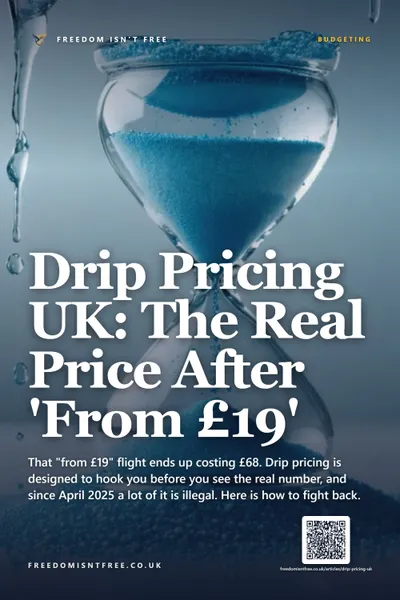
That "from £19" flight ends up costing £68. Drip pricing is designed to hook you before you see the real number, and since April 2025 a lot of it is illegal. Here is how to fight back.
Cite this article
Freedom Isn't Free (2026) Drip Pricing UK: The Real Price After 'From £19'. Available at: https://freedomisntfree.co.uk/articles/drip-pricing-uk (Accessed: 21 September 2026).
Italicise the article title in your bibliography. Accessed date set to today.
TLDR
- Drip pricing shows you a low headline price, then adds mandatory fees once you are committed to the purchase.
- Since 6 April 2025 the Digital Markets, Competition and Consumers Act bans hiding compulsory fees from the headline price.
- The CMA has already ordered refunds and fined firms hundreds of thousands of pounds for it.
- The trick still works on optional-but-default extras and dynamic pricing, so always find the all-in total before you commit.
How a "from £19.99" flight reaches £68
| What you add | Price |
|---|---|
| Headline fare | £19.99 |
| Cabin bag | £25.00 |
| Reserved seat | £8.00 |
| Priority boarding | £6.00 |
| Card / admin fee | £9.00 |
| What you actually pay | £67.99 |
Drip Pricing UK: The Real Price After 'From £19'
Drip pricing is the reason a "from £19" flight ends up costing you £68 by the time you reach the payment page. You see a tempting number, you start booking, and the price climbs one small charge at a time: a booking fee here, a "service" charge there, a seat you did not know you had to pay for. Each drip is small enough to shrug at. Added together, they are the whole game.
This is not an accident of clumsy web design. It is a deliberate tactic, and a profitable one, because of how your brain works once you have started. This article explains what drip pricing is, where you keep meeting it, what the law now says after a major change in 2025, and how to stop paying the tax on your own optimism.
What drip pricing actually is
Drip pricing is showing a headline price that is not the price. The seller advertises a low number to win the click, then reveals the mandatory extras only as you move through the checkout, "dripping" them in one screen at a time.
It works because of a quirk of psychology called the sunk cost effect. Once you have spent ten minutes choosing dates, typing in passenger names and picking a hotel room, you are invested. Abandoning the basket feels like wasting that effort, so a fee that would have sent you elsewhere on the first screen gets waved through on the fifth. By that point the seller is charging you for the path of least resistance, not the product.
The honest alternative is simple: show the full, unavoidable price up front. The fact that so many industries fought to avoid doing exactly that tells you how much money the drip is worth to them.
Where you keep meeting it
Once you know the pattern, you see it everywhere.
Flights are the classic. A "from £19.99" fare, then priority boarding, then a cabin bag, then a seat next to the person you are travelling with, then a card or admin fee. The advertised fare is real. It is just not what anyone actually pays.
Event tickets run it a close second. A £75 face value becomes £90 after a per-ticket booking fee and a "handling" charge for the privilege of printing your own ticket at home. The CMA ordered StubHub UK to refund customers over exactly this kind of hidden fee.
The same move turns up wherever you have already picked something before the total appears. Hotels and holiday lets tack on cleaning fees, "resort fees" and service charges at the final step, long after the nightly rate hooked you. Car hire dangles a low daily rate, then a young-driver surcharge, a second-driver fee, and the insurance upsell at the desk when you are tired and holding your suitcase. Food delivery quotes the restaurant's own menu price, then stacks a service fee, a small-order fee, a delivery fee and a "priority" nudge on top. It is the same convenience tax that subscription traps rely on: a cost you would reject up front but wave through once you are committed.
The common thread is that the extra is compulsory, or made to feel compulsory, and hidden until you are too far in to easily walk away.
What the law now says
Here is the part that changed the rules. Since 6 April 2025, the Digital Markets, Competition and Consumers Act 2024 bans drip pricing where the dripped charges are mandatory. If a fee is unavoidable, it has to be in the headline price the trader shows you, not sprung on you at the checkout.
This has teeth. The Competition and Markets Authority can enforce it directly now, without going to court first, and it has started. In its first year of the new powers the CMA fined a firm close to £900,000 and ordered refunds of more than £590,000 to over 50,000 customers for illegal drip pricing, and it ordered StubHub UK to refund buyers hit by hidden fees. The regulator has been explicit that online pricing is a priority.
In plain terms: if a UK trader advertises a price and then adds a compulsory fee you cannot avoid, that is now against the law, and you have grounds to complain and to expect a refund.
The loophole that is still legal
The ban targets mandatory fees. It does not outlaw every version of the trick, so the drip has mutated rather than died.
Optional extras are still fair game if they are genuinely optional and not pre-selected for you. The grey area is the "optional" add-on that is switched on by default, or buried so that opting out takes three clicks and a guilty conscience. Priority boarding you did not ask for, travel insurance ticked in advance, a donation added to your basket: all legal, all still designed to catch the inattentive.
Then there is dynamic pricing, where the number itself moves with demand rather than being hidden. The CMA investigated Ticketmaster over the way prices behaved during the 2024 Oasis reunion sale, when fans who queued for hours found the cost had climbed by the time they reached the front. That is a different mechanism from drip pricing, but it rhymes: the price you were promised is not the price you pay.
So the law has closed the crudest version and left you to police the rest.
How to beat it
You do not need to boycott anything. You need to change the order in which you make decisions.
Find the all-in total before you emotionally commit. Go through to the final payment screen, note the real number, then decide, rather than deciding at the headline and rationalising the drips.
Compare on the total, never the teaser. A "from £19" fare that lands at £68 loses to a £55 flat fare every time, but only if you compare the right numbers.
Uncheck everything by default. Assume every pre-ticked box is working against you and turn it off unless you actively want it.
Use the law. If a UK seller adds a compulsory fee that was not in the advertised price, that is a breach of the DMCC Act. Screenshot it, challenge the charge, and report the trader to the CMA or Trading Standards. Enough complaints are what forced the change in the first place.
The drip only works on autopilot. Slow down at the checkout, shop around on the all-in total, and it stops working. It is the same discipline that beats the poverty premium and keeps a monthly budget honest: judge the real number, not the one designed to catch your eye. The singles premium is another cost the system prices in by default and hopes you never add up.
Frequently Asked Questions
Is drip pricing illegal in the UK?
Since 6 April 2025, hiding mandatory fees from the headline price is illegal under the Digital Markets, Competition and Consumers Act 2024. Compulsory charges must be shown in the advertised price. Genuinely optional extras remain legal, as long as they are not pre-selected or disguised as compulsory.
What is an example of drip pricing?
A "from £19.99" flight that becomes £68 after a cabin bag, a seat, priority boarding and an admin fee is the textbook case. Event tickets where a booking fee and a handling charge are added at the final screen are another, as are hotel "resort fees" and car-hire surcharges revealed only at the desk.
What can I do if a company adds hidden fees?
Take a screenshot showing the advertised price and the final price, and complain to the trader first. If a mandatory fee was hidden, you can report it to the Competition and Markets Authority or to Citizens Advice consumer service and Trading Standards. The CMA has already ordered refunds for customers hit by unlawful hidden fees.
Is dynamic pricing the same as drip pricing?
No. Dynamic pricing changes the price itself based on demand, so the number you see moves. Drip pricing keeps a low headline and adds fees as you go. Both can leave you paying more than expected, and the CMA has scrutinised both, but only hidden mandatory fees are directly banned by the 2025 rules.
Sources
Prefer to watch?
We turn these money breakdowns into short videos
A few a week, plain-English UK money. If you would sooner watch than read, follow along:
Enjoying the content?
If this site has been useful, a coffee goes a long way.
Browse more articles
Browse all