



UK Salary Percentiles 2026: Top 10%, 5% and 1%
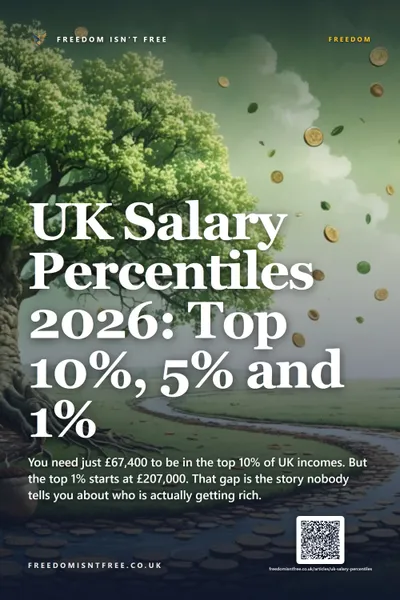
You need just £67,400 to be in the top 10% of UK incomes. But the top 1% starts at £207,000. That gap is the story nobody tells you about who is actually getting rich.
Cite this article
Freedom Isn't Free (2026) UK Salary Percentiles 2026: Top 10%, 5% and 1%. Available at: https://freedomisntfree.co.uk/articles/uk-salary-percentiles (Accessed: 21 September 2026).
Italicise the article title in your bibliography. Accessed date set to today.
TLDR
- The top 10% income threshold in the UK is around £67,400 (HMRC Survey of Personal Incomes, 2023/24) - significantly lower than most people assume.
- The top 1% starts at roughly £207,000. The gap between the top 10% and top 1% is far wider than the gap between median and top 10%.
- HMRC SPI figures cover all individual taxpayer income (including part-time and pensioner income) - the ONS ASHE median for full-time employees only is a higher £39,039.
- The income distribution is compressed in the middle and extreme at the very top. Most people dramatically overestimate where "rich" starts.
UK income thresholds by percentile (HMRC SPI 2023/24)
| Percentile | Threshold | Plain English |
|---|---|---|
| 50th (median) | ~£29,700 | Half of all UK taxpayers earn less |
| 75th | ~£45,000 | Top quarter of all individual taxpayers |
| 80th | ~£50,000 | Top fifth - higher-rate tax territory |
| 90th | ~£67,400 | Top 10% - most people guess this is £90k+ |
| 95th | ~£93,600 | Top 5% - fewer than one in twenty |
| 99th | ~£207,000 | Top 1% - an entirely different world |
Source: HMRC Survey of Personal Incomes, 2023/24 (published April 2026). Individual gross income before tax, all taxpayers including part-time and pensioners.
UK Salary Percentiles 2026: Top 10%, 5% and 1%
UK salary percentiles tell a different story from the one most people carry around. The top 10% income threshold is £67,400 - far lower than most workers guess, and still a long way from the top 1%'s £207,000 line. The income distribution is far more compressed at the top of normal than the "rich list" image implies - and far more extreme at the very top.
The worker on £70,000 who thinks they have made it is comfortably in the top 10% but still closer to the median earner than to the top 1%. The system is not set up to make that obvious, and it is not an accident that it is not.
Here are the actual numbers, what they mean, and why the gap that matters most is not the one people talk about.
Contents
- Which dataset is which - and why it matters
- Where you sit in the UK income distribution
- The top 10% threshold is lower than almost anyone guesses
- The real gap: top 10% to top 1%
- Why it feels like a lie
- What to do with this information
- Frequently Asked Questions
Which dataset is which - and why it matters
Two main datasets cover UK pay and income. Getting them confused is how myths spread.
HMRC Survey of Personal Incomes (SPI) covers all individual taxpayers - roughly 38 million people including full-time workers, part-time workers, pensioners receiving taxable income, and the self-employed. It measures total income before tax from all sources: salary, self-employment profit, pension income, rental income, dividends. The 2023/24 SPI (published April 2026) is the latest available and is the source for the percentile thresholds in this article.
ONS Annual Survey of Hours and Earnings (ASHE) covers employees only, and reports separately for full-time and part-time workers. The April 2025 ASHE puts the median full-time annual salary at £39,039. Because ASHE strips out part-timers and focuses on employment income only, its figures are higher than the HMRC SPI median.
This article is about where you sit in the income distribution. The HMRC SPI is the right tool for that job because it covers the whole picture. The ONS ASHE median is cited where relevant for full-time salary context, and the source is always named.
Where you sit in the UK income distribution
Here are the income thresholds from the HMRC Survey of Personal Incomes, 2023/24 tax year (published 29 April 2026). These are individual gross income before tax, including all taxable income sources.
| Percentile | Income threshold | Plain English |
|---|---|---|
| 50th (median) | ~£29,700 | Half the UK's taxpayers earn less than this |
| 75th | ~£45,000 | You earn more than three-quarters of taxpayers |
| 80th | ~£50,000 | Top fifth of all individual taxpayers |
| 90th | ~£67,400 | Top 10% - a strong benchmark, lower than most expect |
| 95th | ~£93,600 | Top 5% - genuinely rare |
| 99th | ~£207,000 | Top 1% - an entirely different world |
The HMRC SPI median of ~£29,700 is lower than the ONS ASHE full-time median of £39,039 because it includes part-time workers and pensioners. If you are comparing your salary to the full-time workforce only, the ONS figure is the better yardstick for your working life. If you want to know where you sit across the whole adult income distribution - which is what the article's headline questions are really asking - the HMRC table is the one to use.
The top 10% threshold is lower than almost anyone guesses
£67,400 is the 90th percentile of UK individual incomes (HMRC SPI 2023/24). To be in the top 10% of UK taxpayers by income, you need to earn roughly two-thirds of what most people think "rich" means.
That number surprises almost everyone who hears it. People routinely overestimate the top 10% threshold by £20,000 to £30,000 - sometimes more. The reason is simple: the incomes that dominate the news and social media are not typical incomes. They are the outliers. Premier League footballers, FTSE 100 executives, tech founders and city traders are real people with real incomes, but they are statistical noise in a distribution of 38 million taxpayers.
The actual distribution is far more compressed at the top of the working middle than the headlines imply. The gap from the median (£29,700) to the top 10% (£67,400) is around £37,700. That sounds like a lot. But it is a difference of degree, not kind. The people in that range - teachers, nurses, experienced engineers, mid-level managers - are the same kinds of workers, doing the same kinds of jobs. They are better paid, but they are not in a different category of life.
The category change happens elsewhere. It happens between the top 10% and the top 1%.
The real gap: top 10% to top 1%
The 90th percentile is ~£67,400. The 99th percentile is ~£207,000. That is a gap of around £140,000.
Compare that to the gap from median to top 10%: around £37,700.
The gap from top 10% to top 1% is almost four times wider than the gap from the middle to the top 10%. This is not a quirk of this particular year's data. It reflects the structure of income distribution in the UK and in most advanced economies: the distribution is roughly log-normal, which means it is far more spread out at the top end than a quick glance at the averages suggests.
What does this mean in practice? The doctor on £80,000, the solicitor on £90,000 and the senior engineer on £95,000 are all comfortably in the top 5%. They are doing well. They are also, by income, closer to the median worker than to the top 1%. Their lives feel expensive. Their housing is expensive. Their tax bill is significant. And they are right that they have not "made it" in the sense that the word implies unlimited financial ease - because the real gap is not between them and the median, it is between them and the people above the £207,000 line.
This is what the income distribution hides. When someone in the top 10% says they do not feel rich, they are largely telling the truth. The wealth concentration that funds the schools, the offshore accounts and the second homes sits largely above the top 1% line - not in the space between the median and the top 10% that most policy debates treat as the dividing line. The pillar article why the UK won't tax wealth makes the full case for why income percentiles and wealth percentiles are very different tables, and why the income distribution debate mostly misses where power actually concentrates.
Why it feels like a lie
Three things make people misread where they sit.
Social comparison is local, not national. You do not compare your salary to the UK distribution. You compare it to your colleagues, your friends, your neighbourhood. If you work in tech in London, your peer group skews heavily toward the top 10-20% of the national income distribution. Your reference point for "normal" is compressed into a range that looks nothing like the actual population.
Gross income is not disposable income. The top 10% threshold is ~£67,400 before tax. In 2026/27, that produces a take-home of roughly £49,600 after income tax and National Insurance - around £4,100 a month (run your own number with the take-home pay calculator). In London, where a one-bedroom flat easily runs to £1,800-£2,200 per month, that still leaves limited slack. The £67,400 looks large. The life it funds in an expensive city is more ordinary than the number implies. For more on the cost-of-living squeeze on salaries that look generous on paper, the good salary in the UK guide breaks this down by region.
The 60% tax trap compresses the feel of high earnings. Between £100,000 and £125,140, the personal allowance is clawed back at a rate that creates an effective marginal rate of 60%. The higher-rate taxpayer who earns more does not necessarily feel richer because much of the extra gets absorbed. If this applies to you, the wealth inequality UK data provides the macro context for why that compression exists and who benefits from it.
What to do with this information
Knowing where you sit in the distribution is not just an ego exercise. It has real planning value.
If you are in the top 20-30% by income and you do not feel it, the problem is probably not your income. It is one of three things: housing costs eating most of the surplus, lifestyle inflation consuming the rest, or a savings structure that has not kept pace with what you earn. The average savings in the UK by age guide shows what the typical Brit has actually accumulated - the gap between salary percentile and savings percentile is where most of the story lives.
If you are aiming for the top 10%, the honest answer is that the target is more achievable than it sounds. The threshold is lower than most people guess. But crossing the top 10% line does not unlock a different kind of financial life. It just means you have more runway to save and invest - if you use it.
The income that actually changes the structural picture is above £100,000. Above that line, the relationship between salary, savings rate, investment returns and time horizon can compound into something genuinely different. Below it, the maths is still about discipline, savings rate and not letting lifestyle inflation absorb every pay rise. Those tools are available to anyone earning above the median.
The Trading Game - Gary Stevenson - Stevenson's first-person account of trading inside the system that produces the income gap this article describes. The sharpest UK-anchored take on why the top 1% line sits where it does and who put it there. (Affiliate link - we may earn a small commission at no extra cost to you.)
Frequently Asked Questions
What salary puts you in the top 10% in the UK?
According to HMRC's Survey of Personal Incomes (2023/24 tax year, published April 2026), the 90th percentile of individual gross income in the UK is approximately £67,400 before tax. This covers all taxpayers including full-time employees, part-time workers, pensioners with taxable income, and the self-employed.
What salary puts you in the top 5% in the UK?
The 95th percentile of individual gross income is approximately £93,600 before tax (HMRC SPI 2023/24). This is a genuinely rare income - fewer than one in twenty UK taxpayers earn this much or more from all sources.
What is the top 1% income in the UK?
The 99th percentile of individual gross income is approximately £207,000 before tax (HMRC SPI 2023/24). This is the figure that separates the well-paid from the genuinely wealthy. It is more than three times the top 10% threshold.
What is the top 20% salary in the UK?
The 80th percentile of individual gross income is approximately £50,000 before tax (HMRC SPI 2023/24). Given that the basic rate higher-rate threshold is £50,270 in 2026/27, this maps almost exactly onto the point where you become a higher-rate taxpayer - which tells you something about where that threshold was designed to sit.
How rare is a £100,000 salary in the UK?
Very rare. The 97th percentile of individual gross income is around £120,000 (HMRC SPI 2023/24), which puts £100,000 somewhere in the top 2-3% of all UK taxpayers by income. Despite how often £100,000 appears in financial planning discussions (usually because it is the personal allowance taper threshold), only a small fraction of workers ever reach it.
Sources
Prefer to watch?
We turn these money breakdowns into short videos
A few a week, plain-English UK money. If you would sooner watch than read, follow along:
Enjoying the content?
If this site has been useful, a coffee goes a long way.
Browse more articles
Browse all