
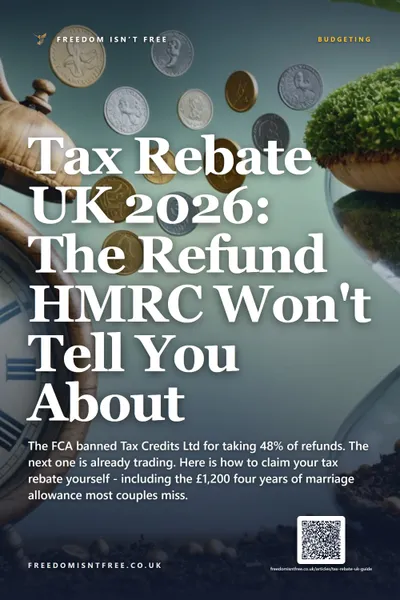
Tax Rebate UK 2026: The Refund HMRC Won't Tell You About
The FCA banned Tax Credits Ltd for taking 48% of refunds. The next one is already trading. Here is how to claim your tax rebate yourself - including the £1,200 four years of marriage allowance most couples miss.
Cite this article
Freedom Isn't Free (2026) Tax Rebate UK 2026: The Refund HMRC Won't Tell You About. Available at: https://freedomisntfree.co.uk/articles/tax-rebate-uk-guide (Accessed: 10 October 2026).
Italicise the article title in your bibliography. Accessed date set to today.
TLDR
- A tax rebate is HMRC returning income tax you overpaid. Most refunds in the UK are PAYE rebates triggered by a wrong tax code, a job change, or a missed allowance.
- You can reclaim back four tax years. The 2022/23 window closes on 5 April 2027. After that, the money is gone.
- Refund agents take 30-50% commission. Since 15 March 2023, HMRC will not honour their old deed-of-assignment forms - they must use a non-binding nomination, so you can always claim direct.
- The biggest unclaimed rebate by volume is marriage allowance, worth up to £1,260 across four backdated years for couples where one earns under £12,570.
UK tax rebates worth claiming in 2026/27
| Rebate | Typical amount | Where to claim |
|---|---|---|
| P800 PAYE overpayment | £200 to £1,200 | gov.uk personal tax account |
| Marriage allowance (4 backdated years) | Up to £1,260 | gov.uk/marriage-allowance |
| Uniform / work clothing flat rate | £60 to £1,022 per year | gov.uk form P87 |
| Working from home (employer-required) | £62.40 / £124.80 / £140.40 | gov.uk form P87 |
| Higher-rate pension top-up (relief-at-source) | 20% of the contribution | Self Assessment or HMRC letter |
| Subscriptions to approved bodies | Tax on the fee | gov.uk form P87 |
Source: HMRC manuals EIM67200, EIM32760, PTM044220, 2026/27 tax year.
Tax Rebate UK 2026: The Refund HMRC Won't Tell You About
A tax rebate is HMRC returning income tax you should never have paid. For most UK workers it is not a windfall and it is not a gift. It is your own money sitting in a Treasury bank account, slowly being eroded by inflation, until you go and ask for it back. By the time you do, the state has already had a four-year free loan off you.
This article is a working guide to the rebates worth claiming in 2026/27, the deadlines that quietly destroy the older ones, and the refund-agent industry that sits between most people and the money they are owed. The Financial Conduct Authority has permanently banned at least one of these firms. There will be others. Reading this article is how you stop being the product.
What counts as a UK tax rebate
The headline word "rebate" is doing a lot of work. HMRC uses three terms loosely interchangeably: rebate, refund, and repayment. The plumbing is the same. You paid more income tax than you owed, and HMRC owes you the difference. The mechanics depend on how the overpayment happened.
The four routes that cover roughly 95% of UK rebates:
- PAYE reconciliation (P800). After 5 April each year, HMRC compares the tax you paid through payroll against what you actually owed. If the gap is in your favour, you get a P800 calculation letter and an option to claim online or wait for a cheque.
- Self Assessment refund. If you file a return and the maths leaves you in credit, HMRC pays it back to the bank account on the return. This is where most pension relief-at-source higher-rate top-ups land.
- Specific reliefs claimed via form P87 or online. Uniform cleaning, professional subscriptions, tools, mileage above the AMAP rate, working from home (where contractually required). These are usually small but cumulative.
- Marriage allowance backdating. One spouse with income under £12,570 transfers 10% of their personal allowance to a basic-rate-paying partner. The current year is worth £252 and you can backdate four years - a maximum of £1,260, sitting on the table at the gov.uk site, waiting to be picked up.
There is no scenario in any of these where you legally need an intermediary. The forms are free. The portal is free. HMRC owes you the money directly. Every middleman exists because the system is opaque enough that a profitable percentage of taxpayers will not chase the money themselves. The same logic runs through the frozen UK tax thresholds and the 60% tax trap - the system creates overpayments quietly and refunds them slowly.
The four-year backstop and the deadlines you cannot move
The single most important rule in this entire article: you can only reclaim income tax for the current year and the four previous tax years. After that, the overpayment is permanently HMRC's.
The deadline operates on the tax year end, 5 April. The window now open in the 2026/27 year:
| Tax year | Window closes | Years past |
|---|---|---|
| 2022/23 | 5 April 2027 | 4 |
| 2023/24 | 5 April 2028 | 3 |
| 2024/25 | 5 April 2029 | 2 |
| 2025/26 | 5 April 2030 | 1 |
| 2026/27 | 5 April 2031 | Current |
The 2021/22 window closed on 5 April 2026. If you were on the wrong tax code in 2021/22, or eligible for marriage allowance from your honeymoon in autumn 2021, that money is now gone. It is not coming back. The frozen personal allowance and four-year backstop work together to make procrastination one of the most expensive habits in the UK tax code.
Practical implication: most rebate-worthy events happen quietly and you are the only person who notices. A wrong tax code persists for a year before HMRC's annual sweep flags it. A spouse stops working and nobody at HMRC writes to tell you to apply for marriage allowance. The four-year clock starts ticking from the moment the overpayment is made, not the moment you find out about it.
The "HMRC will pay you automatically" myth
The most common piece of bad advice about tax rebates is that you do not need to do anything because PAYE reconciliation catches it. The Government Digital Service writes this on the gov.uk pages. Refund-agent marketing also writes it, as the setup for "but we will check anyway."
The honest version: HMRC's Real Time Information system is supposed to compare your PAYE deductions against your actual tax position after the year ends, and issue a P800 if the answer is in your favour. In a year where you stayed in the same job, kept the same code, and had no other income, the reconciliation usually works. In any year where something moved, it sometimes does not.
The 2023 House of Commons Public Accounts Committee report into HMRC customer service flagged significant volumes of unreconciled employment income. Causes include mid-year job changes where the new employer does not have the P45, emergency tax codes that never get refunded inside the year, second jobs at BR or 0T, pension drawdown lump sums taxed at month-1 emergency rates, and self-employed income overlapping with PAYE.
If you have ever experienced any of these and have not personally checked your personal tax account at gov.uk, assume nothing was done. The default outcome is that HMRC keeps the money and writes "we have no record of any outstanding refund" if you eventually ring up. If you are a higher-rate worker on a PAYE-only salary and have never filed a Self Assessment tax return, that is the year-one place to start.
The check takes five minutes. Log into your personal tax account, click "Pay As You Earn", and look at each closed tax year. The figure HMRC has for income, tax paid, and tax due is the figure you can compare against your P60 from that year. If there is a gap, the system tells you and offers a refund button.
The refund-agent industry, and how to never use one
The honest reason refund agents exist is that HMRC's communication is so bad that a parallel industry has grown up to translate it. The dishonest reason is that they charge between 30% and 50% of any rebate they generate, plus VAT, plus admin fees, for filing forms a normal adult could complete unaided in 20 minutes.
The blueprint is reliable. You see a Facebook ad: "Are you owed up to £1,800 from HMRC? Find out in two minutes." You hand over your NI number, employer details, and bank account. You sign a document the agent calls a "form of authority". You forget about it. Six months later, HMRC sends a refund cheque to the agent. The agent banks the lot, takes half, sends you the rest.
The Financial Conduct Authority permanently banned Tax Credits Ltd in March 2022 after finding it had submitted thousands of unauthorised marriage-allowance claims and trousered the lion's share of the refunds. The closure forced HMRC to act on the underlying mechanism. From 15 March 2023, deeds of assignment of tax repayments to third parties are no longer accepted. Agents must now use a non-binding nomination form. The practical effect: even if you signed something a year ago, you can revoke the nomination and reclaim the refund yourself by logging into your personal tax account and changing the receiving bank details. HMRC published guidance for taxpayers caught by an existing assignment. It is buried, but it works.
The structural lesson is uglier than the individual cases. Refund agents are an arbitrage on opacity. As long as gov.uk forms read like they were translated from Latin, somebody will pay 48% commission to avoid filling them in. The system is built to be hard, and a private industry has emerged to charge a rinse for closing the gap. Rip-off Britain in miniature.
The fix is the boring one. Bookmark the gov.uk personal tax account. Use it. The forms are not hard; they are just badly written.
The biggest unclaimed rebates by category
Marriage allowance (up to £1,260)
The single largest unclaimed UK income-tax rebate by volume is marriage allowance. If one of you earns under £12,570 and the other is a basic-rate taxpayer (income between £12,571 and £50,270 in England, Wales and NI), the lower earner can transfer 10% of their personal allowance to the higher earner. That is £1,257 of allowance moved across, saving the higher earner 20% of £1,257 = £251.40 a year. HMRC rounds to £252.
You can backdate four years. If you were eligible in 2022/23, 2023/24, 2024/25 and 2025/26 and never claimed, the application at gov.uk/marriage-allowance triggers a cheque or PAYE adjustment for the lot. Four years times £252 plus the current year is roughly £1,260.
HMRC's own estimate, repeated in the National Audit Office annual reports, is that more than two million eligible couples have not claimed. That is more than £500m a year sitting unclaimed in the Treasury. If you are reading this and one of you stopped working to care for a child, an elderly parent, or to recover from illness, this is the single highest-return form you will fill in this year.
Uniform, work clothing, and tools
If you wear a recognisable uniform for work that you wash at home, you can claim a flat-rate expenses allowance. The default for most occupations is £60 a year, which gives a basic-rate taxpayer a £12 tax reduction. Healthcare workers, mechanics, joiners, police officers, and a long HMRC list have agreed higher amounts running from £140 to £1,022. The list of occupations and the rates is HMRC manual EIM32712 onwards.
The amount looks small per year, but the four-year backdate plus the current year matters. A nurse on the agreed £125 a year gets the basic-rate equivalent of £25 a year times five years = £125. Higher-rate, £250.
You file the claim via the online P87 form. You do not need receipts at the flat-rate amount. The only thing you need is to confirm your employer does not reimburse the cost separately.
Working from home (where required by the employer)
This is narrower than it was during the pandemic. Since 6 April 2022, HMRC has restricted working from home tax relief to taxpayers required by their employment contract or by lack of any employer-provided workplace to work from home. Choosing to work from home for personal preference no longer counts.
For those who qualify, the rates are still £6 a week (£312 a year), which is tax relief of £62.40 (basic) or £124.80 (higher) per year. Five years stacked is £312 or £624. Worth claiming if you genuinely meet the test; not worth lying about, because HMRC has been re-opening claims from the pandemic period.
Higher-rate pension top-up
If you contribute to a relief-at-source pension (most personal pensions, SIPPs at AJ Bell, Hargreaves Lansdown, Vanguard, Trading 212, Fidelity, and any workplace scheme that operates on relief-at-source), the pension provider claims 20% basic-rate tax relief on your behalf and grosses up your contribution. If you are a higher-rate (40%) or additional-rate (45%) taxpayer, the extra 20% or 25% has to be claimed back manually through Self Assessment or by writing to HMRC.
The number is large. A higher-rate taxpayer putting £8,000 of net pay into a SIPP gets £2,000 of basic-rate relief added by the provider (gross £10,000), then claims £2,000 more from HMRC as a rebate or tax-code adjustment. That £2,000 a year, missed for four years, is an £8,000 rebate sitting in the form of unclaimed PAYE relief. A large share of higher-rate taxpayers do not file a Self Assessment because their employer handles PAYE in full. Many never claim the top-up.
Subscriptions to approved bodies
If your professional body is on HMRC's approved list (list 3 on gov.uk), the subscription fee is tax-deductible. Royal College of Nursing, Law Society, ICAEW, RICS, BMA, ACCA, CIPD - the list is several hundred long. A £400 annual subscription gives a basic-rate worker £80 back per year, or £320 across five years.
How to actually claim, step by step
Before you start, run a quick estimate of what your income tax should be using the income tax calculator. If the figure HMRC has on file is higher than the calculator's number, there is a rebate. If your tax code does not match the default 1257L without a reason you can explain, see tax code 1257L explained before claiming - the code itself is usually where the error sits.
- Set up the personal tax account at gov.uk if you do not already have one. Sign-in uses GOV.UK One Login as of 2025; older Government Gateway credentials still work but are being migrated. You will need a passport, driving licence, or P60 to verify.
- Pull your P60s for the current and four previous tax years. If you have lost any, the personal tax account shows the same figures HMRC holds.
- Run the P800 check in the personal tax account. Pay As You Earn → "Check your Income Tax for previous years". If a year shows a refund button, take it.
- Apply for marriage allowance at gov.uk/marriage-allowance from the lower earner's account. The application backdates automatically to the earliest year you were eligible within the four-year window.
- File a P87 for uniform, tools, work-from-home, and professional subscription claims. The online form covers up to four prior years in one submission.
- Claim higher-rate pension top-up by either filing a Self Assessment for the year (if you were already going to) or writing to HMRC with the contribution figure, the provider, and the request to adjust your tax code or issue a refund. HMRC's "claim tax relief on your private pension contributions" page has the post address.
- Revoke any old assignment if you previously used a refund agent. The non-binding nomination form on file can be cancelled by logging in and updating your nominated bank details.
Refunds for a closed tax year usually arrive by cheque within 4 to 8 weeks. Refunds for the current year typically come as a tax-code change that lowers what you pay through PAYE for the rest of the year. Either way the money lands.
Frequently Asked Questions
Does HMRC automatically refund overpaid tax?
Sometimes. The PAYE reconciliation at year end is supposed to issue a P800 if you overpaid. It works reliably for taxpayers who stayed in the same job on the same code with no second income. It misses a meaningful share of mid-year movers, emergency-code cases, and pension lump sums. Always check your personal tax account at gov.uk for each closed year - the system will flag any refundable amount and offer a button to claim. The "wait and HMRC will sort it" strategy works often enough to be plausible advice, but it leaves money behind in any year that was not a clean PAYE year.
How much tax rebate will I get back?
There is no fixed amount because the rebate is just whatever excess tax you paid. The most common figures: a wrong tax code for a year typically generates £200 to £800; backdated marriage allowance is up to £1,260 if eligible for all four prior years and the current year; higher-rate pension top-up for a £8,000 net contribution is £2,000 per year. The honest answer is that you have to do the maths against your P60. The good news is the personal tax account does it for you for PAYE years.
How do I check if HMRC owes me a tax refund?
Log into your personal tax account at gov.uk. Go to "Pay As You Earn". Each closed tax year shows the income HMRC has on file, the tax paid through PAYE, and the calculated tax due. If there is a discrepancy in your favour, the system displays a refund value and a button to claim it. If you are self-employed or otherwise self-assessing, the equivalent figure shows on your Self Assessment statement of account. There is no scenario where you need a refund agent to find this number; the figure is exactly the same one in the agent's portal, taken from the same HMRC API.
When can I expect my tax to be refunded?
PAYE refunds for the current tax year usually arrive as a tax-code adjustment within 4 to 6 weeks, lowering deductions from your next payslip onwards. Refunds for closed tax years arrive as a cheque (or bank transfer if you nominate the account in the online process) within 4 to 12 weeks of the claim. Self Assessment refunds typically pay within 2 weeks of the return being filed if your bank details are on the return. Marriage allowance backdating refunds historically take 8 to 12 weeks because they require HMRC to recompute prior-year codes.
Will HMRC send me a tax rebate by text or email?
No, never. HMRC does not text you a link to claim a tax rebate, does not email you saying you are owed a refund, and does not direct-message you on WhatsApp, Telegram, or Instagram. The only legitimate HMRC contact about a refund is a P800 letter posted to your registered address, or a notification inside your personal tax account when you log in. If you receive a text or email claiming to be from HMRC with a rebate link, it is a scam. Action Fraud receives hundreds of thousands of reports of HMRC rebate phishing each year. The legitimate process is always reactive: you go to gov.uk, you log in, you claim.
Can I claim a tax rebate for council tax?
Council tax is a separate system from HMRC income tax, administered by local councils. The "council tax rebate" most people remember is the £150 Energy Bills Support payment from spring 2022, which was a one-off discount, not a recurring entitlement. Ongoing reductions are possible via Council Tax Support (means-tested), the single-person discount (25% off if you live alone), and the disregards for full-time students, severely mentally impaired residents, and others. None of these are HMRC tax rebates and none are claimable through the personal tax account.
What if I missed the four-year deadline?
The money is gone. HMRC operates a statutory cap on overpayment relief under Schedule 1AB of the Taxes Management Act 1970, and the cap is four years. Exceptions exist for genuine HMRC error, but the bar is high - you typically need to show HMRC made the mistake and you could not reasonably have spotted it earlier. For ordinary cases of "I forgot to claim", the four-year line is firm. The behavioural takeaway is to run the check annually in May once the prior year is reconciled, rather than letting the windows close one by one.
Further Reading:
I Will Teach You To Be Rich - Ramit Sethi - The clearest guide to the fifteen-minute household money moves a tax rebate is. The chapters on automating finances and on reclaiming small wins read like the chapter HMRC will not write. (Affiliate link - we may earn a small commission at no extra cost to you.)
This article is general educational content, not financial or tax advice. Tax rules and HMRC processes can change between tax years and at any Budget. Verify any specific allowance, rate, or deadline against gov.uk before acting on it, and consider speaking to an accountant or tax adviser for material refund claims or anything that touches Self Assessment. The naming of FCA enforcement actions against refund agents reflects publicly reported regulatory decisions at the time of writing.
Prefer to watch?
We turn these money breakdowns into short videos
A few a week, plain-English UK money. If you would sooner watch than read, follow along:
Enjoying the content?
If this site has been useful, a coffee goes a long way.
Browse more articles
Browse all