








What Is a NEET? The UK Definition and the Real Cost
The state loses £244,000 per NEET. The young person loses up to £300,000. Only one of those numbers gets quoted.
Cite this article
Freedom Isn't Free (2026) What Is a NEET? The UK Definition and the Real Cost. Available at: https://freedomisntfree.co.uk/articles/what-is-a-neet (Accessed: 21 September 2026).
Italicise the article title in your bibliography. Accessed date set to today.
TLDR
- NEET means Not in Education, Employment or Training. In the UK it covers 16 to 24 year olds, and there are currently 1,012,000 of them, or 13.5% of that age group.
- Most NEETs are not unemployed in the technical sense. 613,000 of the 1,012,000 are economically inactive rather than actively looking for work, and a rising share of those are out for health reasons.
- Every headline prices the problem to the taxpayer at £244,000 per person over a lifetime. The DWP interim report published in August 2026 puts the loss to the young person at up to £300,000, and almost nobody quotes it.
- The fixable bit is the National Insurance record. Claim Universal Credit or JSA and you get Class 1 credits automatically. Claim nothing and you get nothing, unless you register at Jobcentre Plus, which costs you an afternoon.
What one NEET costs the state over a lifetime
Total £244,000 per additional NEET. Source: Impetus, Closing the Youth Jobs Gap, July 2026.
Who the 1,012,000 UK NEETs actually are
| Group | Number | Rate |
|---|---|---|
| All 16 to 24 year olds who are NEET | 1,012,000 | 13.5% |
| Young men | 553,000 | 14.4% |
| Young women | 459,000 | 12.5% |
| Unemployed and looking for work | 400,000 | 40% of NEETs |
| Economically inactive | 613,000 | 60% of NEETs |
ONS, January to March 2026, published 28 May 2026. Official statistics in development.
What Is a NEET? The UK Definition and the Real Cost
What is a NEET? It stands for Not in Education, Employment or Training, and in Britain it describes 1,012,000 people aged 16 to 24, a number that crossed a million for the first time this year. That is the definition, and you can get it from any of the dozen pages that will tell you the same thing before moving swiftly on to the bit they actually want to talk about: what all these young people are costing the rest of us.
That figure is £244,000 each over a lifetime, and it is quoted everywhere. Here is the number that is not. The Department for Work and Pensions published an interim report on young people and work this month which found that a 24-year-old who is NEET and later returns to work will lose up to £300,000 in earnings over their lifetime as a result. The bill to the young person is larger than the bill to the Treasury. One of those numbers made every front page. The other is sitting in a government PDF being read by nobody.
Contents
- What NEET actually means
- How many NEETs are there in the UK
- Unemployed or economically inactive: the split that changes the story
- What a NEET costs the state
- What being a NEET costs you
- The National Insurance gap nobody mentions
- NEET in Britain, NEET on the internet
- How to stop being a NEET
- Frequently Asked Questions
What NEET actually means
NEET stands for Not in Education, Employment or Training. It is a statistical category rather than a personality type, and in the UK all three of the following have to be true of you at the same time:
- You are aged 16 to 24
- You are not in a job, full-time or part-time
- You are not in education or on a training course
Miss all three and you are in. That is the whole test.
That net is far wider than the word suggests. A 17-year-old who finished her A-levels in June and starts college in September is NEET in July. A 22-year-old caring full-time for a parent with dementia is NEET. A 19-year-old signed off with a serious mental health condition is NEET. So is someone who genuinely has no intention of working. The statistic makes no distinction between them, which does not stop the statistic being deployed as though it does.
The Office for National Statistics runs the 16 to 24 series that produces the headline figure. The Department for Education tracks a narrower 16 to 18 measure in England. When you see two different NEET numbers in the same week, that is usually why.
How many NEETs are there in the UK
The ONS put the figure at 1,012,000 in its January to March 2026 estimate, published on 28 May 2026. That is 13.5% of everyone aged 16 to 24, or roughly one in eight, and it is up 89,000 on the year, a rise of a full percentage point.
Young men make up 553,000 of that total, a rate of 14.4%. Young women make up 459,000, a rate of 12.5%. The gap between the sexes is real but it is not the story, and it runs in the opposite direction to what most people assume.
One caveat that deserves more airtime than it gets, and you can see the ONS make it itself in the bulletin's own opening bullets:
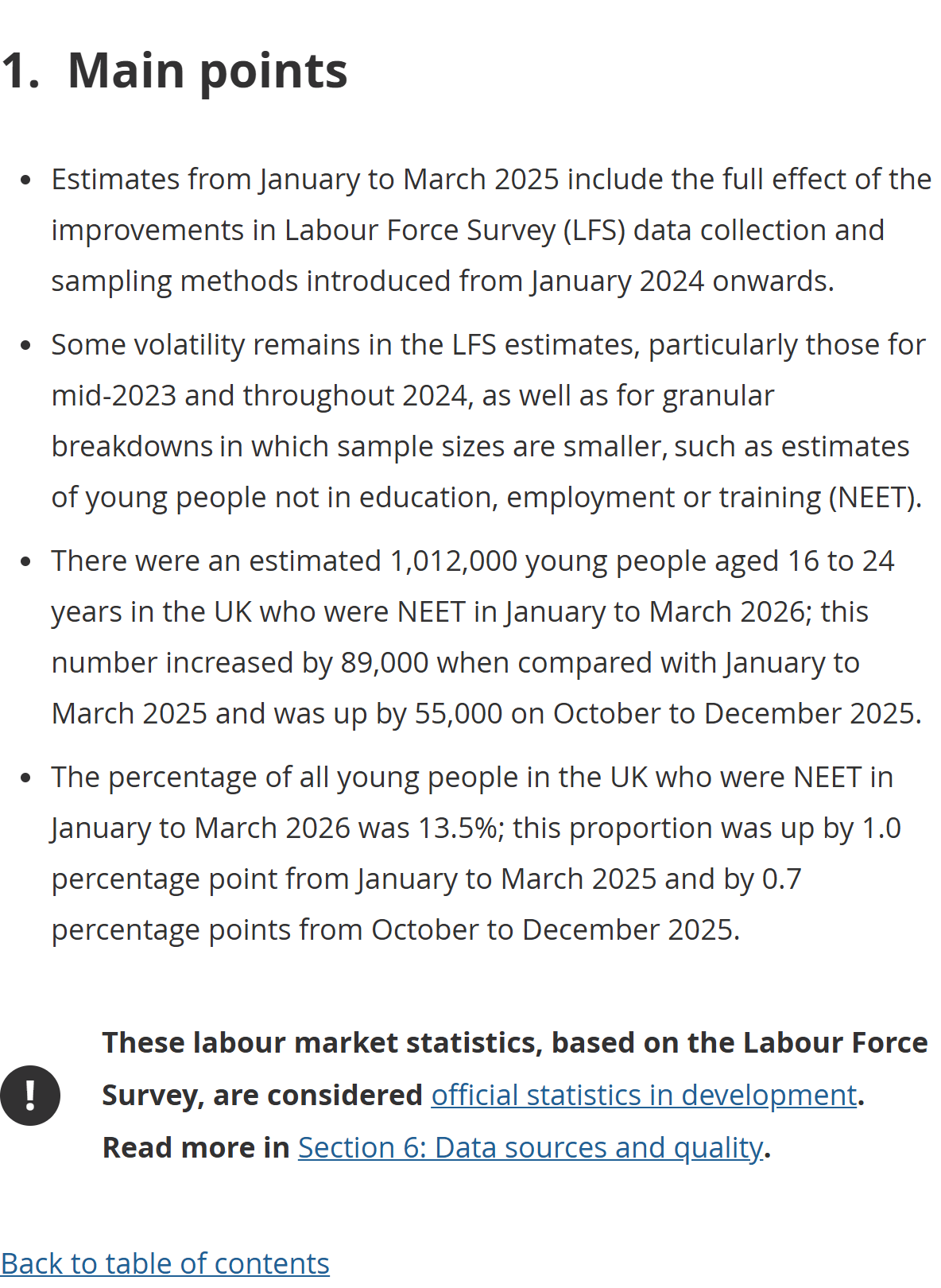
The ONS classifies these as official statistics in development and explicitly warns that volatility remains in the Labour Force Survey, particularly for granular breakdowns with smaller sample sizes, which it names NEET estimates as an example of. The "one million NEETs" headline is a real signal, and it is also a survey estimate with error bars that most of the coverage quietly drops. Both things are true.
Unemployed or economically inactive: the split that changes the story
This is the number that reframes everything, and it almost never survives the trip from the bulletin to the headline.
Of the 1,012,000, only 400,000 are unemployed in the technical sense of being out of work and actively looking for it. The other 613,000 are economically inactive, meaning they are not currently looking. Six in ten.
So the mental image of a million young people all scrolling job sites in vain is wrong. Six in ten are not in the labour market at all. And the DWP report is fairly blunt about why that share has grown: over the past decade the proportion who say they are NEET because of a work-limiting health condition has risen by 70%, and among disabled NEETs the share citing mental health as their primary condition has almost doubled to more than four in ten.
The other statistic in that report that should stop you dead: 6 in 10 young people who are NEET today have never had a job at all, up from 4 in 10 in 2005. The majority of this group never got into work in the first place, which makes "back to work" the wrong phrase for most of them.
What a NEET costs the state
The £244,000 comes from Impetus, in a July 2026 report called Closing the Youth Jobs Gap, and to be fair to it, the figure is properly built. Each additional young person who becomes NEET costs the state that much over a lifetime, made up of £102,000 in lost tax and National Insurance, £68,000 in higher welfare costs, £65,000 in higher NHS costs and £9,000 in higher criminal justice costs. Impetus calls it a deliberately conservative estimate, sitting below the University of York's long-standing benchmark of roughly £256,000 once uprated for inflation.
Multiply it by the million and you get £244 billion, which is more than the GDP of Greece, which is the line that got picked up. The DWP's own framing puts the cumulative annual cost at £125 billion, more than the country spends on education. Impetus separately reckons the post-pandemic rise alone is costing £27 billion a year in lost GDP.
These are useful numbers. They are also, every single one of them, addressed to somebody other than the person the article is about.
What being a NEET costs you
Here is the reframe, and it is the reason this article exists. The cost of being NEET is not mainly the wages you miss while you are NEET. It is the permanently lower wage curve you are on afterwards. The gap costs less than the shadow it casts.
Economists call this scarring, and the classic UK evidence is Gregg and Tominey's 2005 study, which followed a cohort of British men from school into middle age. It found a wage penalty of 13% to 21% still showing up at around age 42, decades after the unemployment spell itself ended. For those who avoided repeat spells, the penalty shrank to 9% to 11%. Still there. Twenty years later. That study is male-only and follows people born in 1958, so treat the exact percentages as a signal rather than a forecast for a 19-year-old today, but the direction has been replicated too often to wave away.
Work it forward and the DWP's £300,000 stops looking dramatic and starts looking like maths. Take someone who would otherwise have been on a £30,000 salary, which sits a little below the UK salary percentiles midpoint for that age group. An 11% permanent scar is £3,300 a year. Over a forty-year career that is £132,000 before you count a single pay rise you never got compounding on top of a base that never recovered, and before you count the employer pension contributions calculated as a percentage of the salary you did not have.
And this is the bit that makes the whole framing so lopsided. The state's £244,000 and your £300,000 are the same event seen from two ends. One of them is used to argue about whether you deserve help. The other one is yours.
The National Insurance gap nobody mentions
Now the actionable part, which takes an afternoon and is worth doing today if any of this applies to you.
Your State Pension is built from qualifying years on your National Insurance record. You need 35 of them for the full new State Pension, currently £241.30 a week or £12,548 a year in 2026/27. Fewer than 10 qualifying years and you get nothing at all. Between the two, each year is worth roughly 1/35th of the full rate, about £358 a year for life.
Here is the trap. If you claim Universal Credit or Jobseeker's Allowance, you get Class 1 National Insurance credits automatically, and those years count exactly like worked years. If you are outside the benefits system entirely, you get nothing by default. You have to contact Jobcentre Plus and claim the credits yourself.
Look again at the split. 613,000 economically inactive against 400,000 unemployed. The larger group, the one not actively job-hunting, is precisely the group least likely to be claiming anything, and therefore precisely the group quietly accruing gap years.
Three years NEET at 18 to 21 with no credits claimed is three missing qualifying years. At £358 each that is £1,075 a year of State Pension, forever, which over a twenty-year retirement is around £21,500 in today's money.
Now the honest caveat, because the overclaimed version of this is everywhere and it is rubbish. A 21-year-old has around 47 years until State Pension age and needs 35 of them. Three gap years at 18 cost nothing at all if the next 47 go well, because you have twelve years of slack. Those three years only bite if you end up short of 35 across your whole life, which is the story for people who later take time out to care for someone, have a long illness, spend years abroad, or run a low-profit self-employed business. In other words, it disproportionately bites people who have already had a hard time of it.
Which is exactly why you claim the credits. They cost you an afternoon of faff, they close the gap permanently, and you will not know at 19 which sort of life you are going to get. If you want to see where your record currently stands, the State Pension forecast tool runs the same maths on your own numbers, and how the State Pension is actually calculated covers the qualifying-year rules in full.
NEET in Britain, NEET on the internet
If you arrived here from a forum rather than a news story, you may have meant a different word, and it is worth clearing up because the two meanings have drifted a long way apart.
The British usage is the boring one above: a labour-market category invented for government statistics in the 1990s. The internet usage came via Japan, where NEET was borrowed into Japanese in the early 2000s and then absorbed into online culture as a self-applied identity, often half-joking, sometimes not. In that context it carries connotations of withdrawal and long-term dependence that the ONS definition simply does not have.
Hikikomori is a related but distinct Japanese term for acute social withdrawal, typically someone who has not left the house or engaged socially for six months or more. A hikikomori will almost always also be NEET. A NEET is very often not remotely hikikomori, because most of them are between things and looking.
And on whether it is an insult: the acronym is neutral, the usage frequently is not. It was built to count people, and it gets used to characterise them. Anyone using "NEET" as a slur about a real person in Britain is describing a spreadsheet cell as though it were a personality.
How to stop being a NEET
Practical, in rough order of how quickly each one pays.
Claim the National Insurance credits. Covered above. If you are not claiming a benefit, contact Jobcentre Plus and claim Class 1 credits directly. This is the highest return per hour of anything on this list.
Check what you are actually entitled to. A large share of the economically inactive 613,000 are not claiming anything, sometimes because they assume they cannot. Universal Credit eligibility is wider than most people think, and claiming it switches the NI credits on automatically as a side effect.
Treat a health condition as a health problem, not a work problem. The DWP's own numbers say a 70% rise in health-related NEET status over a decade is the single biggest moving part here. If that is you, the route back runs through a GP, not a job board.
Apprenticeships have no upper age limit. This surprises people. You can start one at 24 or 44. They pay a wage from day one and end with a qualification, which is a materially different proposition to unpaid experience, and the full comparison against the alternatives is in our piece on university versus going straight into a job.
Aim at the adjacent field, not the perfect one. The most reliable route out is usually a job that values something you can already do, at a higher rate than your current sector pays for it. Retraining perfectly into a completely new box is slower, more expensive, and fails more often. That is the whole argument of investing in yourself, and it holds just as well at 40 as at 20.
One last thing worth knowing, because it cuts against the doom. Automatic enrolment into a workplace pension does not start until age 22 and £10,000 of earnings. So an 18 to 21 year old in a job is not being auto-enrolled either. The pension gap between a NEET and a working teenager at that exact age is much smaller than intuition suggests. The gap that matters is the wage curve, and that one you can still get onto.
Frequently Asked Questions
How much do NEETs cost in the UK?
Impetus puts the lifetime cost to the state at £244,000 per additional NEET, made up of £102,000 in lost tax and National Insurance, £68,000 in welfare, £65,000 in NHS costs and £9,000 in criminal justice. Across the 1,012,000 currently NEET that totals around £244 billion. The DWP's interim report puts the cumulative annual cost at £125 billion, which is more than the UK spends on education.
What is NEET in the UK, exactly?
Aged 16 to 24, and at the same time not in employment, not in education and not in training. All three have to be true. The ONS publishes the headline 16 to 24 series quarterly; the Department for Education runs a separate, narrower 16 to 18 measure for England, which is why you sometimes see two different figures quoted in the same week.
Does being NEET affect your State Pension?
It can, but only through your National Insurance record, and only if you do nothing about it. Claiming Universal Credit or JSA gives you Class 1 NI credits automatically, so those years count in full. If you claim nothing you must ask Jobcentre Plus for the credits or the year is simply missing. Each missing qualifying year costs about £358 a year of State Pension for life, and you need 35 years for the full amount.
What is a Japanese NEET, and how is that different from hikikomori?
Japan borrowed the British acronym in the early 2000s, and online it became a self-applied label implying long-term withdrawal from work and study. Hikikomori is a separate Japanese term for severe social withdrawal, usually defined as six months or more of not leaving home or engaging socially. The overlap is real but partial: a hikikomori is nearly always NEET, while most NEETs are nothing like hikikomori.
Is NEET an insult?
The acronym itself is a neutral statistical category, invented so government could count a group. In practice it is regularly used to imply fecklessness, which is a lot harder to justify when six in ten of the people it describes are not in the labour market at all and a rising share of those are out for health reasons.
This article is general information about UK labour-market statistics, National Insurance credits and State Pension rules, and is not personal financial advice. Tax and benefit rules can change, and your own entitlement depends on your NI record and circumstances. For a binding answer on National Insurance credits or your State Pension forecast, contact Jobcentre Plus or the Future Pension Centre (0800 731 0181). The NEET figures quoted are ONS survey estimates published as official statistics in development.
Sources
Prefer to watch?
We turn these money breakdowns into short videos
A few a week, plain-English UK money. If you would sooner watch than read, follow along:
Enjoying the content?
If this site has been useful, a coffee goes a long way.
Browse more articles
Browse all