







Can You Switch Water Supplier? Why the Answer's No
You can't switch your water company. One set of pipes runs to your street and one firm owns it, which is exactly why the bill only ever moves one way. Here's what that monopoly costs you.
Cite this article
Freedom Isn't Free (2026) Can You Switch Water Supplier? Why the Answer's No. Available at: https://freedomisntfree.co.uk/articles/can-you-switch-water-supplier (Accessed: 10 October 2026).
Italicise the article title in your bibliography. Accessed date set to today.
TLDR
- Households cannot switch water supplier. Your region has one company for supply, and you are stuck with it.
- Only businesses can switch, since the retail market opened in April 2017. Household water stays a straight monopoly.
- With no competition to hold it down, the average bill hit about £603 a year in 2025/26 while the network still leaks around 3 billion litres a day.
- Your real levers are a water meter, WaterSure, a company social tariff, and complaining to CCW. Shopping around is not one of them.
You can't shop around: 2025/26 water bills by region
| Region (2025/26) | Approx. annual bill |
|---|---|
| Northumbrian Water (cheapest) | £506 |
| England and Wales average | £603 |
| Southern Water (most expensive) | £703 |
Same basic service, a £197 gap, and no way to move to the cheaper one without moving house.
Can You Switch Water Supplier? Why the Answer's No
Can you switch water supplier the way you switch your energy tariff or your broadband? If you are a household in England or Wales, no. You cannot. There is one company that supplies water to your postcode, and whether you love them or loathe them, they are the only game in town. That is not a temporary quirk of the market. It is the market, by design, and it explains almost everything you dislike about your bill.
Most guides answer this question in a sentence and move on to bill-cutting tips. That skips the interesting bit. The reason you cannot switch is the same reason your bill keeps rising while the pipes leak: household water is a natural monopoly, and a monopoly with no exit door has very little reason to keep you happy. Let's walk through what that actually means for the money leaving your account.
Contents
- Can you switch your water supplier?
- Why not? Water is a natural monopoly
- The one exception: businesses can switch
- So why does the bill keep going up?
- What you can actually do instead
- Frequently Asked Questions
Can you switch your water supplier?
The short answer for households: no. You do not choose your water and sewerage company. It is assigned by geography. Live in Yorkshire, you get Yorkshire Water. Live in the Thames Valley or most of London, you get Thames Water. Move house across a regional boundary and your supplier changes with your postcode, not with your say-so.
This is different from gas and electricity, where the pipes and wires are shared infrastructure and dozens of suppliers compete to sell you the energy that flows through them. In water, the company that owns the pipes to your street is also the company that bills you, treats the water, and runs the sewers. There is no competing retailer to switch to. Ofwat, the industry regulator, confirms it plainly: household customers cannot change their water company.
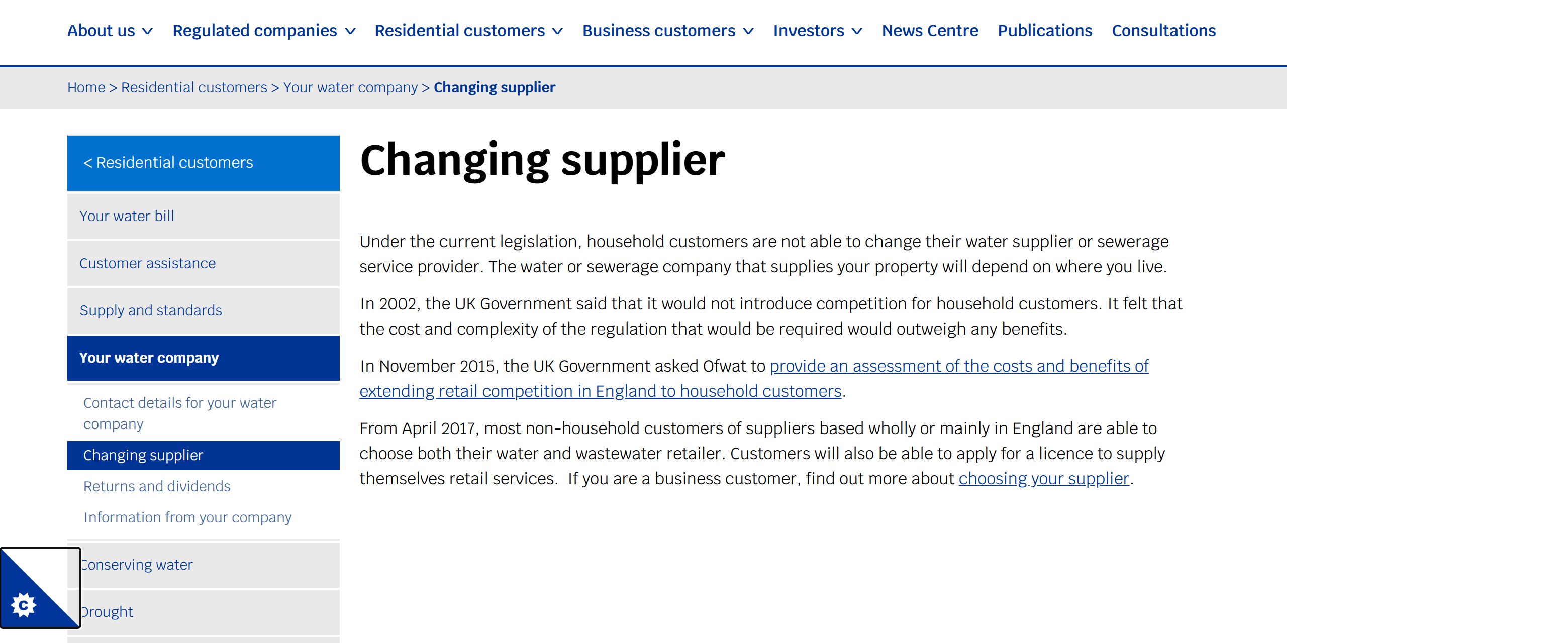
So when a comparison site invites you to "compare water suppliers," or a search throws up a switching service, read the small print. Almost always, they mean business water, which is a genuinely separate market. More on that below.
Why not? Water is a natural monopoly
A natural monopoly is a market where it makes no economic sense to have competitors, because the cost of building the network is so enormous that duplicating it would be mad. Nobody is going to dig a second, rival set of water mains under your road so you can choose between two pipes. One network gets built, one company owns it, and that company has your street to itself.
That is the honest engineering reality. You cannot have a competitive market in the water arriving at your tap, because competition needs at least two sellers and there is only ever going to be one pipe. Fine. The problem is what we did with that reality.
When water in England was privatised in 1989, the natural monopoly did not disappear. It got handed, region by region, to private companies. So the structure is a monopoly, but the owner is a profit-seeking business answerable to shareholders. That is the combination that bites. In a normal market, if a company treats you badly, you leave, and the threat of you leaving disciplines their behaviour. Strip out the ability to leave and that discipline vanishes. The company keeps your custom whether the service is brilliant or dreadful, because you have nowhere else to go.
This is the reframe worth holding onto. Being unable to switch water supplier is the defining feature of a monopoly, and every frustration that follows, the rising bills, the leaks, the sewage in the rivers, flows from that single fact. You are a captive customer. Captive customers get treated like captive customers.
The one exception: businesses can switch
Here is where the confusion comes from. Since April 2017, businesses, charities and public-sector bodies in England have been able to switch their water retailer. Scotland opened its business market even earlier, back in 2008.
But read what actually changed, because it is narrower than it sounds. The retail market only covers the customer-facing bit: billing, meter reading, customer service. A business switches who sends the invoice and answers the phone, while the same regional monopoly still supplies and treats the water through the same pipes. The wholesale monopoly underneath is untouched.
And crucially, none of this applies to your home. Household supply was deliberately left out of the reform. So if you are a homeowner or a tenant, the business switching market is off-limits to you entirely. Anyone telling you otherwise is either confused or selling something.
So why does the bill keep going up?
This is the question that really matters, and it connects straight back to the monopoly. With no competition to hold prices down, what holds them down instead is the regulator, Ofwat, which sets how much each company can charge every five years. That is the only brake in the system, and it has not been a very firm one.
The average household water and sewerage bill in England and Wales rose to around £603 a year in 2025/26, after a jump of roughly £123, about 26%, in a single year. And it varies wildly by region for the same basic service: Northumbrian Water customers paid around £506, while Southern Water customers were closer to £703. You cannot move to the cheaper one without moving house. It belongs on the same list as the other stealth costs quietly draining UK household budgets, the ones nobody legislated and nobody votes on.
| Region (2025/26) | Approx. annual bill |
|---|---|
| Northumbrian Water (cheapest) | £506 |
| England and Wales average | £603 |
| Southern Water (most expensive) | £703 |
Where did the money go over the decades? Not, it turns out, into the reservoir you might assume. Since 1992, Ofwat's own figures show the companies paid out more than £53bn in dividends to shareholders (analyses that fold in other shareholder payments put the total closer to £85bn since privatisation). Over the same era, the network still loses around 3 billion litres a day to leaks, and no major new reservoir was completed in England between Carsington Water in 1992 and the Havant Thicket scheme now finally under construction, the first in more than 30 years.
Then there is the debt. Thames Water, which serves about 16 million people, is carrying close to £20bn of it. The private equity firm KKR walked away from a rescue in 2025, the government rejected a creditor bailout plan in June 2026, and the company has spent the period lurching toward possible special administration. A monopoly you cannot leave, loaded with debt, paying dividends, leaking water, and still sending you a bigger bill each April. Rip-off Britain distilled into one industry, and a close cousin of the wider question of who the tax system actually protects. That is the deal privatisation actually delivered.
What you can actually do instead
You cannot vote with your feet, so your levers are different from every other bill you pay. They are worth knowing, because a captive customer who knows the rules still beats one who does not.
Get a water meter. If your home has more bedrooms than people, you are probably paying an unmetered charge based on your property's old rateable value, which can be far more than your actual usage. In most of England and Wales you can request a meter for free, and if it turns out cheaper you keep the saving. If it is more expensive, many companies let you switch back within a set period.
Check if you qualify for WaterSure. This scheme caps the bill for metered households that are on certain benefits and either have a large family or a medical condition that means high water use. If that is you, it can put a hard ceiling on the charge.
Ask about a social tariff. Every company runs its own reduced-rate scheme for low-income customers, with names and thresholds that differ by region. They are patchy and under-advertised, precisely because a monopoly has little incentive to shout about discounts. Ask directly.
Complain properly when they fail you. Because you have no exit, the complaints system is your substitute for market power. Start with the company, then escalate to the Consumer Council for Water (CCW), the independent body for water customers. Companies also owe automatic compensation under the guaranteed standards scheme when they miss things like appointments or leave you without supply. Claim it.
A rising water bill also lands hardest on the lowest earners, who spend more of their income on the essentials they cannot cut, the same regressive bite as frozen tax thresholds dragging more workers into tax. None of these levers fix that underlying problem, which is structural and political, not personal. But they are the difference between paying the monopoly's asking price and paying the least it can legally charge you.
Frequently Asked Questions
Which water supplier is the cheapest in the UK?
You cannot choose one, so this is a trick question for households. Bills vary by region because each area has a single assigned company. In 2025/26 Northumbrian Water was among the cheapest at around £506 a year, but you can only pay that rate by living in its region. Your postcode picks your price, not you.
Who is the most expensive water supplier in the UK?
Southern Water customers paid among the highest bills in 2025/26, around £703 a year for combined water and sewerage. Again, this is set by where you live. There is no way to switch away from an expensive regional company while staying in the same home.
What is the average water bill for a 2 person household in the UK?
There is no separate official "two-person" figure, because unmetered bills are based on property value, not occupancy. The overall household average was about £603 a year in 2025/26. A two-person household in a larger home is often exactly the case where fitting a water meter cuts the bill, because your usage is low relative to the property's rateable value.
Can I refuse to pay my water bill?
No, and it will not help. Water companies can pursue the debt through the courts and add costs, and unlike energy they cannot be switched away from, so withholding payment just leaves you owing more to the same monopoly. If you are struggling, the right route is a social tariff, WaterSure, a payment plan, or a formal complaint to CCW, not non-payment.
Can I switch water supplier when I move house?
Not by choice. When you move, your supplier changes automatically to whichever company covers your new address. You are simply swapping one regional monopoly for another. The only "switching" that happens is the one geography does for you.
This article is general information about water bills and consumer rights, not personalised financial or legal advice. Tariffs, meter rules and support schemes vary by company and region, so check the specifics with your own supplier, Ofwat or the Consumer Council for Water. Bill figures cover the 2025/26 period and were correct at the time of writing.
Sources
- Ofwat - Changing supplier (households)
- Ofwat - Average bills 2025/26 press statement
- Water UK - Annual average bill changes 2025-2026
- Ofwat - Open water market (business retail)
- ICE - Havant Thicket, first new UK reservoir in 30 years
- Ofwat - WaterSure and help paying your bill
- CCW - The independent voice for water consumers
Prefer to watch?
We turn these money breakdowns into short videos
A few a week, plain-English UK money. If you would sooner watch than read, follow along:
Enjoying the content?
If this site has been useful, a coffee goes a long way.
Browse more articles
Browse all