



Lifestyle Inflation UK: Why Pay Rises Don't Help
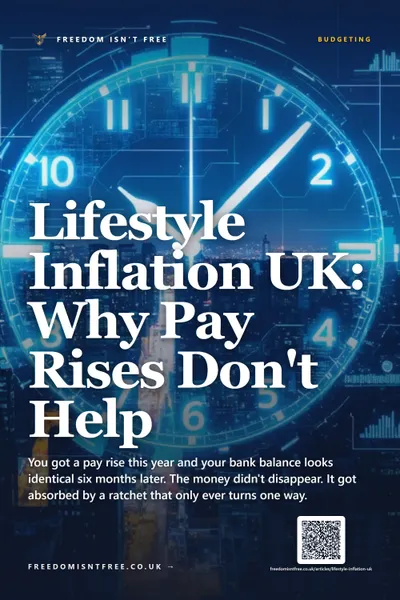
You got a pay rise this year and your bank balance looks identical six months later. The money didn't disappear. It got absorbed by a ratchet that only ever turns one way.
Cite this article
Freedom Isn't Free (2026) Lifestyle Inflation UK: Why Pay Rises Don't Help. Available at: https://freedomisntfree.co.uk/articles/lifestyle-inflation-uk (Accessed: 10 October 2026).
Italicise the article title in your bibliography. Accessed date set to today.
TLDR
- Lifestyle inflation is the silent process by which pay rises get absorbed into spending within months, leaving long-term wealth roughly unchanged.
- It is a ratchet: spending goes up easily but is hard to cut back without feeling deprived.
- The simple defence is to redirect at least half of every net pay rise to savings before it touches your spending account.
- Lifestyle inflation does not just slow your savings - it raises your retirement target too, because you need a bigger pot to fund a bigger lifestyle.
What a single £230/month pay rise does
| Strategy | Extra into savings | Extra into spending | FI target moves by |
|---|---|---|---|
| Absorb it all | £0 | +£230/month | +£69,000 |
| Save half | +£115/month | +£115/month | +£34,500 |
| Save it all | +£230/month | £0 | No change |
FI target rises by roughly 25x any new annual spend. The leak hurts twice.
Lifestyle Inflation UK: Why Pay Rises Don't Help
You got the pay rise. £4,000 a year, maybe £230 a month after tax. For two months you noticed the extra cash. By month six it has vanished into a slightly nicer flat, slightly nicer takeaways, slightly more expensive everything. Your bank balance at the end of the month looks roughly the same as it did before the rise.
This is lifestyle inflation, also called lifestyle creep. It is one of the most predictable patterns in personal finance, and it is the single biggest reason why earning more does not automatically lead to building more wealth. The mechanism is subtle, the cumulative cost is enormous, and the defence is mostly about setting up the right defaults before the next rise lands.
Contents
- What Is Lifestyle Inflation?
- Why It Happens to Almost Everyone
- The Ratchet Effect
- The Hidden Double Cost
- How to Defeat Lifestyle Inflation
- What "Saving Half" Looks Like in Practice
- Frequently Asked Questions
What Is Lifestyle Inflation?
Lifestyle inflation is the tendency for spending to rise in lockstep with income. As you earn more, you do not save more - you simply spend more, on slightly nicer versions of the same things. The standard of living goes up; the savings rate stays flat or even falls.
It is not the same as inflation in the macroeconomic sense. CPI inflation is what the supermarket charges. Lifestyle inflation is what you choose to buy at the supermarket. The first is mostly outside your control. The second is entirely within it.
In the UK, the typical trajectory looks like this: a graduate earns £25,000 and lives with flatmates, eats in, takes the bus. Five years later they earn £45,000 and live alone, eat out twice a week, and Uber home from the pub. The lifestyle has materially improved. The end-of-month bank balance has not.
Why It Happens to Almost Everyone
Three forces drive lifestyle inflation, and most of us are unaware of how powerful they are.
Hedonic adaptation. Humans are remarkably good at adjusting to a new normal. The first time you fly business class it feels luxurious. The fifth time it feels like the baseline. Your sense of what counts as a treat re-anchors upward, so the same dopamine hit now requires a more expensive purchase.
Social comparison. As you earn more, you usually move into circles where everyone else also earns more. The car your colleagues drive, the holidays they take, the area they live in - all of this nudges your sense of what is "normal" upward. The comparison is not malicious, it is just constant.
The "I deserve it" instinct after a rise. A pay rise feels like a reward. The natural response is to celebrate, which usually means spending some of it. But "some" tends to expand: a meal becomes a holiday, a holiday becomes a flat upgrade, and within a year the rise is fully absorbed.
None of this makes you irrational. It makes you human. The point is to know it is happening and put up some structural defences.
The Ratchet Effect
The cruelest part of lifestyle inflation is its asymmetry. Going up is easy and feels good. Going back down is hard and feels like deprivation.
Once you have lived in a one-bedroom flat after years of flat-sharing, moving back into a flat-share feels like a step backwards even if your income has not changed. Once you have got used to ordering Deliveroo twice a week, going back to cooking from scratch feels like a punishment. Spending levels are sticky in a way that savings rates are not.
This is why the only effective strategy is to prevent lifestyle inflation in the first place, not try to reverse it after the fact. Once a £230-a-month rise has been absorbed, getting that £230 back means cutting things that already feel like part of your normal life. Most people will not do it.
The Hidden Double Cost
Lifestyle inflation hurts your wealth in two ways at once, and most people only notice the first.
The visible cost: less money saved. Every pound that leaks into spending is a pound that is not compounding in your ISA or pension. Over 30 years at a 5% real return, an extra £200 a month saved becomes around £165,000.
£200 a month, 30 years at 5% real: saved vs absorbed into spending
The invisible cost: a larger retirement target. Your FI number is roughly 25 times your annual spending. If your spending rises by £200 a month, your FI target rises by £60,000 (£200 x 12 x 25). So lifestyle inflation does not just slow you down - it moves the finish line further away at the same time.
Combined, the £200-a-month leak from a single pay rise costs you something like £225,000 over a 30-year horizon. That is the difference between retiring comfortably at 60 and working until 67. Our FI number calculator lets you model the effect by changing the annual expenses figure.
How to Defeat Lifestyle Inflation
The strategy is mostly structural, not motivational. Willpower fades, defaults persist.
1. Save half of every pay rise on payday one
Before the new salary even hits your account, increase your standing orders to your ISA and pension by at least half of the net rise. If your take-home went up by £230 a month, raise your monthly ISA contribution by £115 immediately.
This is the single most powerful move. The remaining £115 still feels like a pay rise day-to-day, so the psychological reward is intact. But half of the rise compounds quietly in the background.
2. Automate the increase before you see it
In the UK, this is easiest with a workplace pension contribution. Most schemes let you raise your percentage online in 30 seconds. If you got a 4% pay rise, raise your pension contribution by 1-2%. The deduction comes off gross pay, so the impact on take-home is even smaller than it looks.
3. Anchor your spending to a previous version of yourself
When you got your first job, your spending was probably set by what you could afford. Use that as a baseline and let raises flow into savings rather than spending. The phrase that helps: "I am paying my future self first, not last."
4. Reset every January
Once a year, list your monthly subscriptions and recurring expenses. Most people find at least 2-3 they no longer use or value. Cancelling them recovers the equivalent of a small pay rise without any sacrifice.
5. Decide before you earn
The hardest moment to resist lifestyle inflation is the day a windfall arrives. Decide in advance what percentage of any future bonus, raise, or windfall goes to savings. Make it a rule, not a decision. Rules survive emotional moments; decisions usually do not.
For more practical structure on the bank accounts and standing orders that make this automatic, see our I Will Teach You To Be Rich review which covers the UK setup.
What "Saving Half" Looks Like in Practice
Take a UK professional earning £45,000 net and currently saving 20% (£750 a month). They get a 6% pay rise, taking them to £47,700 net. Their take-home goes up by £225 a month.
Without the rule: They keep saving £750 a month and quietly absorb the £225 into spending. After a year, their savings amount is the same as before, but their FI target has gone up by £67,500 because their spending has risen by £2,700 a year.
With the rule: They raise their ISA standing order by £113 (half the rise) on the day the new salary lands. They save £863 a month going forward, their FI target only rises by £33,750, and the £112 of extra spending money still feels like a celebration of the rise.
Over 10 years and three pay rises, the difference between these two paths is roughly £40,000-£50,000 in extra portfolio value, plus a £100,000 lower FI target. That is a meaningful change in retirement timeline from a single rule applied consistently.
The complementary number to track is your overall savings rate, which tells you whether your defences are actually holding over time.
Frequently Asked Questions
Is lifestyle inflation always bad?
Not always. After years of being broke, a small upgrade in housing, food quality, or experiences can be worth the cost. The trap is when lifestyle inflation happens automatically rather than deliberately. If you consciously chose every spending increase, you are unlikely to regret it. If they happened by default, you usually will.
How do I know if lifestyle inflation is happening to me?
Compare your savings rate from two years ago to today. If your income has risen but your savings rate has stayed flat or fallen, you have lifestyle inflation. The exact size of the rise tells you how aggressive the leak has been.
Should I avoid pay rises then?
No. The aim is to capture the wealth-building benefit of higher income while avoiding the trap of letting it all flow to spending. Higher income with the same savings rate is strictly better than lower income with the same savings rate.
What about one-off bonuses?
Treat bonuses more aggressively than salary rises - aim to save 70-80% of every bonus rather than 50%. Bonuses arrive as a single visible chunk, which makes them easier to redirect than a small monthly rise that vanishes into normal spending.
Does lifestyle inflation matter if I am already saving 50%+ of my income?
Less so, but it still matters. A 50% saver who lets their lifestyle inflate is reducing the percentage they save and increasing their retirement target. The mathematical effect is exactly the same as for a lower saver - just starting from a better baseline.
Prefer to watch?
We turn these money breakdowns into short videos
A few a week, plain-English UK money. If you would sooner watch than read, follow along:
Enjoying the content?
If this site has been useful, a coffee goes a long way.
Browse more articles
Browse all