





Savings Rate UK: The Number That Decides When You Retire
Forget your salary. There is one number that decides when you retire, and a teacher on £35k can beat a £85k consultant on it every time. Most people have never calculated theirs.
Cite this article
Freedom Isn't Free (2026) Savings Rate UK: The Number That Decides When You Retire. Available at: https://freedomisntfree.co.uk/articles/savings-rate-uk (Accessed: 10 October 2026).
Italicise the article title in your bibliography. Accessed date set to today.
TLDR
- Your savings rate - the percentage of take-home pay you save each month - is the single biggest determinant of when you reach financial independence.
- A 50% savings rate means around 17 years to FI. A 25% rate means 32 years. A 10% rate means 51 years.
- Income matters far less than people think because higher earners almost always raise spending to match.
- Track it as savings divided by net income, review quarterly, and aim for incremental gains rather than radical overhauls.
Savings Rate UK: The Number That Decides When You Retire
If you only ever track one number in your financial life, your savings rate is the right one. Not your salary, not your investment returns, not your net worth. The percentage of your take-home pay that you do not spend is the single most powerful lever you have over how soon you reach financial independence.
Most people overestimate the importance of income. They believe that if they could just earn more, the rest would take care of itself. The data says otherwise. A teacher on £35,000 saving 30% of their take-home pay reaches FI faster than a consultant on £85,000 saving 10% - even though the consultant earns more than twice as much. Savings rate compounds in a way that income alone cannot.
Contents
- What Is a Savings Rate?
- Why Savings Rate Beats Income
- The Maths: How Savings Rate Translates to Years
- Why 100% Would Mean You Are Already Free
- How to Calculate Your Savings Rate
- How to Raise Your Savings Rate
- What Is a Good UK Savings Rate?
- Frequently Asked Questions
What Is a Savings Rate?
Your savings rate is what proportion of your net (after-tax) income you save and invest, expressed as a percentage. If you take home £3,000 a month and save £600, your savings rate is 20%. If you take home £3,000 and save £1,500, you are at 50%.
The most useful definition for FI planning is savings divided by net take-home pay, not gross. Gross income includes money the government takes that you never see. Using gross flatters your savings rate but does not reflect what you actually have to work with.
Pension contributions count as savings even though you do not see the money. So does any employer match. Anything that compounds toward your future net worth - ISAs, SIPPs, pension contributions, debt overpayment beyond the minimum, money sitting in your investment account - is on the savings side of the equation.
If you want to start with the net number itself, our take-home pay calculator shows what actually lands in your account each month.
Why Savings Rate Beats Income
Two earners. Same age, same job market, same investment returns. The first earns £40,000 net and saves 30%. The second earns £80,000 net and saves 10%. Who reaches FI first?
The first one, by a country mile. Here is why.
The second person needs to fund a £80,000-a-year lifestyle in retirement (because they are spending £72,000 a year), which means they need a much bigger pot. The first person only needs to fund a £28,000-a-year lifestyle (£40,000 minus 30% saved), so their target portfolio is far smaller. They have less to save and they have to fund a smaller retirement. The double effect is what makes savings rate dominate.
This is why lifestyle inflation is the silent killer of FIRE plans. Every pay rise that gets fully absorbed into spending raises your retirement target as fast as it raises your savings.
For the maths nerds, the formula is what financial-independence calculations call the savings-rate-to-years equation. It assumes you live off your savings using the 4% rule and earn a 5% real return on investments. The result is on the lookup table below.
The Maths: How Savings Rate Translates to Years
Assuming a 5% real (post-inflation) return and the 4% withdrawal rule, here is roughly how long it takes to reach FI starting from zero:
| Savings rate | Years to FI |
|---|---|
| 5% | 66 |
| 10% | 51 |
| 15% | 43 |
| 20% | 37 |
| 25% | 32 |
| 30% | 28 |
| 35% | 25 |
| 40% | 22 |
| 45% | 19 |
| 50% | 17 |
| 55% | 15 |
| 60% | 12.5 |
| 65% | 10.5 |
| 70% | 8.5 |
Years to financial independence by savings rate
5% real return, 4% withdrawal rule, starting from zero
Source: Networthify-style FI calculation. See /tools/fi-number-calculator to model your own inputs.
A few things stand out from the table.
The first 10% of savings rate gets you almost nothing - 66 years to 51 years. The middle of the curve is where the action is: every 5 percentage points between 20% and 50% knocks 4 to 5 years off your timeline.
Above 50%, the curve flattens because you are already saving more than half your income, but the absolute difference is large in a different way. A 60% saver has a 5x bigger gap between income and spending than a 30% saver, so they bank far more cash each year.
To put your own numbers through the calculation, our FI number calculator lets you set your savings rate and shows your projected FI date.
Why 100% Would Mean You Are Already Free
The table above stops at 70%, but the logic does not. Follow it all the way to the end and something clicks into place.
A savings rate of 100% means you spend nothing, so your annual spending is zero. And because your financial-independence number is your annual spending multiplied by 25 (the 4% rule in reverse), a spending figure of zero produces an FI number of zero. You would need no pot at all. You would already be financially independent the moment you got there, on any income.
Nobody actually saves 100%. You have to eat, keep a roof warm, and fund a life worth retiring into. That is not the point. The point is what the extreme exposes: financial independence is not about the size of your pot. It is about the gap between what you earn and what you need. A smaller number to live on is funded by a smaller pot, reached sooner.
This is why raising your savings rate does two jobs at once. Every percentage point you claw back both feeds the pot faster and drags the finish line toward you, because a lower spend means a lower target. Income can only ever do the first job. It fills the pot but leaves the finish line where it was, and usually pushes it further away as lifestyle creeps up. That double effect is the whole reason a teacher on £35,000 outruns a consultant on £85,000.
For most people the freeing reframe is not "how do I earn enough to be free" but "how little do I genuinely need to be free". The second question is answerable on almost any salary. The first keeps the goalposts moving forever, which is precisely how a consumption economy prefers to keep you: earning hard, spending harder, and always a little short.
How to Calculate Your Savings Rate
The cleanest version of the formula is:
Savings Rate = (Savings + Investments + Pension Contributions) / Net Take-Home Pay
For a typical UK household, savings include:
- ISA contributions (Cash ISA, Stocks and Shares ISA, LISA)
- SIPP and workplace pension contributions (employee + employer)
- Mortgage overpayments above the minimum
- Money moved into a general investment account
- Cash savings genuinely earmarked for the future, not for next month's car insurance
It does not include:
- Money sitting in your current account because payday is tomorrow
- Cash being held to pay an upcoming bill
- Money saved for a holiday in 4 months (this is deferred consumption, not investment)
Pull a typical recent month, sum your savings as defined above, divide by your net take-home pay, multiply by 100. That is your savings rate.
Track it over a 3-month rolling window so one-off bonuses or expenses do not skew the picture. Review quarterly. Most people are surprised - either pleasantly or not - when they actually do the maths for the first time.
How to Raise Your Savings Rate
The single most powerful move is to increase savings on autopilot before you see the money. A standing order from your salary account into your ISA on payday means your savings rate happens whether you are paying attention or not. Behavioural research is consistent on this: defaults beat willpower. Our piece on automating finances based on Ramit Sethi's I Will Teach You To Be Rich covers the UK setup in detail.
The second move is to save half of every pay rise by default. Lifestyle inflation is what neutralises most income growth. If you got a £3,000 net pay rise, an extra £125 a month going to your ISA on top of what you already save raises your savings rate without changing your day-to-day life much.
The third move is to rank your spending by joy per pound. Cut what you do not actually enjoy, keep what you do. The cliché advice is to skip coffee and avocado toast. The better advice is to look at your largest discretionary line items - subscriptions, eating out, holidays, gadgets - and ask whether each gives you joy proportional to its cost. You will usually find one or two big ones that are pure habit.
What you should not do is try to leap from 10% to 50% overnight. Radical savings sprints almost always end in burnout and a binge that wipes out the gains. Aim for a 1-2 percentage point gain per quarter. Over three years that is 12-24 percentage points, which is the difference between retiring at 65 and retiring at 50.
What Is a Good UK Savings Rate?
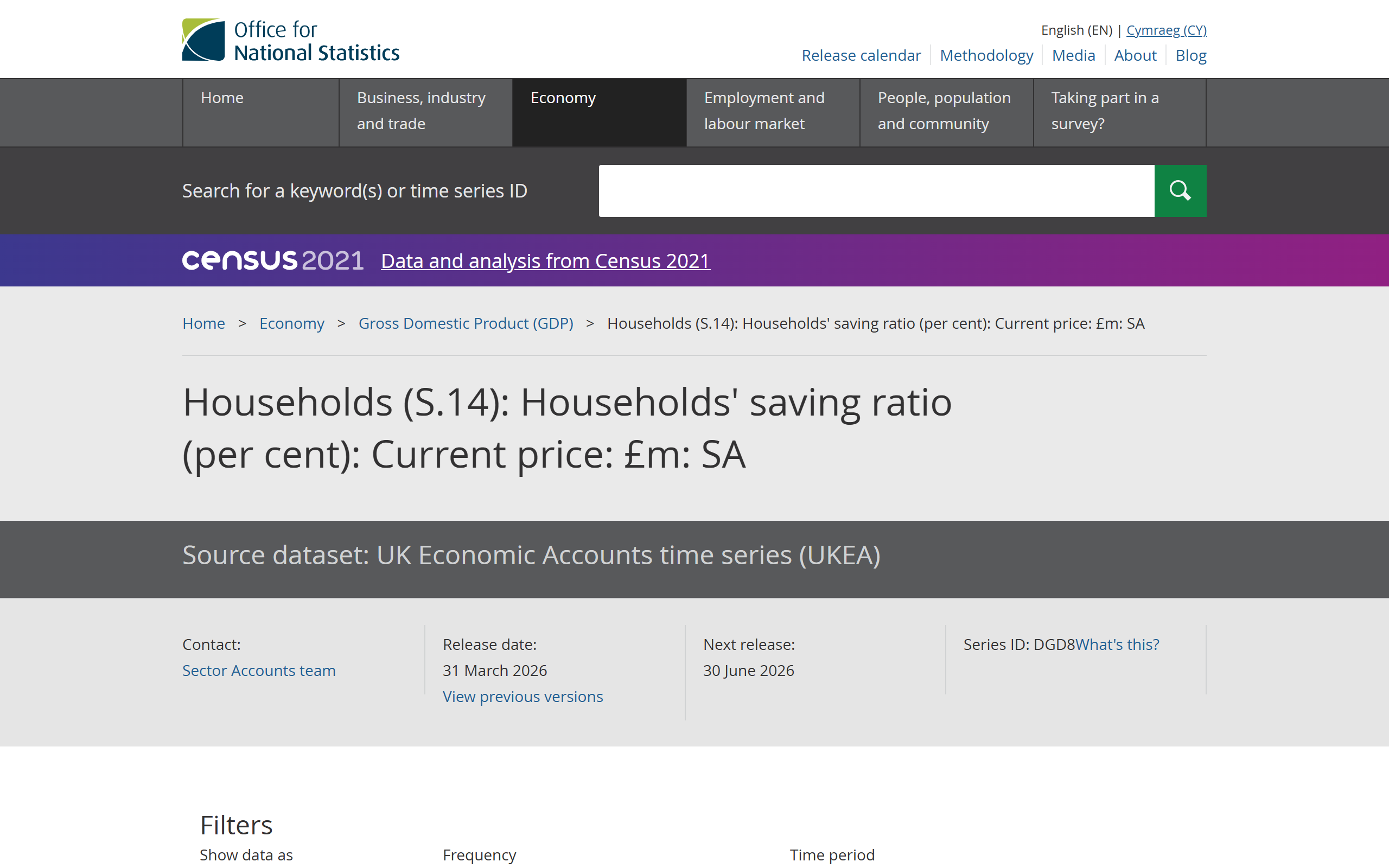
The UK household saving ratio, published by the ONS, has hovered around 5-10% in normal times, spiked to 25%+ during the pandemic, and has settled back into single digits since. So if you are saving 15% of net pay, you are already doing better than most UK households.
Here is a rough scale:
- Under 10%: below average. Workable as a starting point if you are clearing high-interest debt, but this is not a long-term strategy for FI.
- 10-20%: average. You will retire on time at the State Pension age, with a modest pension supplement. Not FIRE, but not catastrophe either.
- 20-35%: above average. This is the sweet spot for most professionals. Compounds into a meaningful pot by your mid-50s.
- 35-50%: aggressive. You are on a serious FIRE track. Expect to reach FI in your late 40s if you started in your late 20s.
- 50%+: committed. You are running close to the optimal savings curve. Most people who sustain this are dual-earning couples without dependents, or singles with a high savings instinct.
Pick a target one band higher than where you are today. Hit it. Stay there for a year. Then move up another band.
Frequently Asked Questions
Should I include my employer's pension match in my savings rate?
Yes, but track it separately so you can see what you are actually doing versus what your employer is doing. A 30% savings rate with employer match feels different from a 30% rate where you are doing all the work. Both are valid; they tell you different things.
What about when I have high-interest debt?
If you have credit-card debt at 20%+ APR, every pound used to clear it is mathematically equivalent to a 20% guaranteed return. Treat debt overpayment beyond the minimum as savings while the debt exists. Once it is cleared, redirect that same monthly amount to your ISA.
Does my savings rate need to grow with my income?
Ideally, yes. The trap most people fall into is that their savings amount stays flat while their spending rises with their salary. Set a rule: every pay rise gets at least 50% redirected to savings before any of it touches lifestyle.
What is the highest savings rate that is realistic in the UK?
The UK is harder than the US for high savings rates because rents and house prices are high relative to income. Anything above 50% sustained is unusual outside of dual-earners or those who have housing security. 30-40% is achievable for most professionals once they have cleared debt and got their housing under control.
Should I prioritise pension contributions or ISA contributions in my savings rate?
Both count. Our ISA vs Pension guide covers the prioritisation in detail, but the headline is: take the full employer pension match first (free money), then favour the ISA below age 35 (flexibility), and lean harder into the pension as you approach access age.
Prefer to watch?
We turn these money breakdowns into short videos
A few a week, plain-English UK money. If you would sooner watch than read, follow along:
Enjoying the content?
If this site has been useful, a coffee goes a long way.
Browse more articles
Browse all