





What Is the S&P 500 and How to Buy It in the UK
You think you own 500 American companies. Look inside the S&P 500 in 2026 and the top ten holdings account for more than a third of the whole index. That's not diversification.
Cite this article
Freedom Isn't Free (2026) What Is the S&P 500 and How to Buy It in the UK. Available at: https://freedomisntfree.co.uk/articles/what-is-the-sp-500-uk-investors (Accessed: 21 September 2026).
Italicise the article title in your bibliography. Accessed date set to today.
TLDR
- The S&P 500 tracks the 500 largest US-listed companies by market cap and covers around 80% of total US equity market value.
- It has returned roughly 10% per year nominal in USD over the last 70 years, but is now heavily concentrated in mega-cap tech.
- UK investors cannot buy US-listed S&P 500 ETFs like SPY or VOO directly. They use UCITS-compliant equivalents listed on the London Stock Exchange.
- CSPX (iShares Core S&P 500), VUAG (Vanguard S&P 500), and SPXP (Invesco S&P 500) are the three most widely held UK options, all charging between 0.05% and 0.07%.
UK-listed S&P 500 UCITS ETFs compared
| Ticker | Provider | TER | Type |
|---|---|---|---|
| CSPX | iShares | 0.07% | Physical, accumulating |
| VUAG | Vanguard | 0.07% | Physical, accumulating |
| VUSA | Vanguard | 0.07% | Physical, distributing |
| SPXP | Invesco | 0.05% | Synthetic, accumulating |
| IUSA | iShares | 0.07% | Physical, distributing |
All Ireland-domiciled to benefit from the 15% US dividend withholding rate.
What Is the S&P 500 and How to Buy It in the UK
The S&P 500 is the most-tracked stock market index in the world. It holds the 500 largest companies listed on US exchanges, weighted by market capitalisation, and is the benchmark every active US fund manager is measured against. For UK investors, getting exposure to the S&P 500 is routine through low-cost UCITS ETFs, but the mechanics are different from what an American investor would do.
This article covers what the S&P 500 actually is, what it owns, what it has returned historically, and the practical steps for buying it from a UK platform inside an ISA or SIPP.
Contents
- What is the S&P 500?
- How a company gets into the S&P 500
- What the S&P 500 actually owns
- Historical performance
- Concentration risk
- Why UK investors cannot buy SPY or VOO
- The main UK-available S&P 500 ETFs
- How to buy the S&P 500 from the UK
- Tax treatment for UK investors
- Frequently Asked Questions
What is the S&P 500?
The S&P 500 is a stock market index that tracks the 500 largest US-listed companies, weighted by free-float market capitalisation. It covers around 80% of total US equity market value and is the benchmark most active US fund managers are measured against. UK investors access it through low-cost UCITS ETFs such as CSPX, VUAG, and SPXP.
The Standard and Poor's 500 was launched in its current form in 1957, building on earlier indexes S&P had been publishing since 1923. It is maintained by S&P Dow Jones Indices, owned today by S&P Global. A committee decides which companies are in the index. It meets regularly and adjusts the membership when companies merge, fail, get acquired, or grow large enough to qualify.
The index is free-float market capitalisation weighted. Each company's slot is set by the market value of its publicly tradeable shares. Apple, at around $3 trillion, takes up far more of the index than the smallest constituent at around $20 billion. The total market cap covered by the index is roughly $50 trillion as of 2026, around 80% of the entire US equity market.
The "500" in the name is approximate. The index sometimes holds slightly more or fewer constituents because some companies (Alphabet, for example) have multiple share classes counted separately.
How a company gets into the S&P 500
The committee uses a set of objective criteria, then applies judgement on top:
- US domicile (with some flexibility for companies with significant US operations).
- Market cap above a current threshold (around $18 billion as of 2026, regularly updated).
- Liquidity above minimum trading volume thresholds.
- Profitability: positive GAAP earnings in the most recent quarter and over the last four quarters combined.
- Public float of at least 50% of shares outstanding.
Inclusion is not automatic when a company crosses the size threshold. Tesla famously waited several quarters after meeting the market-cap criteria because the committee chose its own timing. That human-judgement layer is the main difference between S&P 500 trackers and pure market-cap indexes like the Russell 1000.
What the S&P 500 actually owns
The S&P 500 looks broad on paper. In practice a small number of companies move most of the returns.
Top 10 holdings (approximate, 2026): Apple, Microsoft, Nvidia, Amazon, Alphabet (A and C share classes), Meta, Tesla, Berkshire Hathaway, Eli Lilly. Together, they account for roughly 33-35% of the index.
Sector split:
| Sector | Approximate weight |
|---|---|
| Information Technology | 30% |
| Financials | 13% |
| Healthcare | 11% |
| Consumer Discretionary | 10% |
| Communication Services | 9% |
| Industrials | 8% |
| Consumer Staples | 6% |
| Energy | 4% |
| Utilities | 3% |
| Real Estate | 2% |
| Materials | 2% |
Tech, communication services and consumer discretionary together (which is where the mega-cap platforms live) make up close to half the index. The S&P 500 is not "American industry." It is, increasingly, the global software and platform economy that happens to list in the US.
Historical performance
Over its full history since 1957, the S&P 500 has returned roughly:
- 10% per year in nominal USD total return (with dividends reinvested)
- 6.5-7% per year in real terms after US inflation
- 9-10% per year in GBP terms when the dollar's long-term strength against sterling is included
Those are headline averages over almost seven decades. Inside that long average sit some painful stretches:
- 2000-2009: the "lost decade," with roughly 0% nominal total return after the dot-com crash and the Global Financial Crisis.
- 1973-1974: down approximately 48% peak to trough during the oil crisis.
- 2008: down 38% in a single calendar year.
- 2020: down 34% in 33 days, then fully recovered within months.
The pattern that matters: long-run returns are strong, but the path is brutally lumpy. Anyone who buys an S&P 500 ETF should expect to live through at least one drawdown of 30% or more in any 20-year holding period.
Concentration risk
The most discussed risk in 2026 is concentration. The top 10 stocks at around 35% of the index is the highest top-10 share since the 1960s. The "Magnificent Seven" mega-cap tech names alone account for around 30% of the index.
That has two implications for UK buyers:
- An "S&P 500 tracker" is now substantially a bet on a handful of US tech platforms. If they re-rate sharply down, the index goes with them.
- Adding a "global" index ETF like the FTSE All-World on top of an S&P 500 tracker does not diversify away that exposure as much as it looks. The US is around 60-65% of the FTSE All-World, and the same handful of mega-caps are the largest holdings in both.
Real diversification away from this concentration requires deliberately tilting toward something different: equal-weighted versions of the S&P 500, value funds, ex-US developed funds, or emerging markets.
S&P 500 top-10 share of the index, 1990 to 2026
The 10 largest companies as a percentage of total index weight
Source: RBC Wealth Management 'The Great Narrowing' (2025); Osborne Partners SP500 Concentration note (Jan 2025); Financial Symmetry 'Heavy Weights' analysis; Visual Capitalist 145-year concentration series.
The line is the story. Concentration sat in a tight 17 to 23% range for 25 years, briefly poked above 25% at the 2000 dot-com peak, then exploded after 2015 as the mega-cap platforms compounded faster than everything else they shared an index with. By 2025 the top 10 were a record 40.7% of the index, well past the previous 1960s high. The pullback into 2026 has trimmed it to around 35%, but that is still higher than at any point in the four decades before 2020. An S&P 500 tracker in 2026 is a meaningfully different instrument from the same product anyone bought in 2010.
Why UK investors cannot buy SPY or VOO
If you read US investing content you will see SPY (the SPDR S&P 500 ETF), VOO (Vanguard's), and IVV (iShares') talked about constantly. UK retail investors cannot buy these directly through a normal broker.
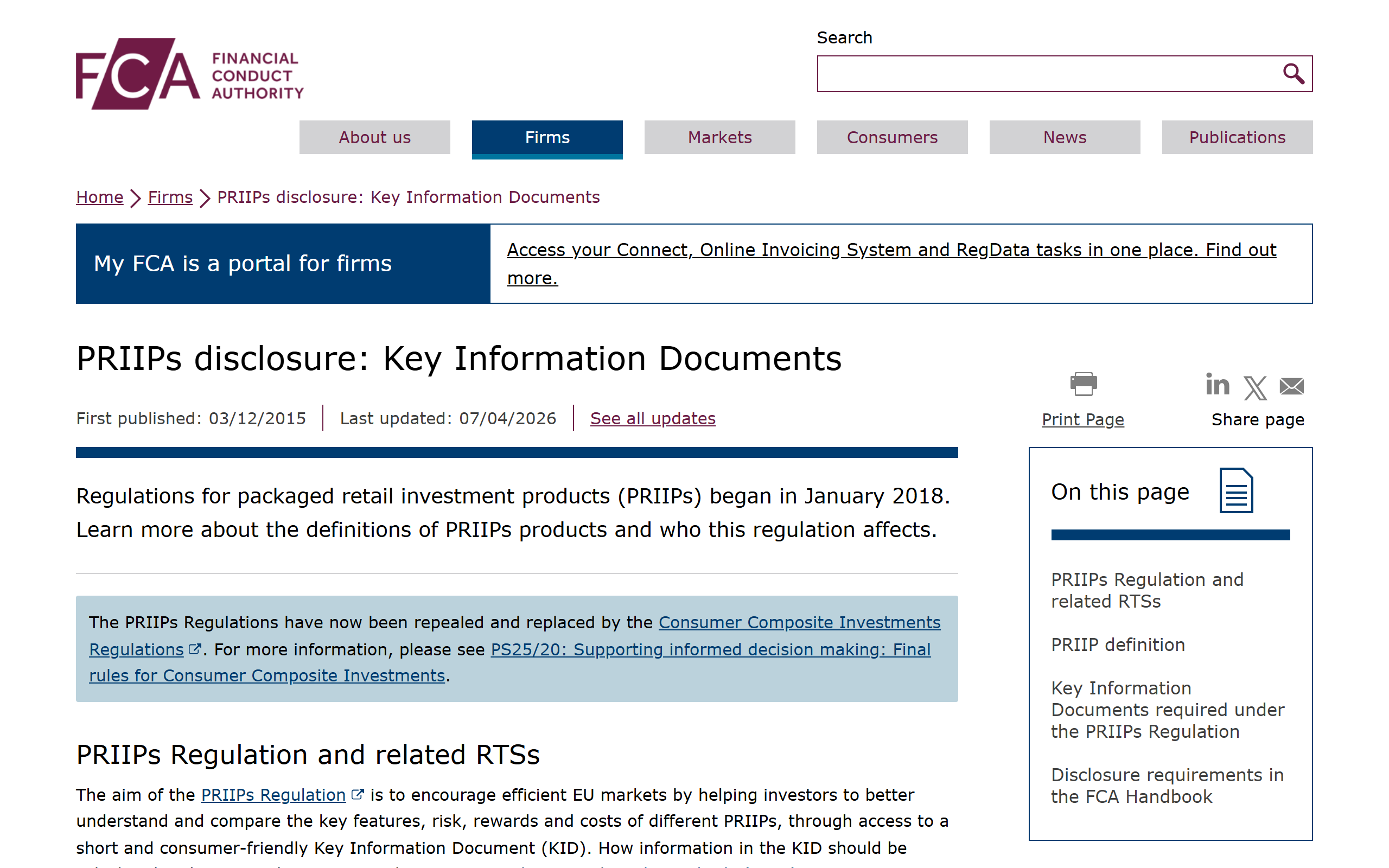
The reason is a piece of European regulation called PRIIPs (Packaged Retail and Insurance-based Investment Products). Since 2018, any product marketed to retail investors in the EU and UK must produce a Key Information Document (KID) in a specific format set out in the FCA's PRIIPs rules. US ETF providers do not produce KIDs because they do not need to, so their funds cannot be sold to UK retail clients. This is a regulatory restriction, not a tax or market-structure issue.
The workaround is simple: every major US ETF has a UCITS-compliant equivalent listed in London, Dublin, or Amsterdam, with virtually the same exposure and similar costs. UK investors use those instead.
The main UK-available S&P 500 ETFs
The three most-held S&P 500 trackers on UK platforms in 2026 are below. For the full six-fund comparison including SPY5 at 0.03% (the cheapest UCITS S&P 500 tracker) and HSBC's HSPX, see the best S&P 500 ETF UK 2026 comparison.
iShares Core S&P 500 UCITS ETF (CSPX)
- TER: 0.07%
- Domicile: Ireland
- Replication: Physical, full
- Distribution: Accumulating (income reinvested into the fund)
- Size: Over $90 billion in assets, the most liquid S&P 500 UCITS ETF available
CSPX is the default for most UK investors holding the S&P 500 long-term inside an ISA or SIPP. It has an income-paying sister fund, IUSA, for investors who want dividends paid into their account.
Vanguard S&P 500 UCITS ETF (VUAG / VUSA)
- TER: 0.07%
- Domicile: Ireland
- Replication: Physical, full
- Distribution: VUAG is accumulating; VUSA is distributing
- Size: Over $50 billion combined
VUAG is the Vanguard equivalent of CSPX. Almost identical in cost and structure. Choice between them often comes down to brand preference and what your platform discounts.
Invesco S&P 500 UCITS ETF (SPXP / SPXS)
- TER: 0.05%
- Domicile: Ireland
- Replication: Synthetic (swap-based)
- Distribution: SPXP is accumulating; SPXS is distributing
- Size: Around $20 billion
The cheapest of the three on stated TER. Worth knowing because synthetic replication can avoid US dividend withholding tax entirely under certain swap structures. Not for everyone - synthetic replication adds counterparty risk to the equation - but a meaningful option for cost-focused investors. If you want to understand what the rest of the line items on a fund factsheet mean, see how to read an ETF factsheet.
There is also a Vanguard S&P 500 fund (open-ended, not an ETF) called the Vanguard S&P 500 Index Fund, sometimes preferred by people using Vanguard Investor UK directly. It charges 0.10% and behaves the same way for tax purposes.
How to buy the S&P 500 from the UK
The step-by-step is mundane but worth spelling out:
- Open an account on a UK investing platform that supports ETFs. Common choices include Vanguard, AJ Bell, Hargreaves Lansdown, Trading 212, InvestEngine, and Interactive Investor.
- Wrap it. Use a Stocks and Shares ISA (£20,000 annual allowance, no tax on growth or income) or a SIPP (tax relief on contributions, locked until age 57+).
- Fund the account by bank transfer or debit card.
- Search for the ticker (CSPX, VUAG, SPXP, etc.) and place a buy order. Use a limit order if the spread looks wide; a market order is fine for liquid funds during normal hours.
- Reinvest or buy more on a schedule. Most platforms support free monthly direct debits into ETFs.
There is no need to do anything clever. Pick one of the three above, hold it inside a tax wrapper, and add to it every month. That is the entire strategy.
Tax treatment for UK investors
Inside an ISA or SIPP, there is no UK tax to worry about. Outside a wrapper (in a General Investment Account), you pay capital gains tax on any growth above the annual allowance and dividend tax on distributions above the dividend allowance.
A point worth knowing: Ireland-domiciled UCITS S&P 500 ETFs benefit from the US-Ireland income tax treaty, which reduces US dividend withholding tax from 30% to 15%. That 15% saving (compared to a Luxembourg-domiciled equivalent) is one of the reasons almost every UK-marketed S&P 500 ETF is Irish-domiciled.
UK investors do not need to file anything separately for US tax. The withholding happens inside the fund automatically.
Frequently Asked Questions
What is the S&P 500 in simple terms?
The S&P 500 is a list of the 500 largest American companies by market value, weighted so that bigger companies count more. When you hear "the US stock market was up today," people usually mean the S&P 500. Buying an S&P 500 ETF means buying a tiny slice of all 500 of those companies in one trade.
Can a UK investor buy the S&P 500?
Yes, easily. UK investors cannot buy US-listed ETFs like SPY directly because of European disclosure rules, but UCITS equivalents (CSPX, VUAG, SPXP) listed in London give the same exposure for similar fees. They are available on virtually every UK investing platform inside an ISA, SIPP, or general account.
What is the cheapest S&P 500 ETF in the UK?
By stated TER, the Invesco S&P 500 UCITS ETF (SPXP) at 0.05% is the cheapest. CSPX and VUAG both charge 0.07%. The differences are small in absolute terms (£0.20 per year on a £1,000 holding) and structural choice often matters more than the headline fee.
Should I buy the S&P 500 or a global tracker?
A global tracker like Vanguard's FTSE All-World (VWRP) gives you about 60-65% S&P 500 plus a small slice of the rest of the world. It is the safer default because it does not bet everything on continued US dominance. An S&P 500-only position is a deliberate active bet that the US will keep outperforming - which it might, but no one knows.
How much should I invest in the S&P 500?
That depends on your overall portfolio. Most UK investors hold the S&P 500 as part of a broader equity allocation, either directly or as a sub-component of a global tracker. There is no single right answer, but holding more than 70-80% of your equity exposure in a single country is concentration risk that should be a deliberate choice, not an accident.
Further Reading:
The Little Book of Common Sense Investing - John Bogle - The case for owning the whole market through a low-cost index, written by the man who built the first S&P 500 index fund. (Affiliate link - we may earn a small commission at no extra cost to you.)
Smarter Investing - Tim Hale - The UK-focused companion: how to build an evidence-based portfolio with index funds inside ISAs and SIPPs, including how much US exposure makes sense. (Affiliate link - we may earn a small commission at no extra cost to you.)
Read Next:
- Popular UCITS ETFs UK Investors Should Know - the full menu of UCITS ETFs UK investors actually use, beyond the S&P 500
- What Is a UCITS ETF? - the regulatory framework that determines what UK retail investors can buy
- Major Stock Market Indexes for UK Investors - how the S&P 500 compares to the FTSE 100, MSCI World, and FTSE All-World
- Adding a Value Tilt to Reduce US Tech Exposure - one practical answer to S&P 500 concentration risk
- VWRP vs VWRL: Accumulating or Distributing? - the same accumulating/distributing decision applied to global trackers
Prefer to watch?
We turn these money breakdowns into short videos
A few a week, plain-English UK money. If you would sooner watch than read, follow along:
Enjoying the content?
If this site has been useful, a coffee goes a long way.
Browse more articles
Browse all