






What Is a UCITS ETF? A Plain-English UK Guide
Every UK ETF ticker ends in 'UCITS'. Most investors could not tell you what it means. The label dictates what the fund holds and what happens if the manager goes bust.
Cite this article
Freedom Isn't Free (2026) What Is a UCITS ETF? A Plain-English UK Guide. Available at: https://freedomisntfree.co.uk/articles/what-is-a-ucits-etf (Accessed: 21 September 2026).
Italicise the article title in your bibliography. Accessed date set to today.
TLDR
- UCITS is a European regulatory framework that imposes strict diversification, leverage and liquidity rules on funds, with assets held by an independent depositary.
- For UK investors, almost every ETF available on a normal platform is UCITS-compliant. It is the default standard, not a niche.
- UCITS guarantees that no single holding exceeds 10% of a fund (with a 5/40 concentration cap), no more than 10% leverage for borrowing, and that fund assets are legally separate from the manager.
- Most UCITS ETFs are domiciled in Ireland or Luxembourg for tax reasons, and the UK has chosen to keep the framework post-Brexit. That is why all the familiar tickers (VWRP, CSPX, SWDA) end with the same regulatory backbone.
What UCITS guarantees vs what it does not
| Protection | UCITS rule | Covers |
|---|---|---|
| Single-stock cap | 10% of NAV max | Concentration risk |
| 5/10/40 rule | Holdings over 5% capped at 40% combined | Cluster risk |
| Leverage limit | 10% borrowing, short term only | Hidden gearing |
| Asset segregation | Independent depositary | Manager insolvency |
| Liquidity | Redemption at least twice a month | Trapped capital |
UCITS does not protect against market losses, tracking error, or platform failure.
What Is a UCITS ETF? A Plain-English UK Guide
A UCITS ETF is an exchange-traded fund built to comply with the European "Undertakings for Collective Investment in Transferable Securities" rulebook. Those rules cap any single holding at 10% of the fund, limit borrowing to 10% of assets, require an independent depositary to hold the assets, and force standardised disclosure. For a UK investor, almost every ETF you can buy on a normal platform is UCITS-compliant - it is the default standard, not a niche.
If you have spent any time looking at UK investing platforms, you have seen "UCITS" tagged onto the end of almost every ETF name. The Vanguard FTSE All-World UCITS ETF. The iShares Core S&P 500 UCITS ETF. The label is everywhere, and most UK investors have only the vaguest idea of what it actually means. It is one of those acronyms that gets skimmed past, but understanding it is genuinely useful, because it explains a lot about why your fund holds what it holds, why it is domiciled where it is, and what protections you are getting for free.
The framework has governed mutual funds and ETFs sold to retail investors across the EU (and the UK) since the original 1985 directive. It now covers around €13 trillion in assets, which makes it the dominant retail fund regime globally.
This article covers what UCITS actually does, what it guarantees, why nearly every fund a UK investor buys is UCITS-compliant, and where the limits of those protections lie.
Contents
- What does UCITS stand for?
- What does a UCITS ETF actually guarantee?
- The 5/10/40 diversification rule explained
- What UCITS does NOT guarantee
- Why are UCITS ETFs domiciled in Ireland?
- Why can't UK investors buy SPY, VOO or QQQ?
- UCITS in the UK after Brexit
- How to spot a UCITS ETF on your platform
- Frequently Asked Questions
What does UCITS stand for?
UCITS launched as a European Council directive in 1985. The original goal was to create a standard set of rules for retail investment funds that would let a fund authorised in one EU member state be sold to retail investors across all the others, without each country having to re-authorise it. Before UCITS, every country had its own fund rules, and cross-border distribution was a regulatory nightmare.
The directive has been updated several times. The major versions:
- UCITS I (1985) - the original framework, mostly equity and bond funds.
- UCITS III (2002) - added derivatives, structured products and money market instruments to what funds could hold.
- UCITS IV (2009) - simplified cross-border distribution further.
- UCITS V (2014) - tightened depositary rules and remuneration disclosures after the financial crisis.
- UCITS VI is in consultation but has not yet been implemented in current form.
Each iteration has tightened protections without changing the fundamental principle: funds sold to retail investors across Europe should follow a single, conservative rulebook.
What does a UCITS ETF actually guarantee?
The UCITS framework imposes a long list of restrictions on funds that want the label. The main ones that matter for UK investors:
Diversification. A UCITS fund cannot put more than 10% of its assets into a single security, and the holdings above 5% combined cannot exceed 40% of the fund (this is called the 5/10/40 rule, covered below). This caps single-name concentration risk in a way US funds do not have to.
Leverage limits. A UCITS fund can borrow no more than 10% of its assets, and only on a temporary basis. Synthetic leverage through derivatives is also tightly capped.
Eligible assets. Funds can only hold transferable securities, money market instruments, deposits, regulated derivatives, and other UCITS funds. They cannot hold private equity, physical real estate, or commodities directly. Commodity exposure has to be through derivatives or structured notes.
Liquidity. UCITS funds must allow redemptions at least twice a month (in practice, daily for ETFs). This rules out illiquid asset classes that cannot be priced and traded that frequently.
Independent depositary. Fund assets must be held by an independent depositary (usually a major bank), legally separate from the fund manager. If the manager goes bust, your assets are not part of their estate.
Risk management. Funds must have a written risk management policy, monitored independently of the portfolio managers, with reporting to the regulator.
Standardised disclosure. Every UCITS fund must produce a Key Investor Information Document (KIID) and a more detailed Prospectus, in standardised formats, freely available to retail investors.
For an everyday UK investor putting money into a global tracker, these rules add up to something genuinely important: the fund cannot blow itself up by piling into one stock, cannot quietly leverage your money 5x, cannot lose your assets to its own bankruptcy, and has to publish a standardised summary of what it does.
The 5/10/40 diversification rule explained
This is the single most-quoted UCITS rule and worth understanding in detail.
- No single security may make up more than 10% of the fund's NAV.
- The combined weight of all holdings above 5% cannot exceed 40% of the NAV.
In practice this means a UCITS fund cannot end up in a position where five or six names dominate the portfolio. There are a few exceptions for funds tracking specific indexes where the index itself is concentrated (a UCITS fund can apply the 35% rule, raising the cap for a single security if the underlying index naturally exceeds 10% on a constituent), but the general principle holds.
This is why, for example, when the S&P 500 mega-caps grew so large that several of them individually approached or exceeded 10% of the index, ETF providers had to apply for special index-tracking exemptions to keep tracking the index faithfully. Without those exemptions, a strict UCITS fund would have to underweight the largest names compared to the actual index. (For context on the index landscape itself, see the major stock market indexes UK investors track.)
What UCITS does NOT guarantee
The framework is strong, but it does not cover everything. Specifically:
- It does not guarantee returns. Your fund can still lose 50% in a market crash. UCITS protects you from structural fund risks, not market risks.
- It does not protect against tracking error. A UCITS S&P 500 tracker can still lag the index slightly through fees, sampling, or operational drag.
- It does not cover counterparty risk in synthetic ETFs perfectly. UCITS limits counterparty exposure to 10% of NAV per counterparty, but synthetic ETFs do introduce a layer of risk that physical funds do not have. The 10% cap means the worst-case loss from a single counterparty failure is bounded, not zero.
- It does not cover platform-level risk. If your broker goes bust, your protection depends on the FCA's FSCS scheme, not on UCITS.
- It is not the same as the FCA's compensation scheme. UCITS regulates the fund. FSCS compensates UK investors when an authorised firm cannot meet its obligations. The two layers complement each other but cover different things.
Why are UCITS ETFs domiciled in Ireland?
Open the factsheet of almost any UCITS ETF a UK investor holds, and the domicile says either Ireland or Luxembourg. Ireland dominates ETF domiciling, with around 70% of European ETF assets. Luxembourg leads for actively-managed UCITS funds.
The reason is mostly tax. Ireland has a US tax treaty that reduces withholding tax on US dividends from 30% to 15%. Since US equities make up roughly 60-65% of global indexes, that 15-percentage-point saving flows directly into fund returns. A Luxembourg-domiciled equivalent (without the same treaty terms) would lose 15% more of its US dividend income to withholding, which compounds over decades into a meaningful drag.
Ireland also has a favourable corporate tax structure for fund administration, well-developed regulatory infrastructure, and English-language operations that make it the path of least resistance for US asset managers setting up European products.
For UK investors, the practical implication is that you do not need to do anything: if your S&P 500 ETF is UCITS-compliant and has a London listing, it is almost certainly Irish-domiciled and already benefiting from the tax treaty. The same logic explains why the most popular UCITS ETFs UK investors actually hold (VWRP, CSPX, SWDA, VHYL) all share an Irish domicile.
Why can't UK investors buy SPY, VOO or QQQ?
This trips up almost every UK investor who has read US-centric content. SPY, VOO, IVV, QQQ, VTI - these famous US-listed ETFs cannot be bought through a normal UK broker. The reason is that since 2018, the PRIIPs regulation (Packaged Retail and Insurance-based Investment Products) has required every retail-facing investment product sold in the UK and EU to produce a Key Information Document in a specific format. US ETF providers do not produce PRIIPs KIDs because they have no commercial reason to.
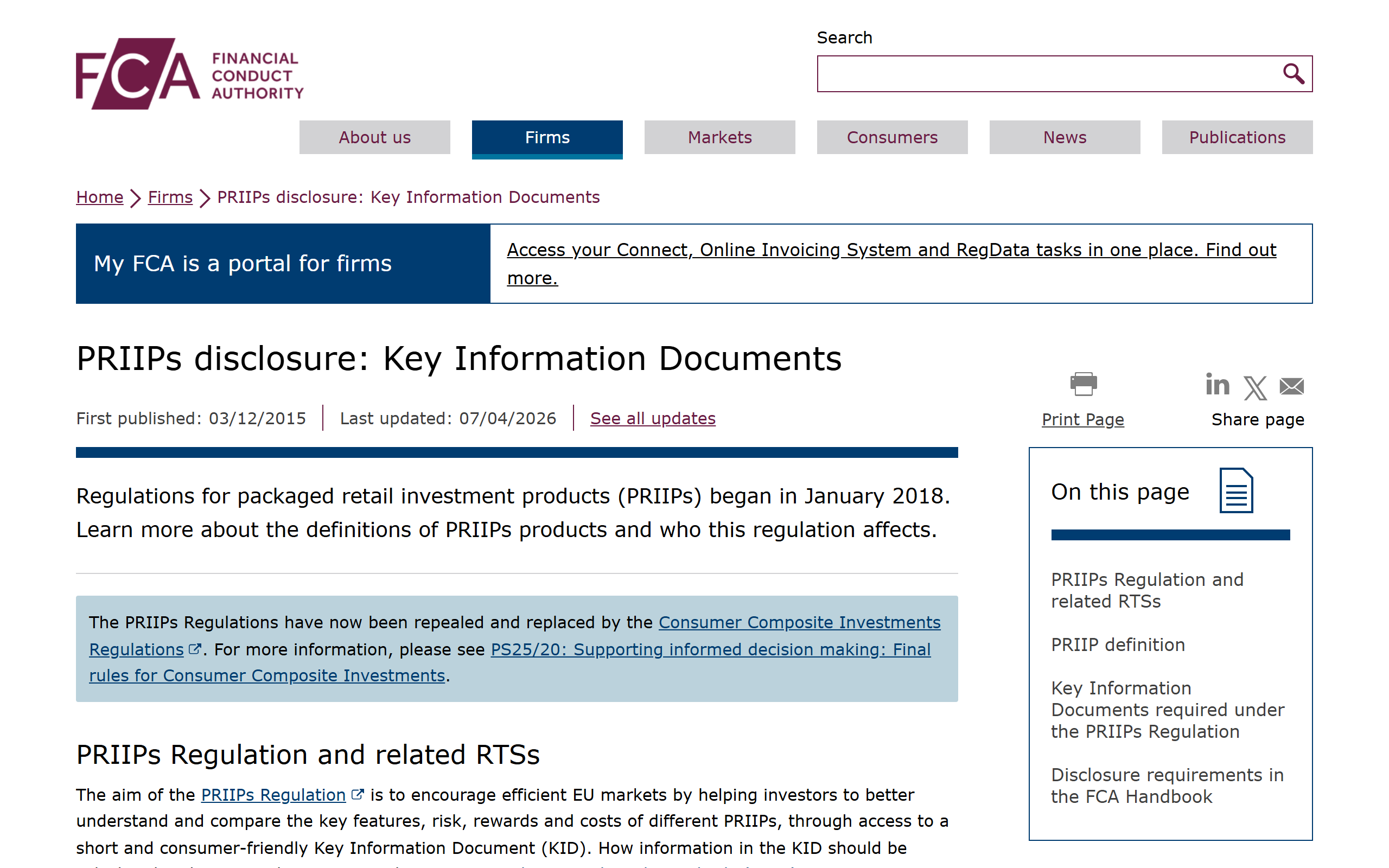
The result: the FCA prohibits UK retail brokers from selling US-listed ETFs to retail clients. Professional clients can sometimes access them, but the overwhelming majority of UK individual investors use the UCITS-listed equivalent. CSPX instead of VOO. EQQQ instead of QQQ. VWRP instead of VT. The exposure is essentially identical, the costs are competitive, and the regulatory protections are arguably stronger. If you are still building your first portfolio, our guide to investing in index funds in the UK walks through which UCITS trackers to consider.
UCITS in the UK after Brexit
When the UK left the EU, one of the open questions was whether it would maintain the UCITS framework or design something new. The answer, in practice, has been "keep it." The UK adopted UCITS into its onshored body of law and continues to recognise EU UCITS funds for sale to UK retail investors under temporary permissions and equivalence arrangements.
The FCA's broader project, called the Overseas Funds Regime (OFR), is replacing the temporary post-Brexit arrangements with a permanent equivalence regime. From a practical perspective, UK investors continue to see the same UCITS funds available on the same platforms with the same protections.
There is a parallel UK regime called NURS (Non-UCITS Retail Schemes) that allows broader asset classes (like physical property funds) for UK retail investors. NURS is less common but is what funds like the old open-ended UK property funds used. UCITS remains the default for ETFs and tracker funds.
How to spot a UCITS ETF on your platform
Easy in practice:
- The name. Almost every UCITS-compliant fund includes "UCITS" in its full name (e.g., "Vanguard FTSE All-World UCITS ETF").
- The listing. UK retail-accessible ETFs are listed on the London Stock Exchange (or sometimes Xetra and Borsa Italiana), and almost all of these are UCITS.
- The KIID/KID. A UCITS fund will have a Key Investor Information Document available on the provider's website and on your platform. If your platform shows a KID, you are looking at a regulated fund. (See how to read an ETF factsheet for what to look at first.)
- The ISIN. UCITS funds typically have ISINs starting with IE (Ireland) or LU (Luxembourg) for the fund domicile.
If a fund does not have UCITS in the name and its ISIN starts with US, it is a US-listed ETF and you almost certainly cannot buy it through a UK broker.
Frequently Asked Questions
What is a UCITS ETF in simple terms?
A UCITS ETF is an exchange-traded fund built to comply with European fund-protection rules. Those rules limit how concentrated, leveraged, or illiquid the fund can be, require independent custody of assets, and force standardised disclosure. For a UK investor, almost every ETF available on a normal platform is UCITS-compliant.
Why does UCITS matter for UK investors?
Because it is the regulatory backbone that makes ETF investing safe for retail. UCITS prevents your global tracker from secretly being a leveraged punt on three stocks, ensures the fund manager cannot run off with your assets, and forces standardised disclosure so you can actually compare funds. It is the boring infrastructure that makes the boring strategy work.
Are UCITS funds covered by FSCS?
Indirectly. FSCS covers UK-authorised firms that fail. The fund itself, if it is a UCITS based in Ireland or Luxembourg, is regulated by the central bank of that country, not the FCA. But your UK platform (which holds the ETF on your behalf) is FCA-regulated and FSCS-covered up to £85,000. The two layers together provide strong protection.
Is a UCITS ETF safer than a US ETF?
Different, not strictly safer. UCITS imposes more restrictions on diversification, leverage and asset segregation than the US 1940 Act regime. US ETFs have to comply with SEC rules that are arguably stronger in other ways (like full daily portfolio disclosure). The practical takeaway: both regimes are robust, and for UK investors the question is moot anyway, because PRIIPs makes the UCITS version the only real choice.
Why are UCITS ETFs domiciled in Ireland?
Mostly for tax efficiency. Ireland has a US tax treaty that reduces withholding tax on US dividends from 30% to 15%, which adds up to meaningful return drag savings on funds with heavy US exposure. Ireland also has well-developed fund administration infrastructure and English-language operations, making it the default home for European ETFs.
Read Next
- The most popular UCITS ETFs UK investors actually hold - a tour of VWRP, CSPX, SWDA, VHYL and friends.
- How to read an ETF factsheet - what to actually look at on a fund's KID.
- Accumulation vs income ETFs (UK) - the share-class choice that sits inside every UCITS ETF.
- VWRP vs VWRL - same UCITS fund, two share classes, one practical decision.
- FSCS protection in the UK - the platform-level safety net that sits underneath UCITS.
Further Reading:
Smarter Investing - Tim Hale - The clearest UK-focused case for low-cost, globally diversified index investing - the strategy that UCITS ETFs are built to deliver. (Affiliate link - we may earn a small commission at no extra cost to you.)
Prefer to watch?
We turn these money breakdowns into short videos
A few a week, plain-English UK money. If you would sooner watch than read, follow along:
Enjoying the content?
If this site has been useful, a coffee goes a long way.
Browse more articles
Browse all