



What Is Late-Stage Capitalism? Meaning and UK Impact
'Late-stage capitalism' is now a meme. The original economists meant something specific, and the modern version describes a UK most personal finance writers refuse to acknowledge.
Cite this article
Freedom Isn't Free (2026) What Is Late-Stage Capitalism? Meaning and UK Impact. Available at: https://freedomisntfree.co.uk/articles/what-is-late-stage-capitalism (Accessed: 21 September 2026).
Italicise the article title in your bibliography. Accessed date set to today.
TLDR
- Late-stage capitalism is a label used to describe a phase where wealth concentration, corporate power, financialisation and inequality become so extreme that they visibly distort everyday life.
- The term originates in early 20th century Marxist analysis (Werner Sombart, later Ernest Mandel) but is now used widely in mainstream commentary.
- Common features include extreme inequality, financialisation, corporate consolidation, gig work, declining affordability, commodification of everything, political capture, and a gap between productivity and wages.
- Critics call the term vague and meme-like; supporters point to genuine structural problems in housing, asset concentration, and intergenerational mobility. For UK personal finance, it is the backdrop against which FIRE, indexing and asset-building strategies make sense.
UK wealth share by household decile
Source: ONS Wealth and Assets Survey. The bottom half of UK households own one-eleventh of what the top tenth holds.
What Is Late-Stage Capitalism? Meaning and UK Impact
Late-stage capitalism is a label for a phase of capitalism in which wealth concentration, corporate power, financialisation and inequality have become so extreme that they visibly distort everyday life. The term has academic roots in early 20th-century Marxist economics but is now used more loosely in mainstream commentary to describe the modern economy's most striking absurdities, from billionaires alongside food banks to record corporate profits during a cost-of-living crisis.
The phrase gets used in three quite different ways. As a piece of academic Marxist theory, it dates back about a century. As journalistic shorthand, it gets attached to any economic absurdity that goes viral. As an internet meme, it usually means "look at this dystopian thing capitalism has produced." This article unpacks what the phrase originally meant, what it means now, the agreed-on features of late-stage capitalism in 2026, the criticism of the framing, and why any of this matters for the boring practical question of how to manage your money in a UK that increasingly feels structurally tilted.
Contents
- Where the term late-stage capitalism came from
- How late-stage capitalism is used today
- Key features of late-stage capitalism
- Examples and contradictions people invoke
- Critics of the late-stage capitalism framing
- The case for taking late-stage capitalism seriously
- Thinkers worth knowing
- Why late-stage capitalism matters for UK personal finance
- Frequently Asked Questions
Where the term late-stage capitalism came from
The phrase "late capitalism" (Spätkapitalismus in German) was coined by Werner Sombart, a German economist and sociologist, in his 1902 work Der moderne Kapitalismus. Sombart used it to describe what he saw as the highly bureaucratised and rationalised form of capitalism that emerged in late 19th century Europe, contrasted with the earlier merchant or industrial phases.
The term was picked up and developed within Marxist economics, most famously by Ernest Mandel in his 1972 book Late Capitalism. Mandel argued that the post-war boom (1945-1970s) had produced a new phase of capitalism dominated by multinational corporations, technological intensification, permanent arms economy, and a creeping financialisation of accumulated capital. Mandel's framing was influential in left academic circles but stayed reasonably technical.
It was the Frankfurt School thinkers like Theodor Adorno, and later Fredric Jameson in his essay Postmodernism, or, the Cultural Logic of Late Capitalism (1991), who pulled the term out into wider cultural and intellectual use. Jameson in particular linked late capitalism to specific cultural patterns: pastiche, depthlessness, the collapse of historical sense, and the saturation of every aspect of life by market logic.
So the original lineage is: technical Marxist economics → cultural theory → general critical vocabulary.
How late-stage capitalism is used today
The current popular usage is mostly post-2010 and mostly internet-driven. The subreddit r/LateStageCapitalism, founded in 2014, helped seed the meme version: a place to post screenshots of a $40 toothpaste subscription, a story about a worker peeing into a bottle to make a delivery deadline, or an advert that monetises grief. The term became a hashtag for "this is absurd."
Around the same time, mainstream commentators (Annie Lowrey at The Atlantic in 2017 wrote a now-cited piece titled Why the Phrase 'Late Capitalism' Is Suddenly Everywhere) noted the explosion in casual usage. By the early 2020s, "late-stage capitalism" was appearing in the New York Times, Financial Times, and broadsheet UK papers, often without any particular Marxist commitment from the writer. It became a generic descriptor for "things in the modern economy that feel broken."
This semantic drift is real and matters. When someone today says "this is late-stage capitalism," they almost never mean Mandel's specific argument about declining rates of profit and the role of multinational firms. They usually mean something closer to "this feels like a system that is either at its limit or out of control."
Key features of late-stage capitalism
Despite the looseness of the term, there is a fairly consistent set of features that get associated with the late-stage label:
| Feature | What people mean |
|---|---|
| Extreme inequality | Billionaires accumulate massive wealth while many struggle with housing, healthcare or wages |
| Financialisation | More profit comes from owning assets, debt and speculation than from producing goods |
| Corporate consolidation | A handful of large firms dominate markets and crush competitors |
| Declining affordability | Housing, education, childcare, healthcare become increasingly inaccessible |
| Gig and precarious work | Stable employment is replaced with contract or platform work |
| Commodification of everything | Hobbies, relationships, identity and attention are all monetised |
| Consumer absurdity | Surreal or wasteful products and services emerge alongside unmet basic needs |
| Political capture | Wealthy interests strongly shape government policy |
| Productivity-wages gap | Workers become more productive but real wages stagnate |
These are not all unique to "late" capitalism. Inequality, financialisation and corporate concentration have ebbed and flowed throughout capitalist history. What people mean by attaching them to "late stage" is that the combination, intensity and systemic character of these features now looks qualitatively different from earlier periods.
Examples and contradictions people invoke
The term gets traction online because of specific paired observations that feel impossible to defend:
- Empty homes alongside homelessness
- Record corporate profits during cost-of-living crises
- Highly educated workers unable to afford property
- Social media platforms monetising every interaction
- Essential workers struggling on wages while asset owners get richer
- Climate breakdown alongside continued fossil fuel investment
The point of citing these contradictions is rhetorical: each one, on its own, looks like a system functioning badly. Pile them up and the case is that the system itself has structural problems, not just bad implementation.
Critics of the late-stage capitalism framing
Several substantive criticisms are worth taking seriously.
The term is vague. "Late-stage capitalism" implies the system is near its end, but Marx made similar predictions in the 1860s, and capitalism has adapted to every prediction of its demise so far. The "late" in late-stage may be wishful thinking dressed as analysis.
It is selectively applied. People reach for the term when they see things they dislike about modern economies but rarely apply the same lens to conditions that have improved sharply in the same period (life expectancy, child mortality, global poverty rates falling, technology access).
It can blame "capitalism" for things that are actually policy failures. UK housing unaffordability is largely a function of restrictive planning policy, not a generic feature of markets. Healthcare outcomes vary enormously across capitalist countries. Lumping every grievance under "late-stage capitalism" can obscure more useful diagnoses.
It is meme-friendly but predictive of nothing. A framework that cannot make falsifiable predictions about what happens next is, in scientific terms, less useful than people give it credit for.
These criticisms are fair. They do not refute the underlying observations about inequality and financialisation, but they do push back on the temptation to use one phrase to explain everything.
The case for taking late-stage capitalism seriously
The case for taking the late-stage label seriously rests on several arguments.
Wealth concentration data is genuinely extreme. UK wealth inequality, on the standard measures (Gini coefficient for wealth, top 1% share, top 10% share), has reached levels last seen in the early 20th century. According to the ONS Wealth and Assets Survey, the top 10% of UK households own around 57% of total wealth, while the bottom 50% own around 5%. These are not gradual shifts. They are a post-1980 acceleration that has compounded for four decades.
Asset returns and labour returns have decoupled. This is Piketty's famous r > g observation: when the rate of return on capital persistently exceeds the rate of economic growth, the share of wealth held by capital owners grows mechanically. The 2010s and 2020s have been a golden age for capital and a flat one for labour in real terms. The pattern shows up sharply in the productivity-pay gap that has dogged the UK since 2008.
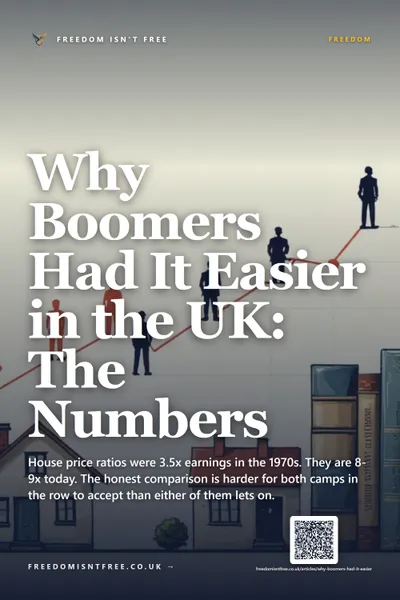
Younger generations face declining mobility. The basic intergenerational deal (work hard, save, buy a home, do better than your parents) has visibly broken in much of the developed world. UK house price-to-earnings ratios that used to sit at 3-4x are now 8-12x in many areas. The signal that this is generational rather than personal is hard to ignore - and is part of why boomers had it materially easier on the path to home ownership and pension accumulation.
Corporate power is empirically more concentrated. Across most sectors in the US, UK and EU, market concentration has increased over the past 30 years. The Big Tech platforms in particular operate with a degree of market power that earlier antitrust regimes would have broken up.
These trends do not require Marxist commitments to take seriously. Mainstream economists like Thomas Piketty, Anne Case and Angus Deaton, Branko Milanović, and Mariana Mazzucato have all made overlapping arguments without using the late-stage frame.
Thinkers worth knowing
A short list of writers whose work informs the late-stage capitalism conversation:
- Karl Marx - the original critic of capitalism's internal contradictions, whose framework underpins much of the later analysis.
- Werner Sombart - coined "late capitalism" in 1902.
- Ernest Mandel - wrote the canonical Late Capitalism (1972), arguing for a third stage of capitalism after the merchant and industrial phases.
- Fredric Jameson - linked late capitalism to postmodern cultural patterns in his influential 1991 essay and book.
- Thomas Piketty - Capital in the Twenty-First Century (2014) put rigorous data behind the inequality story.
- David Harvey - geographer and political economist, whose work on neoliberalism (A Brief History of Neoliberalism, 2005) frames much of the structural critique.
- Mariana Mazzucato - has reframed the role of state versus private in modern economies, particularly in The Entrepreneurial State and The Value of Everything.
- Anne Case and Angus Deaton - Deaths of Despair and the Future of Capitalism (2020) documents the link between economic stagnation and rising mortality among working-age Americans.
These authors disagree on solutions and on framing. Reading them gives you a much richer set of tools than the meme version of the term suggests.
Why late-stage capitalism matters for UK personal finance
If late-stage capitalism is your model of the world, several practical implications follow.
Asset accumulation matters more, not less. If the modern economy disproportionately rewards owning over working, then getting onto the ownership side of the ledger as early as possible is the most important individual move available. This is the case for investing small monthly amounts into global trackers inside an ISA, even when the amounts feel laughable.
Diversification is partly political risk management. Concentrated wealth and political capture mean future tax regimes, property regulation, and inheritance rules are unpredictable. A diversified portfolio across asset classes, geographies and tax wrappers is partly a hedge against your own country making decisions that hurt your financial position.
FIRE and similar movements are partly a response to late-stage features. The decision to accumulate enough capital to step out of selling labour-time forever is, in this framing, an individual response to a system that no longer rewards labour adequately. That does not solve the structural problem (it is by definition not available to everyone), but it explains why the FIRE movement has grown specifically in the past 15-20 years - and why milder variants like PovertyFIRE have spread alongside it.
Scepticism about traditional financial advice is warranted. "Work hard, save in cash, get on the housing ladder" was decent advice in 1985. It is materially worse advice in 2026. Late-stage analysis is one lens (not the only one) that helps explain why.
This is not a counsel of despair. The same forces that make late-stage capitalism feel structurally rigged also make broad-market index investing genuinely accessible to almost everyone for the first time in history.
Frequently Asked Questions
What is late-stage capitalism in simple terms?
A phase of capitalism where wealth concentration, corporate power, financial speculation and inequality have become so extreme that they visibly distort everyday life. People use the term to describe situations where the economic system seems to produce absurd or dystopian outcomes alongside record profits.
Who came up with the term late-stage capitalism?
The phrase originated with German economist Werner Sombart in his 1902 work Der moderne Kapitalismus. It was developed in Marxist theory by Ernest Mandel in the 1970s and pushed into wider cultural usage by Fredric Jameson in the 1990s. The current popular usage is mostly post-2010 and shaped by online discussion.
Is late-stage capitalism a real concept or just a meme?
Both. It has serious roots in Marxist political economy and is associated with substantive academic work on inequality and financialisation. It is also a popular meme used loosely on social media to describe any economic absurdity. Whether you take the term seriously depends on how strictly you want to use it.
How does late-stage capitalism affect personal finance?
If you accept the framing, the practical implication is that wage labour alone is no longer enough to build security in most developed economies, because asset prices grow faster than wages. Building up asset wealth (through index funds, pensions, property where affordable) becomes more important rather than less. The analysis informs why FIRE, index investing and aggressive saving have grown as movements.
What are the main features of late-stage capitalism?
Extreme inequality, financialisation (profits from assets and speculation rather than production), corporate consolidation, declining affordability of essentials, gig and precarious work, commodification of everyday life, political capture by wealthy interests, and a widening gap between worker productivity and real wages.
Are we currently in late-stage capitalism?
There is no formal economic test for it, so the answer depends on which definition you use. By the popular definition (extreme inequality, asset prices outrunning wages, dominant tech monopolies, political capture), most commentators argue the UK and US have shown clear late-stage features since the 2008 financial crisis. By the strict Marxist definition (a final crisis-prone phase before systemic collapse), the answer is unsettled and likely unfalsifiable.
Read Next
- Why FIRE is harder in the UK than the US - the UK arithmetic of stagnant wages and high house prices applied to the FIRE framework.
- Why boomers had it easier - the generational comparison on housing, pensions and income, with the numbers attached.
- What is a K-shaped recovery? - the asset-owner vs wage-earner divergence playing out post-2020.
- Why the UK won't tax wealth - the political capture critique applied to a specific policy stalemate.
- UK productivity stagnation - the productivity-pay gap that sits behind much of the late-stage diagnosis.
Further Reading:
Debt: The First 5,000 Years - David Graeber - Anthropologist David Graeber's sweeping history of debt and money is the closest popular work to a structural critique of where modern capitalism ended up. (Affiliate link - we may earn a small commission at no extra cost to you.)
The Psychology of Money - Morgan Housel - Housel is sober rather than political, but his chapters on luck, inequality and the personal nature of "enough" are useful ballast for any reader chewing on systemic critique. (Affiliate link - we may earn a small commission at no extra cost to you.)
Prefer to watch?
We turn these money breakdowns into short videos
A few a week, plain-English UK money. If you would sooner watch than read, follow along:
Enjoying the content?
If this site has been useful, a coffee goes a long way.
Browse more articles
Browse all