

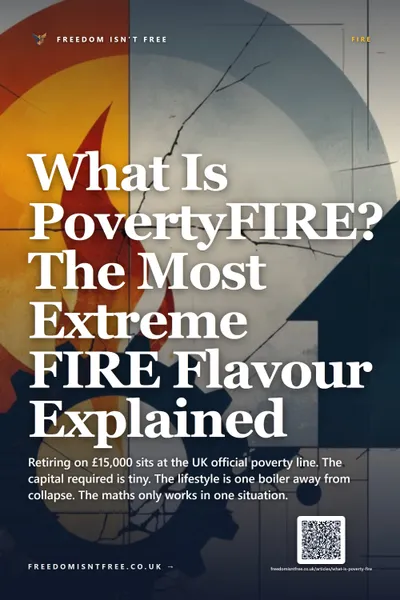



What Is PovertyFIRE? The Most Extreme FIRE Flavour Explained
Retiring on £15,000 sits at the UK official poverty line. The capital required is tiny. The lifestyle is one boiler away from collapse. The maths only works in one situation.
Cite this article
Freedom Isn't Free (2026) What Is PovertyFIRE? The Most Extreme FIRE Flavour Explained. Available at: https://freedomisntfree.co.uk/articles/what-is-poverty-fire (Accessed: 21 September 2026).
Italicise the article title in your bibliography. Accessed date set to today.
TLDR
- PovertyFIRE means retiring on a budget at or below the UK official poverty line, typically £12,000-£18,000 a year for a single adult after housing.
- It is the most extreme flavour of FIRE, sitting one notch below Lean FIRE on the spending scale and treating subsistence as the entire goal.
- The maths only works if your housing is already paid off, or you have permanent low-rent housing, or you live in a country where shelter is genuinely cheap.
- A single boiler replacement, dental bill, or council tax revaluation can blow up the plan, because there is no slack in the budget for unexpected costs.
- For most UK readers, Coast FIRE, Lean FIRE, or Barista FIRE will produce a freer life than PovertyFIRE, because the small extra capital buys disproportionate optionality.
What Is PovertyFIRE? The Most Extreme FIRE Flavour Explained
PovertyFIRE is the lowest-spending flavour of FIRE. It is the strategy of hitting financial independence on a budget that sits at or below the UK official poverty line, then drawing it down for the rest of your life. The capital required is tiny by FIRE standards. The lifestyle, by definition, is not generous. Whether it counts as freedom or as quietly being broke depends almost entirely on what your housing situation looks like the day you pull the trigger.
This article walks through what PovertyFIRE actually means in pounds and pence in 2026, where the maths breaks down, and the situations in which it can genuinely work.
Contents
- What PovertyFIRE Actually Means
- The Numbers (UK, 2026)
- The Maths: Rule of 25 at the Bottom
- Why Housing Decides Everything
- The Hidden Costs That Break PovertyFIRE
- PovertyFIRE vs Lean, Coast, and Barista
- The State Pension Floor
- When PovertyFIRE Genuinely Works
- Author's Take
- Frequently Asked Questions
- Read Next
What PovertyFIRE Actually Means
In FIRE shorthand, the flavours line up roughly like this on annual spend for a single adult in the UK:
| Flavour | Annual spend | Vibe |
|---|---|---|
| PovertyFIRE | £12,000-£18,000 | At or below official poverty thresholds, no slack for surprises. |
| Lean FIRE | £20,000-£28,000 | Frugal but comfortable. Heating on, modest holidays. |
| Standard FIRE | £30,000-£45,000 | Average UK lifestyle, sustainable indefinitely. |
| Fat FIRE | £60,000+ | Lifestyle expansion beyond the median. |
PovertyFIRE is not "the version of FIRE for people who like camping." It is a structural trade: you accept a lower ceiling on consumption in exchange for buying back your time at a much smaller capital total. The freedom buyout is the early exit from work, not the standard of living afterwards.
The label is sometimes used dismissively in the FIRE community, as in "that is not financial independence, that is just being poor and self-employed at managing it." There is a real difference between intentional minimalism and being one boiler away from disaster, and the difference is mostly whether your housing is locked in.
The Numbers (UK, 2026)
The official UK relative poverty threshold is set by the Department for Work and Pensions at 60% of median equivalised household income. For a single working-age adult in the most recent Households Below Average Income (HBAI) statistics, that works out at roughly:
- Before housing costs: about £14,000 a year.
- After housing costs: about £11,500 a year.
The Joseph Rowntree Foundation Minimum Income Standard, which asks the public what budget covers an "acceptable" standard of living, lands at roughly £28,000 a year for a single working-age adult outside London in 2024-25. PovertyFIRE chooses to live inside the gap between that figure and the poverty line.
So when somebody tells you they have FIREd on £15,000 a year in the UK, they are by definition living at or below the official poverty line for a single adult before housing costs. That is a statistical fact about where the threshold sits, not a value judgement.
The Maths: Rule of 25 at the Bottom
The classic FIRE number is annual spend multiplied by 25, derived from the 4% safe withdrawal rate. PovertyFIRE leans hard on this because the lower your spend, the smaller the absolute number you need to save:
| Annual spend | FIRE number (Rule of 25) | Years to save at 50% rate, £35k income |
|---|---|---|
| £12,000 | £300,000 | ~14 years |
| £15,000 | £375,000 | ~16 years |
| £18,000 | £450,000 | ~18 years |
| £25,000 (Lean) | £625,000 | ~22 years |
| £40,000 (Standard) | £1,000,000 | ~30 years |
Years-to-save figures assume a 7% real return and that the saver is investing the difference into low-cost trackers inside an ISA and SIPP. The point is the curve. Dropping target spend from £25,000 to £15,000 cuts the required pot by 40% and the savings runway by about six years. That is the seductive logic of going lower.
The trap is that the 4% rule was derived from US historical data, with no leverage on UK-specific risks like rising council tax bands, energy price shocks, or NHS dental access drying up. Many UK FIRE writers, including Monevator, suggest using 3.3% or 3.5% as a more honest UK figure. At 3.5%, the multiplier becomes 28.6 instead of 25, which pushes the £15,000 PovertyFIRE pot from £375,000 to about £429,000.
For why the UK version is structurally tougher than the US one, see FIRE is harder in the UK.
Why Housing Decides Everything
The post-housing poverty figure of about £11,500 a year for a single adult is a usable, if frugal, budget for someone who has already solved housing. It buys roughly £960 a month for food, utilities, transport, council tax, insurance, household goods, clothing, and any kind of social life. Tight, but possible.
Now layer rent back on. The average UK private rent for a one-bedroom flat outside London in late 2025 sat around £900-£1,000 a month. That is more than the entire post-housing PovertyFIRE budget, before you have eaten anything or heated anything. At market rents, PovertyFIRE is arithmetically impossible.
The flavour therefore only works in one of three housing positions:
- Owned outright. Mortgage finished, only ground rent, service charges, council tax, insurance, and maintenance. The canonical version.
- Permanent low-rent. Council tenancy at a sub-market rent, a long-term family arrangement, or co-housing with shared infrastructure costs.
- Geo-arbitrage out. Living somewhere structurally cheaper, where rent is genuinely £200-£400 a month for an adequate flat. Portugal, parts of Spain, Greece, parts of Eastern Europe, parts of Southeast Asia.
The Hidden Costs That Break PovertyFIRE
A PovertyFIRE budget has no slack by design. In practice, the following items routinely break the plan:
- Boiler replacement: £2,500-£4,500 mid-winter. One to four months of total budget gone in a weekend.
- Roof repair after a storm: £1,000 for minor work, easily £8,000-£15,000 for a full re-tile.
- Council tax band reassessment: A jump from Band C to Band D adds £200-£400 a year, indefinitely.
- NHS dentist disappearing: Private treatment for a single root canal and crown is £1,500-£2,500.
- Car replacement: Even a £5,000 used car is roughly four months of a PovertyFIRE budget, paid in one go.
- Energy price shocks: The 2022-23 cap rise added about £700-£1,200 a year to the average household.
- Long illness or injury that increases unavoidable spending: transport to appointments, special food, equipment, heating a flat 24 hours a day.
Each item on its own is recoverable. The problem is that the budget assumes none of them happen. Standard FIRE absorbs them by under-spending the planned £40,000 in a quiet year. Lean FIRE absorbs them by skipping a holiday. PovertyFIRE has nothing to skip.
PovertyFIRE retirees therefore usually keep a separate cash buffer, sometimes £20,000-£40,000, sitting outside the invested pot. That buffer is real money that came out of the savings phase but does not appear in the headline FIRE number. It is the asterisk on the strategy.
PovertyFIRE vs Lean, Coast, and Barista
Three adjacent flavours deserve a direct comparison, because they are the realistic alternatives most PovertyFIRE candidates should be weighing:
- Lean FIRE (£20k-£28k): One notch up. Adds £5,000-£15,000 a year of slack, enough to absorb the boiler-and-dentist class of shocks. The pot needs to be roughly £500,000-£700,000 instead of £300,000-£450,000.
- Barista FIRE: Retire from career work, keep a small part-time job. In a UK context, Barista FIRE on £20,000-£25,000 of total spend with £8,000-£10,000 from light work is far steadier than pure PovertyFIRE on the same £15,000 with no income at all.
- Coast FIRE: Save aggressively when young, then let compound growth carry you to a normal retirement age while you work a job that just covers current expenses. The Coast FIRE calculator guide walks through the maths.
The FreedomFIRE article reframes the whole spectrum around structural position rather than spend level.
The State Pension Floor
There is one big asterisk that applies to every UK PovertyFIRE plan: the state pension. As of 2025-26, the full new State Pension is around £11,973 a year for someone with 35 qualifying years of National Insurance contributions. State pension age is 67, rising to 68.
That figure is almost identical to the official after-housing poverty threshold for a single adult. So a PovertyFIRE plan, in practice, is a plan to bridge yourself from your retirement-from-work age to your state pension age on portfolio drawdowns alone, then have the state take over a large fraction of your spend.
This is not a small detail. It changes the maths considerably. If you retire at 50 on £15,000 a year and the state pension picks up the full £11,973 at 67, you only need the portfolio to fully fund 17 years of spending alone, then top up the difference for the rest of your life. The pot can therefore be smaller than the naive Rule of 25 suggests, provided you trust that the state pension will still exist in roughly its current form when you reach 67.
Whether you should trust that is a personal judgement. The triple lock and the political untouchability of pensioner benefits suggest the floor is reasonably solid. The slow drift in state pension age suggests the timing is not. A prudent PovertyFIRE plan models the state pension at today's real value with no real-terms growth, and treats anything more generous as a windfall.
When PovertyFIRE Genuinely Works
PovertyFIRE is not a strategy for everyone, but there are narrow profiles where the maths and the lifestyle line up cleanly:
- Single adult with a paid-off small flat in a low-cost UK town. Mortgage discharged in their forties, no children, no plans for them. Stable health. Hobbies that are intrinsically cheap (walking, reading, gardening, volunteering). Small social network in walking distance. Genuinely lower demand for spending than the median.
- Couple living in one paid-off property. Two state pensions arriving at 67, two sets of personal allowances, one shared housing cost. Couples can run PovertyFIRE on roughly 1.4-1.5x the single budget rather than 2x, because shelter, utilities, council tax, broadband, and most subscriptions are shared.
- UK retiree relocating to a structurally cheaper country. Portugal NHR (the old generous version) is largely gone, but the underlying point holds: rent of £400 a month, food of £250 a month, and a different social fabric can make £15,000-£18,000 a year feel comfortable in a way it does not in Surrey.
- Someone using PovertyFIRE as a bridge. They have an inheritance, a property sale, or a defined benefit pension arriving in 5-15 years. The portfolio only needs to bridge the gap, not fund a full lifetime, so a small pot at a tight withdrawal works.
- Someone with non-financial assets that substitute for spending. A smallholding that produces vegetables, a workshop with skills monetised lightly on the side, a long-running creative practice that occasionally pays. These reduce the cash spending floor without the budget showing it.
Outside those profiles, the strategy tends to age badly. The pot does not survive two decades of accumulated shocks without a meaningful slack budget that the PovertyFIRE label disguises.
Frequently Asked Questions
Is PovertyFIRE the same as Lean FIRE?
No. Lean FIRE is the frugal-but-comfortable end of the FIRE spectrum, usually £20,000-£28,000 a year for a single UK adult. PovertyFIRE is one notch below that, at or under the official poverty line, typically £12,000-£18,000. The difference is small in pot terms, but the lived difference is large because Lean FIRE budgets have slack for unexpected costs and PovertyFIRE budgets do not.
What is the PovertyFIRE number for a UK single adult?
At the 4% safe withdrawal rate, a £15,000 annual budget needs a £375,000 portfolio. At the more conservative 3.5% UK-adjusted rate, about £429,000. Most retirees also hold a separate £20,000-£40,000 cash buffer outside the invested pot.
Does the state pension change the maths?
Yes, materially. The full new State Pension at 2025-26 rates is roughly £11,973 a year, almost equal to the after-housing poverty line for a single adult. The portfolio only needs to fully fund the gap years to 67, then top up the difference for life. That assumes the state pension still exists in roughly today's form when you get there.
What is the difference between PovertyFIRE and just being poor?
The difference is structural choice. Someone who is poor because their wages are low and their housing precarious has limited optionality and is exposed to wage cuts, eviction, and benefit changes. Someone on PovertyFIRE has chosen the low spend, owns or controls their housing, has a portfolio cushioning them, and could in principle spend more if they decided to. The lifestyle can look identical from the outside. The structural position is not. The FreedomFIRE article goes deeper into why the structural difference matters more than the cash-flow snapshot.
What should I do instead?
For most readers, Coast FIRE, Lean FIRE, or Barista FIRE produces a sturdier life than PovertyFIRE. The extra capital required is modest, the slack it buys is large, and the exposure to single-shock risk falls dramatically. Run your own numbers in the FI Number calculator and the Life Plan calculator to see what target gets you out a few years later but with a meaningfully sturdier budget for the decades that follow.
Read Next
- What Is FIRE? The Full Spectrum of Financial Independence Flavours - the parent overview of every flavour from PovertyFIRE up to Fat FIRE.
- Your FIRE Number: The Magic Figure You Need to Quit Work - how the Rule of 25 and safe withdrawal rates set your target pot.
- Why FIRE Is Harder in the UK Than the US - the structural reasons UK retirees should use a lower safe withdrawal rate.
- Coast FIRE Calculator Guide - the maths for the more humane sibling of PovertyFIRE.
- FreedomFIRE: A Better Way to Frame Financial Independence - reframing the FIRE spectrum around structural position rather than spend level.
Further Reading
Quit Like a Millionaire - Kristy Shen - The cleanest first-person account of hitting FIRE on a low budget through extreme savings, with the maths on geo-arbitrage and frugal living that PovertyFIRE assumes. (Affiliate link - we may earn a small commission at no extra cost to you.)
Die With Zero - Bill Perkins - The counterweight to PovertyFIRE: a serious case that spending too little for too long is its own form of waste, especially in the decades when health and energy still let you enjoy money. (Affiliate link - we may earn a small commission at no extra cost to you.)
Prefer to watch?
We turn these money breakdowns into short videos
A few a week, plain-English UK money. If you would sooner watch than read, follow along:
Enjoying the content?
If this site has been useful, a coffee goes a long way.
Browse more articles
Browse all