
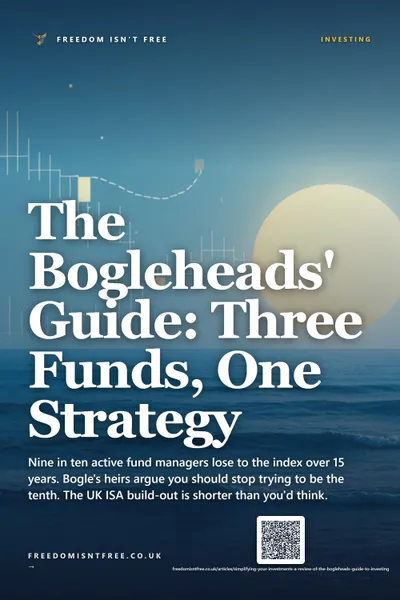

The Bogleheads' Guide: Three Funds, One Strategy
Nine in ten active fund managers lose to the index over 15 years. Bogle's heirs argue you should stop trying to be the tenth. The UK ISA build-out is shorter than you'd think.
Cite this article
Freedom Isn't Free (2026) The Bogleheads' Guide: Three Funds, One Strategy. Available at: https://freedomisntfree.co.uk/articles/simplifying-your-investments-a-review-of-the-bogleheads-guide-to-investing (Accessed: 21 September 2026).
Italicise the article title in your bibliography. Accessed date set to today.
TLDR
- The Bogleheads' Guide to Investing emphasizes simple, low-cost, diversified portfolios using index funds over active management.
- A three-fund portfolio with domestic stocks, international stocks, and bonds is recommended for broad diversification.
- Simplicity in investing leads to lower costs, reduced complexity, and better behavioural outcomes over the long term.
- UK investors can adapt the Boglehead philosophy using ISAs and SIPPs instead of US-centric accounts.
UK Boglehead three-fund example portfolio
| Sleeve | Example fund | Typical OCF |
|---|---|---|
| UK equity | Vanguard FTSE UK All Share Index | 0.06% |
| Global equity | Vanguard FTSE All-World UCITS ETF | 0.22% |
| Bonds | Vanguard UK Government Bond Index | 0.12% |
Three funds, total cost well under 0.25%. Hold for decades. Rebalance once a year.
Bogleheads' Guide to Investing: Book Review
"The Bogleheads' Guide to Investing" by Taylor Larimore, Mel Lindauer, and Michael LeBoeuf is one of the most widely recommended investing books for beginners. Rooted in the principles of John Bogle - founder of Vanguard and pioneer of the index fund - the book argues that a simple, low-cost, diversified portfolio beats the vast majority of professionally managed funds over the long term.
For UK investors, the Boglehead philosophy translates well. The core principles of keeping costs low, diversifying broadly, and staying the course apply regardless of which side of the Atlantic you invest from. The main adaptation required is swapping US-centric accounts for ISAs and SIPPs.
What the Bogleheads' Guide to Investing Covers
The book is structured as a complete investing education, starting from first principles. It covers saving, the power of compound interest, asset allocation, tax efficiency, and the psychology of staying invested during market downturns. Unlike many investing books that focus on stock-picking or market timing, this one makes the case that you do not need to be clever to build wealth - you just need to be consistent and patient.
The central argument is that index funds - funds that passively track a broad market index rather than trying to beat it - deliver better results than active management for most investors. This is not opinion; S&P Global's SPIVA research consistently shows that over 15-year periods, roughly 90% of actively managed funds underperform their benchmark index.
The Three-Fund Portfolio Approach
One of the book's core recommendations is the three-fund portfolio. This strategy involves investing in three broad asset classes: domestic stocks, international stocks, and bonds.
Example UK Three-Fund Portfolio
For UK investors, a practical implementation might look like this:
| Fund | Example | Typical Cost |
|---|---|---|
| UK Equity | Vanguard FTSE UK All Share Index | 0.06% |
| Global Equity | Vanguard FTSE All-World UCITS ETF | 0.22% |
| Bonds | Vanguard UK Government Bond Index | 0.12% |
By allocating your investments across these three funds, you achieve a well-diversified portfolio with minimal effort and total annual costs well under 0.25%.
For a deeper look at how to implement this specific strategy, see our review of The Bogleheads' Guide to the Three-Fund Portfolio, which focuses exclusively on this approach.
Why Simple Portfolios Outperform Complex Ones
The book makes a strong case for simplicity. Complex investment strategies come with higher fees, more trading costs, and greater behavioural risk - the temptation to tinker when markets move.
Lower Costs: Every fund you add to your portfolio carries its own management fee. By limiting your portfolio to three low-cost index funds, you keep total costs minimal. Over a 30-year horizon, the difference between 0.2% and 1.5% annual fees can reduce your final portfolio value by 20-30%.
Reduced Complexity: Managing a large number of funds is time-consuming and error-prone. The Boglehead approach frees you to focus on earning more, saving more, and living your life rather than monitoring your portfolio daily.
Behavioural Benefits: Having fewer funds reduces the temptation to constantly adjust your holdings. This "set it and forget it" approach fits with buy-and-hold investing, which consistently delivers better long-term results than frequent trading. Carl Richards calls the gap between investment returns and investor returns the behaviour gap - and simplicity is one of the best defences against it.
Tax Efficiency for UK Investors: ISAs and SIPPs
Tax efficiency is one of the most important factors for UK investors, and the book dedicates significant attention to it. While the specific US accounts (401k, IRA) do not apply here, the principles translate directly to UK tax wrappers.
ISAs: Tax-Free Growth and Withdrawals
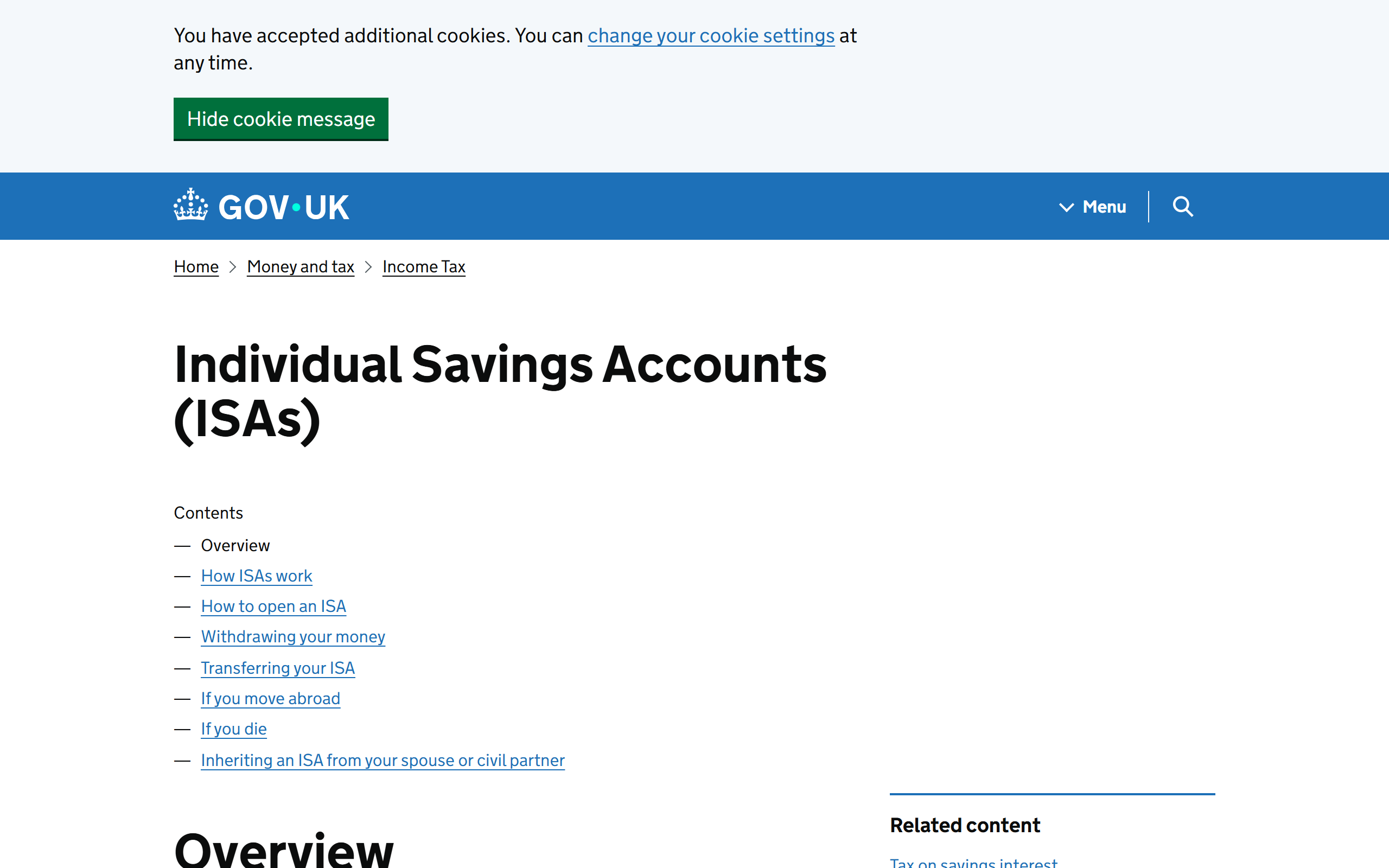
Investments held within an ISA are free from capital gains tax and income tax on dividends. The annual ISA allowance is £20,000, and you can withdraw at any time without penalty. This makes ISAs ideal for both medium-term goals and early retirement savings.
SIPPs: Tax Relief on Contributions
A SIPP provides tax relief on contributions - effectively a 20% or 40% bonus depending on your tax band. Investments within a SIPP grow tax-free, though you cannot access funds until age 57 (rising from 55 in 2028). For retirement savings specifically, the tax relief makes SIPPs hard to beat.
Which Should You Use?
For most UK investors, the answer is both. Maximise your ISA first for flexible, tax-free access, then contribute to a SIPP for the additional tax relief. If you are a higher-rate taxpayer, the SIPP tax relief is particularly valuable and may justify prioritising it.
Asset Allocation: How Much in Stocks vs Bonds?
The book recommends choosing an asset allocation based on your risk tolerance, investment timeline, and financial goals. A younger investor with decades until retirement can afford a higher equity allocation, while someone approaching retirement should hold more bonds to reduce volatility.
A common rule of thumb is to hold your age in bonds (a 30-year-old holds 30% bonds, a 60-year-old holds 60%), though this is just a starting point. The book emphasises that the most important thing is choosing an allocation you can stick with during market downturns. An 80/20 portfolio you hold through a crash beats a 100/0 portfolio you panic-sell at the bottom.
You can model how different allocations grow over time using our compound interest calculator.
How to Apply Boglehead Principles in the UK
Here is a step-by-step approach for UK investors:
- Open an ISA or SIPP: Choose a low-cost platform. Vanguard Investor, InvestEngine, and Trading 212 all offer competitive fees for index fund investors.
- Choose Low-Cost Index Funds: Select funds that track broad market indices with ongoing charges under 0.25%.
- Set Your Asset Allocation: Decide your stock/bond split based on your timeline and risk tolerance. The FI number calculator can help you work out how much you need to invest in total.
- Automate Regular Contributions: Set up monthly standing orders to invest automatically. This takes advantage of pound-cost averaging and removes the temptation to time the market.
- Rebalance Annually: Once a year, check whether your allocation has drifted and rebalance back to your target. This is the only active management the strategy requires.
How This Book Compares to Other Investing Guides
"The Bogleheads' Guide to Investing" is broader than the companion book on the three-fund portfolio, covering the full spectrum from saving basics to estate planning. It is more accessible than Tim Hale's "Smarter Investing," which is the gold standard for UK-specific evidence-based investing but assumes slightly more prior knowledge. And it is more practical than John Bogle's own "The Little Book of Common Sense Investing," which focuses on the philosophical case for indexing rather than step-by-step implementation.
For UK readers, this book works best as a foundation. Read it first for the principles, then supplement with a UK-specific guide for the tax wrapper and platform details. If you are building a reading list, our full UK personal finance and investing book list ranks where this one sits alongside the rest.
Conclusion
"The Bogleheads' Guide to Investing" offers a clear, evidence-based approach to building wealth that UK investors can adopt with minimal modification. By keeping costs low, diversifying broadly through index funds, and using tax-efficient accounts like ISAs and SIPPs, you give yourself the best chance of long-term investment success. The book's greatest insight is that you do not need to be an expert to invest well - you just need to be disciplined, patient, and willing to keep things simple.
Purchase "The Bogleheads' Guide to Investing" here.
Frequently Asked Questions
What is the Bogleheads' Guide to Investing about?
The book is a comprehensive introduction to passive, index-based investing. It covers saving, compound interest, asset allocation, tax efficiency, and the behavioural discipline needed to stay invested through market ups and downs. The core message is that low-cost index funds, held consistently over decades, outperform the vast majority of active strategies.
Is the Bogleheads' Guide relevant for UK investors?
Yes. The investing principles are universal - low costs, broad diversification, and long-term patience apply regardless of country. UK investors need to substitute US-specific accounts (401k, IRA) with ISAs and SIPPs, and choose UK-domiciled or UCITS-compliant funds, but the strategy itself translates directly.
What is a Boglehead?
A Boglehead is someone who follows the investing philosophy of John Bogle, founder of Vanguard. The core tenets are: invest in low-cost index funds, diversify broadly, minimise taxes and fees, and stay the course through market volatility. The Bogleheads community originated on an online forum and has grown into one of the largest investing communities in the world.
How does the Bogleheads' Guide differ from the Three-Fund Portfolio book?
The Guide to Investing is a broader book covering everything from saving and budgeting to estate planning. The Three-Fund Portfolio book focuses specifically on implementing a simple three-fund strategy. Think of the Guide as the full curriculum and the Three-Fund Portfolio as the practical lab exercise.
What are the best index funds for UK Bogleheads?
Popular choices include Vanguard FTSE All-World UCITS ETF (global equity), Vanguard FTSE UK All Share Index (UK equity), and Vanguard UK Government Bond Index (bonds). HSBC and Fidelity also offer competitive global tracker funds. The key criteria are low ongoing charges (under 0.25%), broad diversification, and availability on your chosen platform.
Further Reading:
The Little Book of Common Sense Investing - John Bogle - John Bogle's own case for index investing, making the philosophical and mathematical argument that underpins the entire Bogleheads approach. (Affiliate link - we may earn a small commission at no extra cost to you.)
Smarter Investing - Tim Hale - The best UK-specific guide to evidence-based investing, covering fund selection, asset allocation, and tax wrappers with a focus on British investors. (Affiliate link - we may earn a small commission at no extra cost to you.)
Read Next
Prefer to watch?
We turn these money breakdowns into short videos
A few a week, plain-English UK money. If you would sooner watch than read, follow along:
Enjoying the content?
If this site has been useful, a coffee goes a long way.
Browse more articles
Browse all