



The Art of Thinking Clearly: Finance Lessons
Losing £1,000 hurts roughly twice as much as winning £1,000 feels good. That single quirk of your brain costs UK investors more than fees, tax, and bad timing combined.
Cite this article
Freedom Isn't Free (2026) The Art of Thinking Clearly: Finance Lessons. Available at: https://freedomisntfree.co.uk/articles/avoiding-financial-pitfalls-key-lessons-from-the-art-of-thinking-clearly (Accessed: 21 September 2026).
Italicise the article title in your bibliography. Accessed date set to today.
TLDR
- Loss aversion causes investors to hold onto losing stocks longer and sell winning investments too soon.
- Social proof leads investors to follow the crowd, which can result in poor investment decisions.
- Confirmation bias makes investors focus on information that supports their beliefs while ignoring contradictory evidence.
Five cognitive biases that wreck portfolios
| Bias | What it does | Counter-move |
|---|---|---|
| Loss aversion | Hold losers, sell winners early | Pre-written rebalancing rules |
| Social proof | Pile into popular trades | Written investment plan |
| Confirmation bias | Ignore contradicting evidence | Argue the opposite case |
| Sunk cost | Throw good money after bad | Ask: would I buy this today? |
| Overconfidence | Overtrade, mistime market | Buy a global tracker, leave it |
Dobelli catalogues 99 biases. These five do most of the damage to investors.
The Art of Thinking Clearly: Finance Lessons
Rolf Dobelli's "The Art of Thinking Clearly" catalogues 99 cognitive biases and logical errors that warp everyday decision-making. The book is not specifically about finance, but many of the biases it covers hit investors hardest. Loss aversion, social proof, confirmation bias, sunk cost thinking, and overconfidence all show up in how people save, invest, and spend.
This review picks out the biases most relevant to UK investors and explains how to spot them in your own financial behaviour.
Loss Aversion: Why Losses Hurt More Than Gains Feel Good
Loss aversion is one of the most well-documented findings in behavioural economics. Research by Daniel Kahneman and Amos Tversky showed that the pain of losing a given amount is roughly twice as intense as the pleasure of gaining the same amount. For a deeper look at how loss aversion plays out during real market crashes, see our article on the psychology of market crashes. For investors, this creates two common mistakes:
- Holding losers too long. You refuse to sell a falling stock because selling makes the loss "real." Meanwhile, the money sits in a declining asset instead of being redeployed.
- Selling winners too early. You bank a small profit quickly to lock in the good feeling, even when the investment's fundamentals suggest further upside.
How UK Investors Can Counter Loss Aversion
Inside an ISA or SIPP, there is no capital gains tax to consider, which removes one common excuse for holding losers. If a position no longer fits your thesis, selling costs you nothing in tax. Use that freedom.
A practical tactic is to set rebalancing rules in advance. For example, if any single holding drifts more than 5% from its target allocation, rebalance back. This takes the emotional sting out of selling, because you are following a pre-written rule rather than making a judgment call in the moment.
Writing an investment thesis for each holding before you buy also helps. When the thesis breaks, you have a clear, documented reason to sell rather than relying on gut feeling.
Social Proof: The Danger of Following the Crowd
Social proof is the tendency to copy what others are doing, especially under uncertainty. In investing, this shows up as herd behaviour - piling into whatever stock or asset class is making headlines.
The UK property market is a textbook example. "Property always goes up" became a cultural belief reinforced by decades of rising prices, media coverage, and dinner-party conversations. Investors who bought buy-to-let properties at peak prices in 2007 or overextended themselves to afford London flats learned that social consensus is not the same as sound analysis.
How to Build Independent Thinking
The antidote to social proof is a written investment plan that you commit to before market euphoria (or panic) sets in. If your plan says you will hold 60% equities and 40% bonds, a neighbour boasting about crypto gains should not change that allocation.
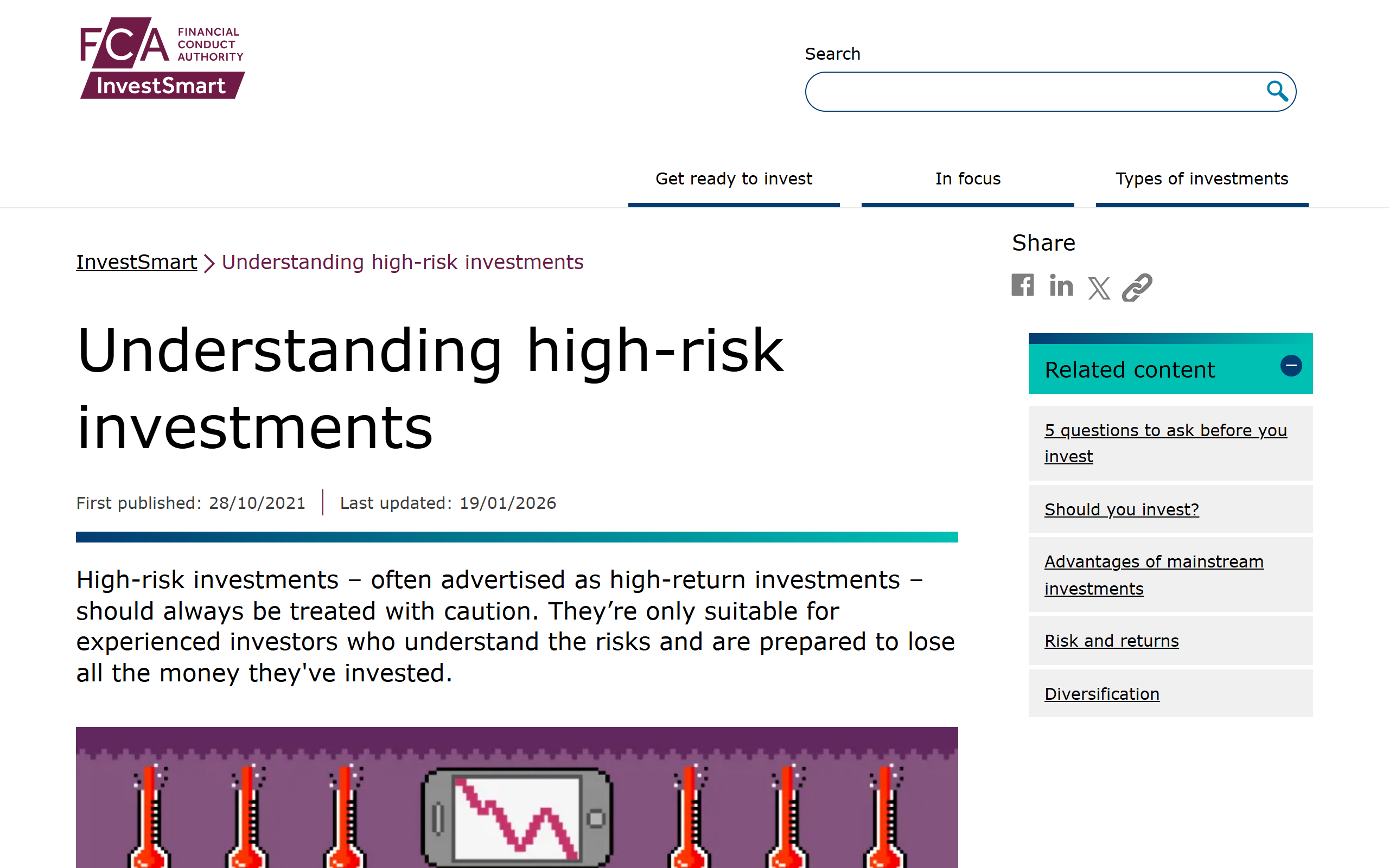
The FCA's InvestSmart guidance on high-risk investments is a useful reference point. It stresses the importance of assessing your own risk tolerance rather than copying what others are doing.
It also helps to diversify your information sources. If every article you read and every podcast you listen to agrees on a particular trade, that is a warning sign, not a confirmation.
Confirmation Bias: Seeing Only What You Want to See
Confirmation bias is the habit of seeking out information that supports what you already believe and dismissing anything that contradicts it. If you are bullish on a stock, you will unconsciously give more weight to positive news and skim past warning signs.
This bias is especially dangerous during market bubbles. UK investors caught up in the dot-com boom of 1999-2000 had no shortage of bullish commentary to reinforce their positions. The bearish voices were there too - they were just easy to ignore.
Practical Ways to Fight Confirmation Bias
One effective technique is to deliberately argue the opposite case before making any investment decision. If you want to buy a stock, spend 15 minutes writing down every reason it could fail. If you still want to buy after that exercise, your conviction is at least partially tested.
Reading broadly helps too. If you follow only growth-focused investors, you will develop growth-biased thinking. Balance your reading with perspectives on value investing, income strategies, and macro analysis.
The Sunk Cost Fallacy: Throwing Good Money After Bad
The sunk cost fallacy is the tendency to continue investing in something because of what you have already spent, rather than what you expect to gain going forward. Dobelli gives everyday examples - sitting through a terrible film because you paid for the ticket - but the financial version is far more costly.
An investor who has put £10,000 into a fund that has consistently underperformed its benchmark for five years might keep holding because "I've already lost so much, I need to wait for it to come back." The £10,000 already spent is irrelevant to the forward-looking decision. The only question that matters is: would you buy this fund today with fresh money?
Overconfidence: The Most Expensive Bias
Overconfidence leads investors to overestimate their ability to pick stocks, time the market, or predict economic outcomes. Research by Barber and Odean at UC Berkeley found that the more actively people trade, the worse their returns tend to be - partly because of transaction costs, but mostly because of poor timing driven by misplaced confidence.
For most UK investors, the evidence points towards a simple, low-cost approach. A global index fund held inside an ISA and left alone will outperform the majority of actively managed funds over any 20-year period. Use our compound interest calculator to see how a simple index fund grows over 20 years. The case for low-cost index funds is one of the strongest in all of personal finance.
How to Apply These Lessons to Your Finances
These biases do not only affect stock-picking. They shape everyday money decisions too.
- Loss aversion can make you too cautious with savings, leaving money in a current account earning nothing when it could be growing in a Stocks and Shares ISA.
- Social proof drives lifestyle inflation - upgrading your car or house because your peers have, not because you need to.
- Confirmation bias keeps people loyal to expensive financial products (actively managed funds, whole-of-life insurance) because they only read material from the provider selling them.
- Sunk costs keep people paying for gym memberships, subscriptions, and insurance policies they no longer use.
Building a Sound Financial Strategy
A strategy that accounts for cognitive biases looks like this:
- Automate wherever possible. Standing orders to your ISA and pension remove daily decision-making from the equation.
- Write your rules down. A written investment policy statement prevents you from overriding your plan during emotional moments.
- Diversify across asset classes. Spreading risk reduces the chance that any single bias-driven mistake wipes out your portfolio.
- Review on a schedule, not on impulse. Checking your portfolio daily invites emotional reactions. Quarterly reviews are frequent enough.
- Seek out disagreement. Before any major financial decision, find someone who holds the opposite view and listen to their reasoning.
Frequently Asked Questions
What are the most common cognitive biases that affect investors?
The biases that cause the most financial damage are loss aversion (holding losers too long), confirmation bias (ignoring evidence that contradicts your view), social proof (following the herd), overconfidence (trading too frequently), and the sunk cost fallacy (refusing to cut losses on past investments). Dobelli covers all of these in The Art of Thinking Clearly.
How can I reduce the impact of cognitive biases on my investments?
The most effective approach is to automate your investing and follow written rules. Set up regular contributions to a diversified portfolio inside an ISA or SIPP, rebalance on a fixed schedule, and avoid checking your portfolio daily. Writing an investment thesis for each holding gives you an objective benchmark for when to sell.
Is The Art of Thinking Clearly a good book for investors?
It is not an investing book, but it is one of the most useful books an investor can read. Understanding the mental shortcuts that lead to poor decisions is arguably more useful than learning another valuation technique. Pair it with a book specifically about investing psychology for the fullest picture.
Does behavioural finance suggest you should avoid active investing?
The SPIVA scorecard consistently shows that most individual investors underperform passive benchmarks, largely because of bias-driven mistakes like panic selling, overtrading, and chasing recent performance. This does not mean active investing is impossible to do well, but it does mean that a passive, index-based approach removes many of the psychological traps that trip people up.
How does loss aversion affect UK ISA and pension investors?
Inside an ISA or SIPP, there is no capital gains tax on sales, which means the tax argument for holding a losing position does not apply. Despite this, many investors still hold underperforming funds because the emotional pain of crystallising a loss outweighs the rational case for switching. Recognising this pattern is the first step to breaking it.
Further Reading:
The Psychology of Money - Morgan Housel - Housel explores how emotions and personal history shape financial decisions, making it an ideal companion to Dobelli's work on cognitive biases. (Affiliate link - we may earn a small commission at no extra cost to you.)
The Behavior Gap - Carl Richards - Richards focuses specifically on the gap between smart financial decisions and what investors actually do, with simple illustrations that bring behavioural finance to life. (Affiliate link - we may earn a small commission at no extra cost to you.)
Read Next:
Prefer to watch?
We turn these money breakdowns into short videos
A few a week, plain-English UK money. If you would sooner watch than read, follow along:
Enjoying the content?
If this site has been useful, a coffee goes a long way.
Browse more articles
Browse all