

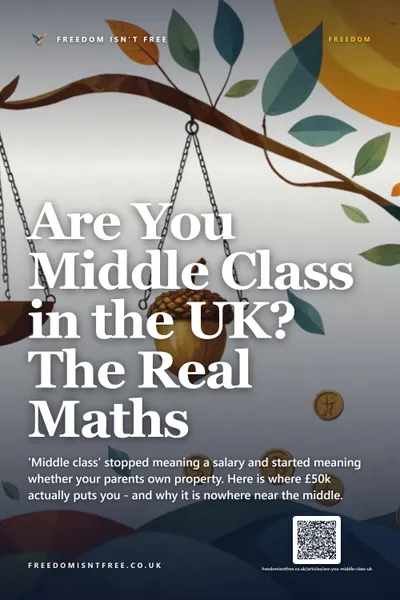


Are You Middle Class in the UK? The Real Maths
'Middle class' stopped meaning a salary and started meaning whether your parents own property. Here is where £50k actually puts you - and why it is nowhere near the middle.
Cite this article
Freedom Isn't Free (2026) Are You Middle Class in the UK? The Real Maths. Available at: https://freedomisntfree.co.uk/articles/are-you-middle-class-uk (Accessed: 21 September 2026).
Italicise the article title in your bibliography. Accessed date set to today.
TLDR
- The median UK full-time salary is £39,039 (ONS), and the median across all taxpayers is around £29,700 (HMRC) - far below where most self-described middle-class people sit.
- A £50,000 salary feels middle but is roughly the top 20% of earners; £67,400 is the top 10%. Most people who call themselves middle class are statistically near the top.
- Class in 2026 is decided more by assets, property and inheritance than by job title or salary. The Bank of Mum and Dad now shapes class more than a payslip does.
- Feeling squeezed on a good salary is real, but it is driven by housing and childcare costs eating the surplus, not by being genuinely middle of the pack.
| £29,700 | Median individual taxpayer (HMRC SPI) |
| £39,039 | Median full-time salary (ONS ASHE) |
| £50,000 | Roughly the top 20% of earners |
| £67,400 | Top 10% of earners |
Where UK salaries actually sit (HMRC and ONS, latest data)
Are You Middle Class in the UK? The Real Maths
Ask whether you are middle class in the UK and you will get two completely different answers depending on who you ask. The cultural answer is about accent, occupation, what newspaper you read and whether you say "lunch" or "dinner" for the midday meal. The numerical answer is far less flattering and far more useful: most people who confidently call themselves middle class are either much higher up the distribution than they realise, or quietly being squeezed out of it from below.
The British conversation about class loves everything except the money. So let us do the money. It turns out the "middle" is a long way from where most middle-class people think it is.
Contents
- What salary is actually middle class in the UK?
- Why the label drifted from the money
- Class is now about what you own, not what you earn
- So, are you middle class?
What salary is actually middle class in the UK?
Start with the genuine middle. The median full-time UK salary is £39,039 (ONS Annual Survey of Hours and Earnings). Across all taxpayers, including part-timers and pensioners, the median individual income is closer to £29,700 (HMRC). That is the mathematical middle of the country. Half of full-time workers earn less than £39,039. Half.
Now hold that against the salary most people picture when they say "comfortable middle class". A household where one earner is on £55,000 and the other on £35,000 feels solidly, unremarkably middle. It is nothing of the sort by the numbers. A £50,000 individual salary is roughly the top 20% of all earners. The top 10% threshold is £67,400. A worker on £70,000 who thinks of themselves as a striving member of the middle is closer to the top 1% than they are to the genuine median earner doing the same job for less.
| Income | Where it lands |
|---|---|
| £29,700 | Median individual taxpayer (HMRC) |
| £39,039 | Median full-time salary (ONS) |
| £50,000 | Roughly the top 20% of earners |
| £67,400 | Top 10% of earners |
So "is £50k middle class?" By culture, maybe. By arithmetic, it is an upper-middle income that most of the country does not earn. The label and the data have come unstuck from each other.
Why the label drifted from the money
Part of this is the BBC's fault, in a good way. The 2013 Great British Class Survey blew up the old three-class model (working, middle, upper) and replaced it with seven classes built from economic, social and cultural capital combined: from the "precariat" at the bottom through an "established middle class" and "technical middle class" up to a tiny "elite". The point of that work was that class in modern Britain runs on more than income: your networks, your cultural tastes and, above all, your assets.
That richer model is genuinely truer to life than "what do you earn". But it has a side effect: it lets people pick the bits of "middle class" that flatter them (the degree, the tastes, the holidays) and ignore the bit that does not (where their income actually ranks). You can feel middle class on a top-20% salary because the cultural markers say middle while the pay packet says top. Both can be true at once, and the gap between them is where most of the confusion lives.
Class is now about what you own, not what you earn
Here is the uncomfortable maths the cultural conversation tiptoes around. In 2026, the line that most reliably separates the classes is assets, not salary. Median household wealth in Great Britain is £293,700, the top 10% of households hold £1.2 million or more, and most of that gap is property and pensions, not pay.
Two people on identical £45,000 salaries can live in different class realities. One bought a flat in 2012, has £200,000 of equity and parents who can chip in for a house move. The other rents, has £2,000 in savings and no family safety net. Same income, different worlds. The deciding factor is the Bank of Mum and Dad - whether your family owns assets it can pass down. Inherited property and parental deposits increasingly determine who joins the propertied middle and who is locked out, regardless of what either person earns.
This is why class mobility has stalled. When a salary alone cannot buy the markers of middle-class life - a home, a comfortable pension, the option to help your own kids - those markers get rationed by inheritance instead. The reader on a good salary who still feels they are treading water is not imagining it. They are earning like the upper-middle while spending like the squeezed-middle, because housing and childcare swallow the surplus that used to define being comfortable. Why earlier generations had it easier is not nostalgia. It is the same point in historical form.
So, are you middle class?
By the numbers, three rough tiers describe most people better than the word "middle" does. If your household income is near £30,000 to £40,000, you are at the genuine centre of the country, whatever the culture tells you. If you are on £50,000 to £80,000, you are upper-middle by income and probably feel poorer than that, because your costs scale with your postcode. And if your wealth runs past £1.2 million, mostly through property and pensions, you are in the top 10% of households even on an ordinary wage.
The honest version of the question is not "am I middle class" but "where do I actually sit, by income and by assets, and are those two answers the same". For most people they are not, and noticing the gap tells you more about your real position than any class label ever will.
What They Don't Teach You About Money - Claer Barrett - The FT's Claer Barrett on the money realities behind the British class script, written for exactly the reader who suspects the label and the bank balance have come apart. (Affiliate link - we may earn a small commission at no extra cost to you.)
Frequently Asked Questions
What salary is classed as middle class in the UK?
There is no official definition, but the genuine middle of the income distribution is a full-time salary around £39,039 (ONS) or roughly £29,700 across all taxpayers (HMRC). Salaries of £50,000 and above are statistically upper-middle to top-10% territory, even though they often feel ordinary because of high housing costs.
What are the 7 social classes in the UK?
The BBC's 2013 Great British Class Survey identified seven: the elite, established middle class, technical middle class, new affluent workers, traditional working class, emergent service workers, and the precariat. The model measures economic, social and cultural capital together rather than income alone.
Is £50k a year middle class in the UK?
Culturally, often yes. Numerically, a £50,000 individual salary is roughly the top 20% of UK earners, which is upper-middle rather than mid-pack. It can still feel middling because housing, childcare and the cost of living absorb much of the difference, especially in and around London.
What is a top 10% salary in the UK?
The top 10% of UK earners by individual income starts at around £67,400 (HMRC). The top 1% begins near £207,000. Both thresholds are lower than most people guess, because the very high incomes that dominate the headlines are statistical outliers.
Am I wealthy for my age in the UK?
Wealth is better measured by net worth than salary. Median household wealth is £293,700, and the top 10% of households hold £1.2 million or more, mostly in property and pensions. If your net worth is well above the median for your age group, you are wealthier than most - but much of typical UK wealth is locked in housing and pensions you cannot spend yet.
Sources
Prefer to watch?
We turn these money breakdowns into short videos
A few a week, plain-English UK money. If you would sooner watch than read, follow along:
Enjoying the content?
If this site has been useful, a coffee goes a long way.
Browse more articles
Browse all