






Financial Literacy Quiz: Test Your Money Knowledge
You probably overrate your money knowledge. Most UK adults do. Three basic questions on inflation, interest and risk decide if your confidence is real or just noise.
Cite this article
Freedom Isn't Free (2026) Financial Literacy Quiz: Test Your Money Knowledge. Available at: https://freedomisntfree.co.uk/articles/financial-literacy-quiz-guide (Accessed: 21 September 2026).
Italicise the article title in your bibliography. Accessed date set to today.
TLDR
- 44% of UK adults - about 23.3 million people - fail the three classic financial literacy questions on interest, inflation, and diversification (Aberdeen Savings Ladder Index).
- The free financial literacy quiz covers five areas: pensions, ISAs, tax, budgeting, and investing, and adapts its difficulty to your answers.
- The results give you a level from Beginner to Expert plus a topic-by-topic breakdown, so you know exactly which gap to close first.
- You can retake the quiz after studying your weak areas - the trajectory matters more than the starting score.
What the financial literacy quiz covers
| Topic | Sample area | Why it matters |
|---|---|---|
| Pensions | Annual allowance, salary sacrifice | Tax-efficient but poorly understood |
| ISAs | Allowance, transfers, LISA rules | Simple wrapper, fiddly rules |
| Tax | Bands, NI, CGT, dividends | Direct hit to take-home pay |
| Budgeting | 50/30/20, emergency funds | Foundation of every plan |
| Investing | Index funds, compounding, fees | Where most wealth is built |
Five topics, adaptive scoring, level from Beginner to Expert.
Financial Literacy Quiz: Test Your Money Knowledge
Most people in the UK leave school without ever being taught how a pension works, what an ISA actually is, or how income tax bands affect their take-home pay. These are the mechanics of everyday life, and not understanding them costs real money.
The problem is that financial literacy is hard to measure. You might feel confident about your knowledge, but confidence and competence are not the same thing. Aberdeen's Savings Ladder Index put the standard three-question literacy test to UK adults: 20% could not answer a single question correctly and another 24% managed only one. That is 44% of the country - roughly 23.3 million adults - classed as having poor financial literacy. The gap between what people think they know and what they actually know is where the costly mistakes happen.
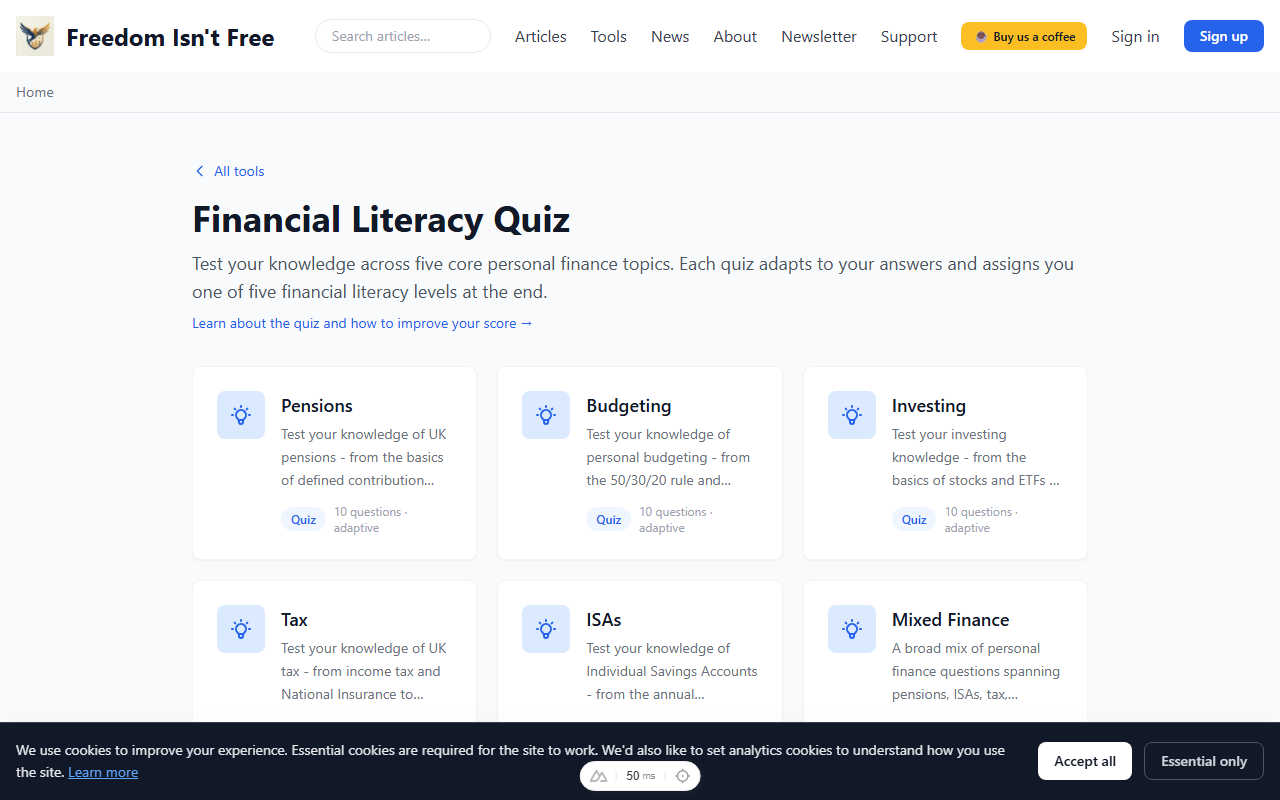
That is why we built the financial literacy quiz. It is a free, adaptive test that measures your knowledge across five core areas of personal finance and assigns you a level from Beginner to Expert. No sign-up required. Just honest feedback on where you stand and where you can improve.
Contents
- The Three Questions Most UK Adults Get Wrong
- What the Quiz Covers
- How the Adaptive Scoring Works
- What Each Level Means
- How to Improve Your Score
- Putting It All Together
- Frequently Asked Questions
The Three Questions Most UK Adults Get Wrong
The "Big Three" questions, developed by economists Annamaria Lusardi and Olivia Mitchell, are the global standard for measuring financial literacy. They look almost insultingly easy. Try them before reading on:
- Compound interest. You have £100 in a savings account paying 2% interest a year. After five years, do you have more than £102, exactly £102, or less than £102?
- Inflation. Your savings account pays 1% a year and inflation is 2% a year. After one year, can the money in the account buy more than today, the same, or less?
- Diversification. True or false: buying a single company's shares usually provides a safer return than a fund holding many companies' shares.
The answers are "more than £102" (the interest earns interest), "less" (prices grew faster than your savings), and "false" (one company is one point of failure; a fund spreads the risk). Simple. And yet 44% of UK adults, per Aberdeen's research, get at least two of the three wrong.
These three ideas are not trivia. Compounding is why starting a pension at 25 beats starting at 40. Inflation is why cash under the mattress quietly shrinks. Diversification is why a global index fund beats a hunch about one company. The FCA's Financial Lives 2024 survey found 13.1 million UK adults (24%) had low financial resilience in May 2024 - and low literacy and low resilience travel together.
Our quiz goes well beyond the Big Three, but they set the baseline. If any of the three answers surprised you, take the quiz. You will learn more from twenty minutes of finding your gaps than from another year of feeling vaguely fine about money.
What the Quiz Covers
The quiz draws from five topic areas, each chosen because they represent the building blocks of sound financial decision-making in the UK.
Pensions
Questions cover workplace pensions, personal pensions, the annual allowance, the abolition of the lifetime allowance, salary sacrifice, and the state pension. Pensions are one of the most tax-efficient savings vehicles available, yet many people have only a vague understanding of how their own pension works, let alone how to optimise contributions.
ISAs
The Individual Savings Account is one of the simplest and most powerful tools for UK investors, but the rules around contribution limits, transfer rules, and the differences between Cash ISAs, Stocks and Shares ISAs, and Lifetime ISAs trip people up regularly. The quiz tests whether you understand not just what an ISA is, but how to use one effectively.
Tax
Income tax bands, National Insurance, capital gains tax, dividend allowances - the UK tax system is not simple, and it changes frequently. The quiz covers the practical tax knowledge that affects how much of your money you actually keep. If you have ever wondered whether you are overpaying or missing legitimate ways to reduce your tax bill, this section will tell you where you stand.
Budgeting
Budgeting is the foundation of every financial plan. Questions in this area cover spending frameworks like the 50/30/20 rule, emergency funds, debt management, and the behavioural side of money. If you are new to budgeting, our budgeting 101 guide is a good place to start before or after taking the quiz.
Investing
This section covers the basics of stocks, bonds, ETFs, diversification, compound interest, and risk. It also touches on UK-specific investment topics like the difference between accumulating and distributing funds, platform fees, and how to evaluate an investment product. For those looking to go deeper, our guide on how to read an ETF factsheet pairs well with this section.
How the Adaptive Scoring Works
The quiz adjusts the difficulty of its questions based on how you are performing, rather than serving everyone the same fixed set.
Here is how it works in practice:
- You start with a set of mid-level questions across all five topics.
- If you answer correctly, the next question in that topic area becomes harder.
- If you answer incorrectly, the next question becomes easier.
- Your final score reflects not just how many questions you got right, but the difficulty level you were able to handle consistently.
This approach gives a more accurate picture of your knowledge than a simple percentage score. Getting 8 out of 10 easy questions right is not the same as getting 6 out of 10 hard questions right. The adaptive model accounts for that difference.
At the end, the quiz assigns you a level and provides a breakdown by topic area so you can see exactly where your strengths and weaknesses lie.
What Each Level Means
Beginner
You are at the start of your financial education. You may not yet have a clear picture of how pensions, tax, or investing work in the UK. That is completely fine. Everyone starts here, and the fact that you are testing yourself already puts you ahead of most people. Focus on building a solid foundation with the basics: budgeting 101 is a strong starting point.
Intermediate
You understand the fundamentals. You probably have a budget, know how an ISA works, and have a rough sense of your tax situation. But there are gaps, likely in areas like pension optimisation, capital gains tax, or investment strategy. This is the most common level, and closing these gaps can have a meaningful financial impact over time.
Advanced
You have a strong grasp of personal finance across most areas. You understand how different accounts, tax wrappers, and investment strategies interact. You are likely already making informed decisions about your money. The areas where you lost marks are worth investigating, as they often represent the more technical topics where small improvements can yield outsized results.
Expert
You have a thorough understanding of UK personal finance. You can handle questions about pension carry-forward rules, CGT calculations, ISA transfer mechanics, and portfolio construction. At this level, the main risk is overconfidence. Keep testing your assumptions, and remember that tax rules and allowances change regularly.
How to Improve Your Score
The quiz gives you a topic-by-topic breakdown, so you will know exactly which areas need work. Here are targeted resources for each.
If You Scored Low on Budgeting
Start with the basics. Our budgeting 101 guide walks through building a budget from scratch, including the 50/30/20 framework and how to automate your savings. The single most impactful thing you can do is track your spending for one full month.
If You Scored Low on Pensions
Pensions are the area where the most money is left on the table. Many people do not even know their employer match percentage, let alone whether salary sacrifice would save them money. Check your workplace pension scheme details and read up on the annual allowance and tax relief rules. The difference between understanding your pension and ignoring it can be worth tens of thousands of pounds over a career.
If You Scored Low on ISAs
Make sure you understand the annual ISA allowance - £20,000 for the 2026/27 tax year - and the rules around transfers. A common mistake is thinking you cannot transfer a Cash ISA into a Stocks and Shares ISA without losing the tax-free status. You can. Understanding these mechanics lets you make better decisions about where your money sits.
If You Scored Low on Tax
Tax is the area most people find driest, but it is also where knowledge directly converts to money saved. Focus on understanding your marginal tax rate, the personal allowance taper, and how dividends and capital gains are taxed differently from income. If you have student loan repayments, our guide on whether to pay off your student loan early covers the interaction between loan repayments and effective tax rates.
If You Scored Low on Investing
Start with compound interest - the first Big Three question above, and the one concept that makes time in the market matter more than timing the market. Our compound interest calculator lets you model different scenarios so you can see the numbers for yourself. From there, learn about diversification, index funds, and how to evaluate costs. Once you are comfortable with the basics, our guide on how to read an ETF factsheet will help you evaluate specific investment products.
Putting It All Together
The quiz is a starting point, not an end point. Knowing your level is useful, but only if you act on it.
If you are working towards financial independence, knowing your weak spots matters. A gap in pension knowledge might mean you are missing out on free employer contributions. A gap in tax knowledge might mean you are paying more than you need to. A gap in investing knowledge might mean your money is sitting in cash, slowly losing value to inflation - the second Big Three question, playing out in your own accounts.
Use the quiz alongside our other tools. The FI number calculator helps you work out how much you need to reach financial independence, the compound interest calculator lets you do the maths on how your current savings rate translates into long-term wealth, and the net worth tracker tells you what the whole picture adds up to today. If you want to know how that picture compares with everyone else's, average net worth by age in the UK is the reality check.
Take the financial literacy quiz now and find out where you really stand.
Frequently Asked Questions
How long does the quiz take?
Most people complete it in 5 to 10 minutes. Because the quiz is adaptive, the number of questions may vary slightly, but it is designed to be quick enough to complete in a single sitting.
Do I need to create an account?
No. The quiz is completely free and requires no sign-up. Your results are shown immediately after you finish.
Can I retake the quiz?
Yes. In fact, retaking the quiz after studying your weak areas is one of the best ways to measure your progress. Your results are not stored, so each attempt is a fresh start.
Are the questions UK-specific?
Yes. The quiz is built for a UK audience. Questions reference ISA allowances, HMRC tax bands, UK pension rules, and other country-specific topics. If you are based outside the UK, some questions may not apply to your situation.
How financially literate are UK adults?
Not very, on the evidence. Aberdeen's Savings Ladder Index found 44% of UK adults - around 23.3 million people - could answer no more than one of the three standard literacy questions on interest, inflation, and diversification. The FCA's Financial Lives 2024 survey separately found 24% of UK adults had low financial resilience.
Further Reading:
I Will Teach You To Be Rich - Ramit Sethi - A practical, no-nonsense system for getting your finances in order, covering budgeting, saving, investing, and spending without guilt. (Affiliate link - we may earn a small commission at no extra cost to you.)
The Psychology of Money - Morgan Housel - Explores the gap between knowing what to do with money and actually doing it, making it an ideal companion after discovering your financial literacy blind spots. (Affiliate link - we may earn a small commission at no extra cost to you.)
Read Next
Sources
Prefer to watch?
We turn these money breakdowns into short videos
A few a week, plain-English UK money. If you would sooner watch than read, follow along:
Enjoying the content?
If this site has been useful, a coffee goes a long way.
Browse more articles
Browse all