


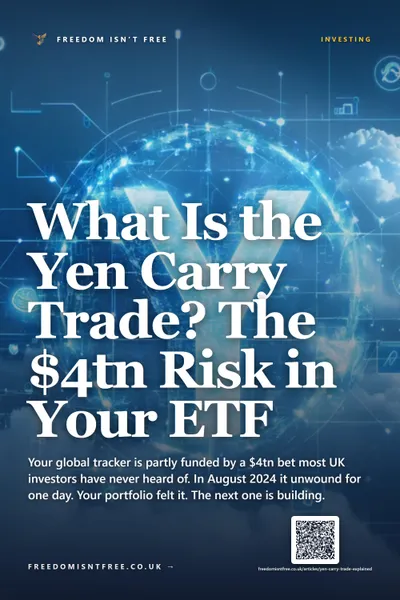


What Is the Yen Carry Trade? The $4tn Risk in Your ETF
Your global tracker is partly funded by a $4tn bet most UK investors have never heard of. In August 2024 it unwound for one day. Your portfolio felt it. The next one is building.
Cite this article
Freedom Isn't Free (2026) What Is the Yen Carry Trade? The $4tn Risk in Your ETF. Available at: https://freedomisntfree.co.uk/articles/yen-carry-trade-explained (Accessed: 21 September 2026).
Italicise the article title in your bibliography. Accessed date set to today.
TLDR
- The yen carry trade is a strategy where investors borrow Japanese yen at near-zero interest rates and use the proceeds to buy higher-yielding assets in other currencies. It has quietly funded a slice of global asset prices for two decades.
- When the trade unwinds, it does so violently. The August 2024 episode saw the Nikkei fall 12% in a single day, the worst drop since 1987, with global equities, the dollar and risk assets dragged down with it.
- You do not need to trade the yen to be affected. If you hold a global index fund, an unwind shows up as a sharp drawdown in your portfolio, usually followed by a recovery within weeks or months.
- The right response for a long-term UK investor is not to time the next unwind. It is to hold a globally diversified portfolio, keep contributions automatic, and ignore the noise when it comes.
5 August 2024: one-day moves as the carry trade unwound
Recovery: Nikkei back near pre-crash levels by mid-September. Passive investors who did nothing came out unscathed.
What an unwind hits in a UK portfolio
| Asset | Direction | Why |
|---|---|---|
| Global equity tracker | Down sharply | Forced selling to raise yen |
| US Treasuries / UK gilts | Yields up, prices down | Carry-trade was a quiet buyer |
| Sterling vs yen | Down 5%+ in 24hrs | Borrowers scramble to buy yen back |
| Long-term fundamentals | Unchanged | Liquidity event, not a solvency event |
Carry-trade gross exposure peaked around $3 to $4 trillion before the August 2024 unwind.
Yen Carry Trade Explained: What It Is and Why It Matters
The yen carry trade is the most important market story most British investors have never heard of. It is the reason your global tracker dropped 8% in a single week in August 2024, the reason currency traders watch the Bank of Japan more closely than they watch the Federal Reserve, and the reason a small interest rate move in Tokyo can send the FTSE down 200 points by lunchtime.
This guide explains what the trade is, how it works, why it unwinds with such violence, and what any of it has to do with a UK investor running a Vanguard ISA. The answer to the last question, briefly, is more than you might think.
Contents
- What is the yen carry trade?
- How big is the trade?
- Why the yen carry trade unwinds violently
- What the August 2024 unwind looked like
- What it means for UK investors
- Will it happen again?
- Frequently Asked Questions
What is the yen carry trade?
The yen carry trade is a borrowing arbitrage. An investor borrows in Japanese yen, where short-term interest rates have been close to zero for most of the past two decades, converts the yen into another currency, and uses the proceeds to buy assets paying a higher yield. The profit is the gap between the two interest rates, often called the carry, less any move in the exchange rate against you.
The mechanics are simpler than they sound. Suppose you can borrow ten million yen overnight at 0.1%. You convert it to roughly £52,000 at the prevailing rate and use it to buy a UK gilt yielding 4.5%. As long as the yen does not strengthen against the pound, you pocket the 4.4% spread for as long as you hold the position. Scale that up with leverage, run it across thousands of accounts, and you have one of the biggest flows in global finance.
The trade can be expressed in dozens of ways. Hedge funds borrow yen to buy Mexican peso bonds. Japanese life insurers hold foreign government debt funded internally. Macro desks short the yen against the dollar as a way of expressing a "risk on" view, because the trade tends to work when markets are calm and break when they are not. Even Japanese retail investors, nicknamed Mrs Watanabe by FX traders, have run versions of it through margin accounts since the 1990s.
The reason it has worked for so long is that Japan has had ultra-low rates while most of the rest of the developed world has had higher ones. As long as that gap exists, money flows out of yen and into other things.
How big is the trade?
Nobody knows exactly. The yen carry trade is not a product with a single ticker. It is a strategy executed across thousands of balance sheets, much of it through FX swaps that do not appear in headline lending figures. Estimates have ranged from $1 trillion to $4 trillion in gross exposure at the peak, with JP Morgan and several sell-side desks landing in the $3 to $4 trillion area in the months before the August 2024 unwind.
What is clearer is the direction. After Japan adopted its negative interest rate policy in 2016 and the rest of the world started hiking from 2022 onwards, the rate gap widened to its largest in a generation. The carry trade scaled with it. By mid-2024, USD/JPY had drifted past 160, a level not seen since the late 1980s, partly because so much yen was being borrowed and sold.
For perspective, the entire UK government bond market is around £2.5 trillion. The yen carry trade, at its peak, was bigger.
Why the yen carry trade unwinds violently
A carry trade is built on two assumptions: that the funding currency stays cheap, and that the target currency does not collapse. Strip away the jargon and it is the same bet as borrowing on a 0% credit card and putting the money in a savings account, repeated at institutional scale. Both work fine until one of the two conditions changes.
For the yen trade, the two conditions are the Bank of Japan keeping rates close to zero and the yen not appreciating sharply. Both held for two decades. Investors came to treat the trade as something close to free money, which is exactly when a financial position becomes dangerous.
The break happens when the rate gap narrows or the yen rallies. Usually both. The Bank of Japan hikes, the Federal Reserve signals cuts, the carry shrinks, and the yen starts to climb as borrowers race to repay. The race itself causes the move they are trying to escape: every investor unwinding has to buy yen, which pushes the yen up, which triggers margin calls on remaining positions, which forces more selling of the assets the borrowed yen was funding. Treasuries, equities, gold, even Bitcoin can all sell off at once as the carry leg gets liquidated.
It is the financial equivalent of everyone running for the same fire exit. The exit is fine until it isn't.
What the August 2024 unwind looked like
The textbook example is now barely two years old. On 31 July 2024 the Bank of Japan raised its policy rate by a tiny 0.15 percentage points, to 0.25%. The same week, the Federal Reserve signalled it was preparing to cut. The rate gap, the lifeblood of the carry trade, was about to close from both sides simultaneously.
The yen had already strengthened from around 162 against the dollar in mid-July to roughly 150 by the end of the month. That was enough to trigger the first wave of unwinds. On Monday 5 August, the Nikkei 225 fell 12.4%, its worst single day since Black Monday in 1987. The S&P 500 dropped 3%. The VIX briefly spiked above 60, a level only ever seen in genuine crises. UK investors watched their global trackers fall 4 to 5% in a session for reasons that had nothing to do with the UK.
The remarkable part is how quickly it recovered. By mid-September the Nikkei was back near its pre-crash levels, the S&P had hit fresh highs, and most retail investors who simply did nothing came out unscathed. The damage was concentrated in leveraged players who could not meet margin calls and were forced to sell at the bottom.
If you were globally diversified and stayed invested, the carry trade unwind is by now a footnote in your portfolio history. If you panicked and sold on the Monday, it is a much more painful memory.
Nikkei 225 close, July to September 2024 (day index)
Day 1 = 1 July 2024. Day 11 = 11 July (all-time high). Day 25 = 5 August crash close.
Source: Nikkei 225 historical closes via Wikipedia Nikkei 225 article, CNN Business (5 Aug 2024 rout coverage), Bloomberg (3 Sep 2024 'Shaky Start to September'), Bitget Wiki Japan stock market crash summary. All-time high of 42,427 on 11 July 2024; 31,458 close on 5 August (down 12.4%); 34,675 close on 6 August (record point gain); year-end 2024 closed at 39,895.
The shape is the lesson. A vertical line down on 5 August (day 25), an almost matching vertical line up the next session as covering buying tore back through the move, then six weeks of choppy recovery as the market gradually rebuilt the gap. The Nikkei was within 5% of its pre-crash level by the end of September. Anyone who saw the Monday close and sold locked in losses that mostly closed themselves over the next four weeks.
What it means for UK investors
You do not need to hold yen, borrow yen or care about Japanese monetary policy to be exposed to the carry trade. If you own a global index fund, you own a slice of every asset the carry trade has been funding. That includes US large-cap equities, emerging market debt, and high-yielding corporate credit. When the trade is on, those assets benefit from the extra liquidity. When it unwinds, they take the hit.
A few practical points worth keeping in mind.
First, an unwind is a liquidity event, not a fundamental one. The underlying businesses in your global tracker are no less valuable on the Monday of a flash crash than they were on the previous Friday. The price has moved because forced sellers are dumping positions to raise yen. Patient buyers come back within days.
Second, do not try to time the unwind. The signals that one is brewing - rising yen, falling rate gap, BoJ hawkishness - are visible to every desk on Wall Street, and they still get caught by the timing. A retail investor reading market commentary has no edge here.
Third, sterling itself responds. The pound tends to fall against the yen during an unwind because the yen is the one being bought. In a 24-hour window the move can be 5% or more, which matters if you hold unhedged Japanese assets or are travelling. This is part of why a globally diversified portfolio behaves the way it does, and why currency hedging is a debate worth having before you build your equity allocation, not in the middle of a crash.
Fourth, your bond holdings move too. The carry trade has been a quiet buyer of UK gilts and US Treasuries for years. An unwind pushes yields up briefly as positions are liquidated. If you hold gilts directly, expect mark-to-market pain alongside any equity selloff.
The right response is the same as for any market shock that is not actually about you. Keep your monthly contributions automated, keep your asset allocation steady, and let the people on margin do the panicking on your behalf. The psychology of market crashes is what destroys most retail portfolios, not the crashes themselves.
Will it happen again?
Almost certainly. The yen is still the cheapest major funding currency even after the Bank of Japan's gradual hiking cycle, and a sizeable carry position has rebuilt since 2024. Trillions of dollars of gross exposure remains, much of it lightly hedged.
The pre-conditions for another unwind are easy to list. The Bank of Japan would need to keep tightening, the Federal Reserve would need to cut, the rate gap would need to compress, and some risk-off catalyst would need to trigger the rush for the exit. All four happen periodically. The exact timing is unknowable.
What is knowable is that the trade will not vanish, and that future unwinds will look much like the last one: a few days of frightening price action, a flood of media commentary about the end of the bull market, and then a quiet recovery as the dust settles. If you are buying every month into a globally diversified portfolio, those days are when your contributions buy the most units.
Frequently Asked Questions
Can retail investors do the yen carry trade?
In theory, through leveraged FX brokers. In practice, the spreads, financing costs and overnight risk eat the differential before retail traders see any of it. Institutional desks borrow at rates and on terms a personal account holder cannot match. Treat any retail "carry trade" product the same way you would treat a structured note: assume the maths is built so the bank wins.
Why does Japan not just raise rates and end the carry trade?
Japan has the highest government debt-to-GDP ratio in the developed world, over 250%. Every 0.25 percentage point on policy rates eventually feeds through to the government's interest bill. The Bank of Japan moves in tiny increments because the cost of moving faster falls on the Japanese taxpayer. The carry trade is a side effect of decades of accommodative policy, not the main thing the BoJ is trying to manage.
How does the yen carry trade affect UK mortgages?
Indirectly. The trade has been a steady buyer of US Treasuries and UK gilts, helping to suppress global sovereign yields. UK fixed mortgage pricing is built from swap rates, which track those yields. A sustained carry trade unwind pushes yields up and can leak into higher fixed mortgage rates over weeks or months. The effect is real but lives behind several other drivers.
What signals an unwind is coming?
The classic combination is a hawkish surprise from the Bank of Japan, dovish moves from the Federal Reserve or other central banks, and a rapidly strengthening yen. The first two narrow the carry, the third triggers the scramble to repay. Most unwinds get going when USD/JPY has fallen 5 to 10% in a short window and the VIX is rising at the same time.
Should I change my portfolio because of the carry trade?
No. A globally diversified passive portfolio is the correct vehicle for riding through these events. The unwind itself is impossible to time and the recovery is usually quicker than the selloff. The investor who comes out best is the one whose monthly contribution lands during the dip, not the one trying to second-guess the Bank of Japan. If you want the long version of that argument, the case for time in the market over timing the market covers it with real S&P 500 data.
Further Reading:
The Behavior Gap - Carl Richards - The clearest short book on why retail investors lose money during events like a carry trade unwind, and what to do instead. (Affiliate link - we may earn a small commission at no extra cost to you.)
A Short History of Financial Euphoria - John Kenneth Galbraith - A 100-page tour of every speculative bubble and unwind in modern finance. The yen carry trade is the latest verse in a very old song. (Affiliate link - we may earn a small commission at no extra cost to you.)
Prefer to watch?
We turn these money breakdowns into short videos
A few a week, plain-English UK money. If you would sooner watch than read, follow along:
Enjoying the content?
If this site has been useful, a coffee goes a long way.
Browse more articles
Browse all