
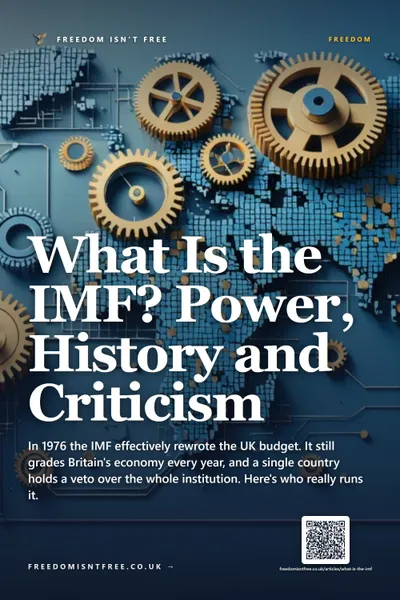
What Is the IMF? Power, History and Criticism
In 1976 the IMF effectively rewrote the UK budget. It still grades Britain's economy every year, and a single country holds a veto over the whole institution. Here's who really runs it.
Cite this article
Freedom Isn't Free (2026) What Is the IMF? Power, History and Criticism. Available at: https://freedomisntfree.co.uk/articles/what-is-the-imf (Accessed: 10 October 2026).
Italicise the article title in your bibliography. Accessed date set to today.
TLDR
- The IMF was created in 1944 to stabilise the post-war monetary system and act as a lender of last resort to countries in financial trouble.
- Voting power is weighted by money, so the United States holds an effective veto and wealthy creditor nations dominate the decisions.
- Its bailout conditions have repeatedly forced austerity, privatisation and spending cuts that fall hardest on workers and the poor.
- Britain has felt it directly: the 1976 sterling crisis bailout reshaped UK politics, and the IMF still passes annual judgement on the UK economy.
Who holds the votes at the IMF
The biggest decisions need an 85% supermajority, so the US vote alone is a veto.
What Is the IMF? Power, History and Criticism
The IMF, or International Monetary Fund, is a global financial institution of more than 190 countries that lends money to governments in financial crisis and passes judgement on how nations run their economies. It is one of the most powerful organisations most people never think about, and it has shaped British policy more than once.
It is also one of the most criticised. The IMF presents itself as a neutral firefighter for the world economy. Its critics see something closer to a debt collector for wealthy nations, one that hands out loans with conditions that have crushed public services and wages across the globe. Both descriptions contain truth. This guide explains where the IMF came from, how it works, why it is so controversial, and why it matters to you in Britain.
When was the IMF established, and why?
The IMF was founded in July 1944 at the Bretton Woods conference in New Hampshire, where 44 Allied nations met to design the financial system for the post-war world. It came into existence in December 1945 and made its first loans in 1947.
The problem it was built to solve was real. The 1930s had been a decade of competitive currency devaluations, trade barriers, and bank collapses. Countries had tried to export their way out of the Great Depression by devaluing their currencies, which simply pushed the pain onto their neighbours. The result was economic chaos that fed directly into the Second World War.
Bretton Woods set up two institutions. The World Bank would fund long-term reconstruction and development. The IMF would keep the monetary system stable by anchoring currencies to the US dollar (itself fixed to gold) and lending to any member that ran short of foreign reserves. The idea was to give a struggling country breathing room so it would not have to slam the brakes on its whole economy. In theory, that prevents one nation's crisis from spreading.
How the IMF has changed over time
The IMF you see today does a very different job from the one designed in 1944.
The original system of fixed exchange rates died in 1971, when the United States abandoned the dollar's link to gold. Currencies began to float against each other, which removed the IMF's founding purpose at a stroke. Rather than wind itself down, the institution found new work.
From the 1980s onward it became the world's emergency lender, stepping in when developing countries could not pay their debts. This is where its modern reputation was forged. The IMF rarely lends without strings. In exchange for cash, borrowing governments sign a "letter of intent" promising specific policy changes, known as conditionality. Through the 1980s and 1990s these conditions hardened into a standard recipe: cut public spending, raise interest rates, privatise state assets, deregulate, and open markets to foreign capital. Economists named the package the Washington Consensus.
The IMF also took on a surveillance role. Every year it sends staff to examine each member's economy and publishes an assessment, called an Article IV report. That is how an institution born to manage exchange rates ended up grading the budgets of countries that have never borrowed a penny from it, Britain included.
How the IMF actually works
The IMF is funded by its members. Each country pays in a subscription called a quota, roughly sized to how large its economy is. That quota determines three things: how much a country contributes, how much it can borrow, and, most importantly, how many votes it gets.
That last point is the heart of the controversy. The IMF is not one country, one vote. It is one dollar, one vote. Voting power is weighted by money, which means the richest nations decide what the institution does.
| Member | Approximate share of the vote |
|---|---|
| United States | 16.5% |
| Japan | 6.1% |
| China | 6.1% |
| Germany | 5.3% |
| United Kingdom | 4.0% |
| France | 4.0% |
The numbers look modest until you read the rulebook. The biggest decisions, such as changing the IMF's structure or its mandate, need an 85% supermajority. Because the United States holds more than 15% of the vote on its own, as the IMF's own published quota and voting data confirms, it can block any of those decisions single-handedly. No other country has that power. By long-standing convention the IMF's managing director is always European, while the United States picks the head of the World Bank. The wealthy world did not just build the system. It kept the keys.
Why the IMF is so controversial
The core criticism is simple: the IMF lends to desperate countries and then dictates policies that hurt ordinary people.
When a government accepts a bailout, the conditions usually mean cutting subsidies on food and fuel, freezing or cutting public sector wages, reducing pensions and welfare, and selling off public assets. These measures fall hardest on workers and the poor, who depend most on public services and have the least cushion to absorb price rises. Wealthy bondholders, by contrast, get repaid. Critics argue this is the IMF's real function: making sure creditors are made whole, with the bill sent to a country's poorest citizens.
The record gives the criticism weight. Structural adjustment programmes across Africa and Latin America in the 1980s and 1990s coincided with stagnant growth and gutted public health and education. During the 1997 Asian financial crisis, many economists argued the IMF's demand for austerity deepened the recession rather than fixing it. The handling of Greece after 2010 became a byword for austerity that shrank the economy faster than the debt.
There is also the democracy problem. Decisions that reshape entire nations are taken by an institution where voting power is concentrated in a handful of rich countries. Research by the Tricontinental Institute found the Global North holds roughly nine times the voting power of the Global South, despite the South being where most IMF programmes actually land.
What is striking is that some of this critique now comes from inside the building. In 2016 the IMF's own researchers published an article asking whether neoliberalism had been "oversold," conceding that austerity can raise inequality and that freely flowing capital does not always help. An institution admitting its medicine sometimes makes the patient sicker is not a small thing.
To be fair, the alternative to an IMF loan is often a disorderly default, which can be even more brutal. The institution is not a villain in a cartoon. But its governance is undemocratic by design, and its instinct for austerity has a long history of protecting the powerful at the expense of the powerless. Both things are true at once.
How the IMF affects life in Britain
It is tempting to file the IMF under "things that happen to other countries." That would be a mistake.
In 1976 Britain became the IMF's most famous patient. A sterling crisis forced James Callaghan's Labour government to request a loan of 3.9 billion US dollars, the largest the IMF had ever made at the time. In return, Chancellor Denis Healey signed up to deep public spending cuts and strict monetary targets monitored by the Fund. In practice, the IMF helped write the British budget. Only half the loan was ever drawn, and it was repaid by 1979, but the political damage lasted far longer. The episode shattered the post-war consensus on government spending, paved the way for the monetarism of the Thatcher years, and still shapes how British politicians talk about debt and "credibility" today. It is a chapter in a much longer story of how national debt has shaped Britain's fortunes.
The IMF has not gone away. It still publishes an annual Article IV verdict on the UK economy, commenting on tax, spending, interest rates and housing. When it speaks, the Treasury listens and the press reports it. In 2022 the IMF took the rare step of publicly criticising the Truss government's unfunded mini-budget, a warning that landed as markets were already punishing UK government bonds. A body Britain helped create now grades Britain's homework in public.
Britain is also a shareholder. With around 4% of the vote, the UK is one of the IMF's larger members, and British taxpayers underwrite part of its lending capacity. So you are, in a small way, both a part-owner of the institution and a subject of its judgements. A country with North Sea oil could have built the kind of national savings buffer a sovereign wealth fund provides, the sort of reserve that lets a nation negotiate from strength rather than queue for a bailout. Britain chose not to. Its forecasts move sterling, feed into Budget arguments, and shape the global stability that your pension, much of it invested overseas, quietly depends on.
Frequently Asked Questions
What does the IMF actually do?
The IMF does three main things: it lends foreign currency to member countries facing a financial crisis, it monitors the health of the global economy and individual members through annual reports, and it provides technical advice on running economies. Its lending almost always comes with policy conditions attached.
Is the IMF the same as the World Bank?
No, though they were created together at Bretton Woods in 1944 and sit across the street from each other in Washington. The IMF focuses on short-term financial stability and crisis lending. The World Bank funds long-term development projects such as infrastructure, health and education in poorer countries.
Who controls the IMF?
Member countries control it through a system of weighted voting based on the size of each economy. The United States holds the largest share at roughly 16.5% and, because the biggest decisions require an 85% supermajority, it effectively holds a veto. Wealthy nations as a group dominate the institution.
Has the UK ever borrowed from the IMF?
Yes. The most significant case was 1976, when Britain borrowed 3.9 billion US dollars during a sterling crisis and accepted spending cuts as a condition. It was the largest IMF loan made up to that point. The loan was repaid by 1979.
Why do people criticise the IMF?
Critics argue its bailout conditions force austerity, privatisation and wage cuts that harm ordinary workers while protecting wealthy creditors, and that its decisions are made undemocratically by a small group of rich countries. Even the IMF's own researchers have admitted that some of its preferred policies can worsen inequality.
Further Reading:
Debt: The First 5,000 Years - David Graeber - A sweeping history of how debt, credit and creditor power have shaped societies, which puts the IMF's role as a global creditor in deep context. (Affiliate link - we may earn a small commission at no extra cost to you.)
This article is educational commentary on economic history and policy, not financial advice. Economic and tax policy can change.
Prefer to watch?
We turn these money breakdowns into short videos
A few a week, plain-English UK money. If you would sooner watch than read, follow along:
Enjoying the content?
If this site has been useful, a coffee goes a long way.
Browse more articles
Browse all