

What Is a Short Squeeze? Famous Examples Explained
A slow-growing German carmaker briefly became the most valuable company on Earth in 2008. Bad earnings, no new product. Just two numbers most retail investors never check.
Cite this article
Freedom Isn't Free (2026) What Is a Short Squeeze? Famous Examples Explained. Available at: https://freedomisntfree.co.uk/articles/what-is-a-short-squeeze (Accessed: 21 September 2026).
Italicise the article title in your bibliography. Accessed date set to today.
TLDR
- A short squeeze is what happens when a heavily shorted stock rises sharply, forcing short sellers to buy back shares to close their losing positions, which in turn pushes the price even higher.
- The two key indicators are short interest (the percentage of a stock float sold short) and days to cover (short interest divided by average daily trading volume). When both are high, the stock is squeeze-vulnerable.
- The most famous modern example is GameStop in January 2021, where retail investors organising on Reddit drove the stock from $20 to $483, costing hedge funds billions and triggering Robinhood to halt buying.
- The most extreme example in history is Volkswagen in October 2008, which briefly became the most valuable company in the world for two days when Porsche revealed it had quietly accumulated a 74% stake.
Famous short squeezes by the numbers
| Stock | Year | Pre-squeeze price | Peak price |
|---|---|---|---|
| GameStop (GME) | 2021 | ~$20 | $483 |
| Volkswagen (VOW) | 2008 | €210 | >€1,000 |
| AMC Entertainment | 2021 | ~$5 | $72 |
| Bed Bath & Beyond | 2022 | ~$5 | $30 |
Sources: NYSE/Xetra historical price data. Volkswagen briefly became the world's most valuable company.
What Is a Short Squeeze? Famous Examples Explained
A short squeeze is when a heavily shorted stock rises sharply, forcing short sellers to buy back shares to close their losing positions, which pushes the price even higher and triggers more shorts to capitulate in a self-reinforcing feedback loop. The mechanic can quintuple a sleepy stock in a week, or in the most extreme case (Volkswagen, 2008) briefly make a slow-growing carmaker the most valuable company on Earth.
This article explains the mechanics in plain English, covers the two indicators that make a stock squeeze-vulnerable, and walks through the most famous short squeezes in stock market history: GameStop in 2021 and Volkswagen in 2008.
Contents
- Short selling, in one paragraph
- How a short squeeze actually works
- The two numbers that predict squeeze risk
- The gamma squeeze (a related but different beast)
- GameStop, January 2021
- Volkswagen, October 2008
- What it means for ordinary investors
- Frequently Asked Questions
Short selling, in one paragraph
To understand a short squeeze, you need to understand short selling. A normal investor buys shares, hopes the price goes up, and sells later for a profit. A short seller does the opposite: they borrow shares from another investor (usually via their broker, who charges a fee), immediately sell them at the current price, and hope to buy them back later at a lower price. The difference is profit. The lent shares get returned. Everyone moves on.
The catch is that the upside is capped (the price can only fall to zero) but the downside is theoretically infinite (the price can rise forever). If you short a stock at £50 and it goes to £500, you have lost £450 per share, with no ceiling on how much worse it can get. That asymmetry is what makes short squeezes so dangerous, and so violent when they happen.
How a short squeeze actually works
Imagine 100 investors have shorted a stock at £20. They are all waiting for it to fall. Then something changes - good earnings, a new product, a Reddit post, an insider revealing a big buy - and the stock drifts up to £25. A few short sellers panic and buy back to close their positions, locking in a small loss. That buying pushes the price to £30. More short sellers get nervous and close. Now it is £40. Their broker margin calls force the rest. Buying begets buying. Within hours, a stock that was £20 is £200, with very few real buyers driving it - just shorts capitulating in waves.
The key thing to understand: a short squeeze is not driven by people who think the company is suddenly worth more. It is driven by people who originally bet against it being forced to buy it, regardless of what they think it is worth. That makes squeezes look like sudden bubbles, except the buying is mechanical rather than enthusiastic.
Once the shorts have all covered, the squeeze ends. The stock typically falls back toward whatever the underlying business actually justifies, often within days or weeks. That is why squeezes look like a spike on the chart followed by a long, slow grind back down.
The two numbers that predict squeeze risk
Two metrics signal a stock is squeeze-vulnerable:
Short interest as a percentage of float - the share of all freely tradeable shares that have been borrowed and sold short. Most stocks sit at 1-5%. Anything above 20% is unusually high. GameStop in January 2021 had short interest of around 140% of float (yes, more than 100% - shares can be lent and re-lent multiple times in the institutional borrow market).
Days to cover (also called the short interest ratio) - short interest divided by the stock's average daily trading volume. This tells you, in days, how long it would take for all short positions to be closed at current trading volumes. Anything above 5 days is high. Above 10 is dangerous. Pre-squeeze GameStop had days-to-cover of around 6-7, which is meaningfully high but not extreme. The combination with the 140% short interest is what made it explosive.
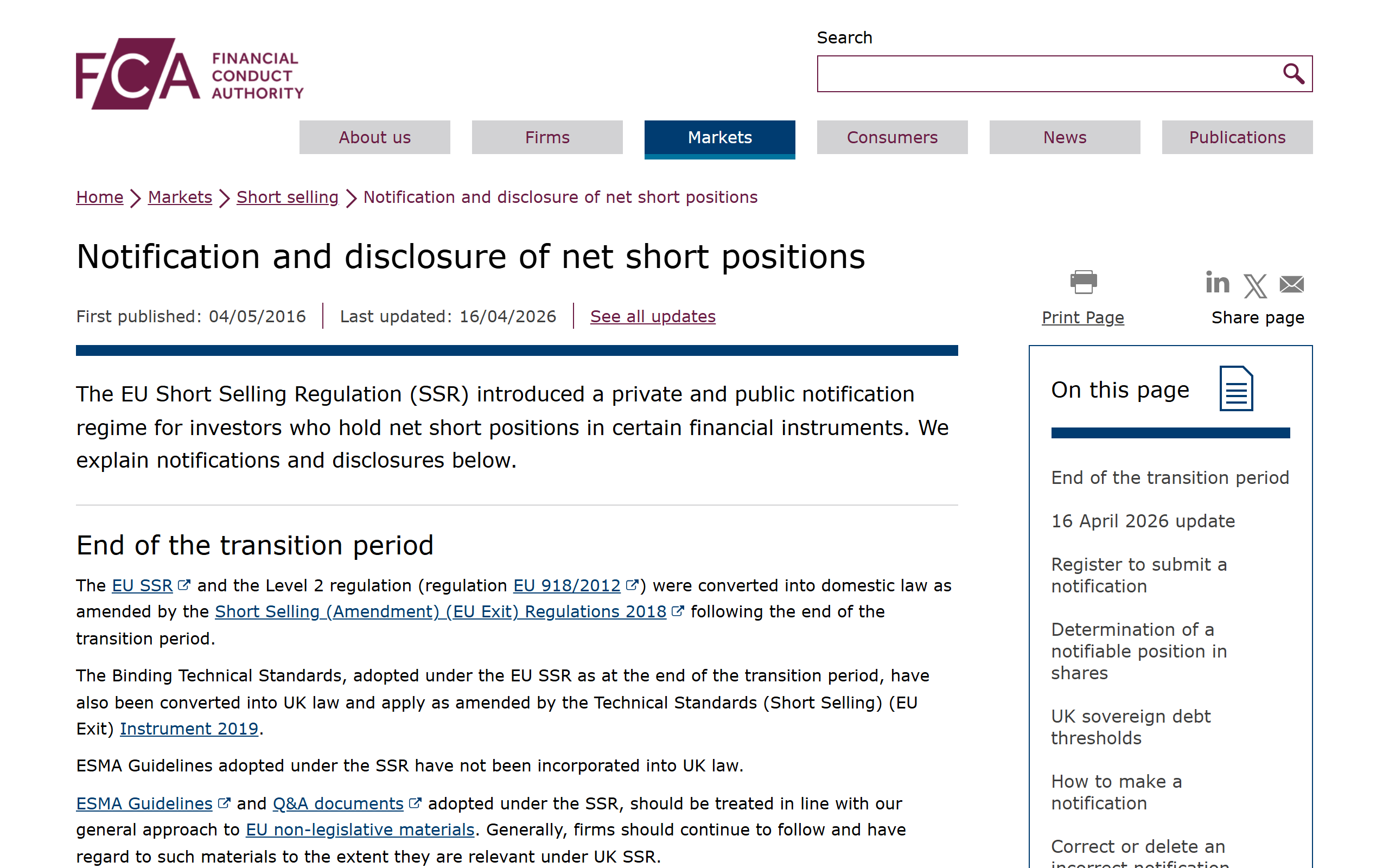
Both numbers are publicly available. In the US, short interest is reported twice a month by FINRA and aggregated on sites like S3 Partners and Ortex. UK short interest above 0.5% of share capital must be disclosed to the FCA and is published on the FCA's daily short positions register. So squeeze-vulnerable stocks are not secret information - what is secret is the timing of any catalyst that triggers the squeeze.
The gamma squeeze (a related but different beast)
A gamma squeeze is often confused with a short squeeze but is mechanically different. It happens when retail traders buy huge volumes of out-of-the-money call options. The market makers who sold those calls have to hedge by buying the underlying stock, which pushes the price up, which moves more calls closer to the money, which forces more hedging.
GameStop in January 2021 was both a short squeeze AND a gamma squeeze running at the same time, which is what made the move so violent.
GameStop, January 2021
The canonical modern short squeeze. The story has been turned into a film, two books, and several documentaries, but the mechanics are simple.
GameStop was a struggling US video game retailer with declining revenue and an outdated business model. Hedge funds, including Melvin Capital, had been short the stock heavily, betting it would eventually go to near-zero. Short interest reached around 140% of the public float - a structurally absurd number that meant more shares had been borrowed and sold than actually existed in tradeable form.
A community on Reddit (r/wallstreetbets), led by an investor called Keith Gill (handle: Roaring Kitty / DeepFuckingValue), built a thesis that GameStop was undervalued because of an upcoming console cycle, a board change including activist investor Ryan Cohen, and most importantly, the absurd short interest. The argument: if enough retail buyers held the stock, the shorts would have nowhere to cover, and the squeeze would be mathematically forced.
The squeeze ran from a base of around $20 in early January 2021 to an intraday peak of $483 on 28 January. Melvin Capital lost more than $6 billion, was bailed out by Citadel and Point72, and eventually shut down entirely in 2022. Robinhood (one of the main retail brokers) controversially halted buying in GameStop and other meme stocks at the peak, citing collateral requirements at its clearing house. That decision triggered congressional hearings, lawsuits, and a permanent reputational hit.
The episode was something genuinely new: organised retail traders, coordinating publicly on social media, beat institutional short sellers on their own terms. It changed how short interest is talked about in the US market, made hedge funds more careful about telegraphing their positions, and seeded a "meme stock" category that AMC, Bed Bath & Beyond, and others would later occupy.
GameStop (GME) daily close, January 2021 (day index)
Day 1 = 4 January 2021 (first trading day). Day 18 = 27 January peak close ($347.51).
Source: GME daily closes from StatMuse Money historical data for January 2021. Prices shown are pre-split (GameStop ran a 4-for-1 split in July 2022). Intraday peak of $483 on 28 January is well above that day's close of $193.60.
You can see exactly what the article describes in the line: a sleepy stock loitering below $20 for two weeks, then a near-vertical climb as the short squeeze and gamma squeeze ran together, peaking at $347.51 on the close of 27 January before Robinhood's halt and the wave of profit-taking sent it back below $200 the next session. The intraday $483 on 28 January is the spike that lives in folklore. The close on the same day was less than half that, and the round-trip back to $40s by mid-February was already in motion before most retail traders had finished arguing about whether to buy more.
Volkswagen, October 2008
The most extreme short squeeze in modern history, and largely forgotten outside Europe.
The setup: Porsche, the German sportscar maker, had been quietly accumulating Volkswagen stock and call options for years, building toward a takeover. By October 2008, hedge funds were heavily short Volkswagen, partly because the stock looked overvalued and partly because they assumed the takeover thesis would not work in the credit-crunched post-Lehman environment.
On Sunday 26 October 2008, Porsche announced that it had effectively built a 74.1% stake in Volkswagen via direct shares and call options. The German state of Lower Saxony already held 20%. That left a free float of less than 6% available to be borrowed and traded - against a short interest of around 12%.
The maths was structurally impossible: more shares had been borrowed and sold short than were actually available to buy back. Shorts had to cover and there was nothing to cover with.
On Monday 27 October, Volkswagen shares opened at €210 and closed at €517. On Tuesday they hit an intraday peak of over €1,000, briefly making Volkswagen the most valuable company in the world by market capitalisation, ahead of ExxonMobil. Hedge funds were estimated to have lost between $20 billion and $30 billion in 48 hours. One German billionaire, Adolf Merckle, lost so much that he died by suicide a few weeks later.
Porsche eventually released some shares back to the float, the squeeze ended, and Volkswagen drifted back down to a more rational price. Porsche's takeover plan ultimately failed, partly because it had taken on huge debts to build the stake, and the irony is that Volkswagen ended up acquiring Porsche rather than the other way around.
The 2008 Volkswagen squeeze is still the largest short squeeze in dollar terms in stock market history.
What it means for ordinary investors
A few honest takeaways:
Squeezes are not investments. Buying a stock because it is heavily shorted, hoping for a squeeze, is a trade with binary outcomes and terrible expected value for retail. Most "potential squeeze" stocks never squeeze. The ones that do are usually identified after the fact. The GameStop crowd that bought below $50 made fortunes; the crowd that bought at $400 lost most of it within weeks. This is closer to gambling than investing, and the maths is unforgiving for anyone arriving late.
Squeezes are evidence of dysfunction in the underlying market, not a sign that retail has won. The fact that 140% of GameStop's float was shorted in the first place is a regulatory and market structure issue. When prices move that violently for non-fundamental reasons, ordinary index investing is the boring rational response, not the boring losing one.
For UK investors specifically, the logistics are inconvenient. UK retail brokers like Trading 212 do not offer short selling on the Invest/ISA accounts (only on the separate CFD product, which most retail investors should avoid). Buying squeeze candidates via the long side requires holding US stocks, which adds an FX layer and concentration risk. Most UK readers are better off watching squeezes as spectator sport than trying to play them, or reading about them in the historical context of speculation versus investing.
The pattern repeats. Roughly every decade or two, retail or insider money finds another technically-vulnerable shorted stock and triggers another squeeze. Volkswagen 2008 and GameStop 2021 are the same story in different costumes, and similar episodes go back as far as the 1901 Northern Pacific corner. The dynamic is as old as short selling itself. Whether you find that comforting or worrying depends on whether you are short the next candidate.
Frequently Asked Questions
What is a short squeeze in simple terms?
A short squeeze is when a stock that lots of investors have bet against (sold short) suddenly starts rising, forcing those short sellers to buy the stock back to limit their losses. Their forced buying pushes the price even higher, which forces more short sellers to buy, and the feedback loop can drive prices to extreme levels in days or even hours.
What is the most famous short squeeze in history?
In modern memory, GameStop in January 2021 is the most famous. The most extreme in absolute dollar terms was Volkswagen in October 2008, which briefly became the world's most valuable company when Porsche revealed it had cornered the float.
How do you spot a potential short squeeze?
Two metrics matter most: short interest as a percentage of the stock's free float (high = squeeze-vulnerable, with anything above 20% notable), and days to cover (short interest divided by average daily trading volume - high values mean shorts cannot easily exit). Both are publicly available; in the UK, short positions above 0.5% of share capital are disclosed on the FCA's daily register.
Are short squeezes legal?
Yes, short squeezes themselves are not illegal. However, deliberately coordinating to manipulate a stock price (whether to engineer a squeeze or for any other reason) can be market manipulation, which is illegal under both UK FCA rules and US SEC rules. The 2021 GameStop episode triggered SEC investigations into whether retail coordination on Reddit crossed any legal lines. No criminal charges resulted from the retail side of the activity.
Can a short squeeze last forever?
No. Once all the short sellers have covered (bought back the shares they borrowed), there is no more forced buying to drive the price higher. At that point the stock typically falls back toward whatever the underlying business is genuinely worth, often quickly. The peak of a squeeze is almost always followed by a sharp decline within days or weeks. GameStop fell from $483 to under $50 within a month.
Further Reading
Devil Take the Hindmost - Edward Chancellor - A history of financial speculation that puts every modern squeeze, from GameStop back to the South Sea Bubble, in proper context. The cast changes; the script does not. (Affiliate link - we may earn a small commission at no extra cost to you.)
A Short History of Financial Euphoria - John Kenneth Galbraith - A short, sharp essay on why every speculative episode follows the same template and why each generation of investors believes theirs is different. Pairs perfectly with the squeeze stories above. (Affiliate link - we may earn a small commission at no extra cost to you.)
Read Next
Prefer to watch?
We turn these money breakdowns into short videos
A few a week, plain-English UK money. If you would sooner watch than read, follow along:
Enjoying the content?
If this site has been useful, a coffee goes a long way.
Browse more articles
Browse all