

The Slight Edge Review: Small Habits, Big Wealth
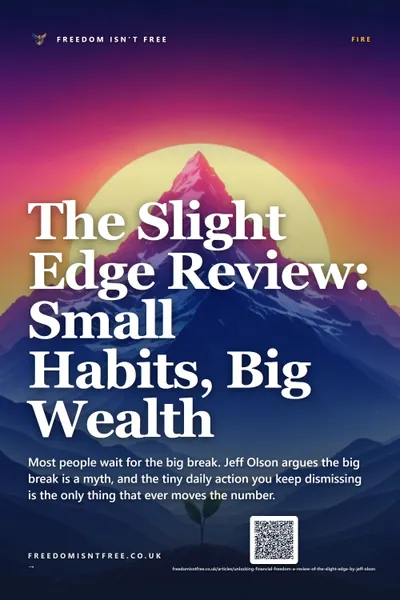
Most people wait for the big break. Jeff Olson argues the big break is a myth, and the tiny daily action you keep dismissing is the only thing that ever moves the number.
Cite this article
Freedom Isn't Free (2026) The Slight Edge Review: Small Habits, Big Wealth. Available at: https://freedomisntfree.co.uk/articles/unlocking-financial-freedom-a-review-of-the-slight-edge-by-jeff-olson (Accessed: 21 September 2026).
Italicise the article title in your bibliography. Accessed date set to today.
TLDR
- Building wealth comes from repeating small, consistent actions over time.
- Small positive actions can lead to big results over years, while small negative actions can gradually pull you back.
- The FIRE movement relies on consistent saving and investing, cutting unnecessary expenses, and building positive financial habits.
- UK readers can apply the slight edge philosophy by maximizing ISAs and SIPPs, and claiming employer pension matching.
- Small, regular actions, such as saving a little bit each month, can lead to significant financial growth.
The Slight Edge Review: Small Habits, Big Wealth
Most people assume that building wealth requires a single big break - a windfall, a lucky investment, or a massive salary increase. Jeff Olson's The Slight Edge argues the opposite: financial success comes from small, boring actions repeated daily over years. This review covers the book's core philosophy, how it maps onto the FIRE (Financial Independence, Retire Early) movement, and how UK readers can put it into practice.
What Is the Slight Edge Philosophy?
The central idea is that success and failure are not sudden events but slow, progressive processes. Olson argues that small, consistent actions - what he calls the "slight edge" - compound over time to produce extraordinary outcomes. The catch is that easy actions are also easy to skip, which is why most people never benefit from them.
Consider a simple example: saving £50 a month from your salary. It feels trivial. But put that £50 into a Stocks and Shares ISA earning 7% annually, and after 30 years you have roughly £57,000 - from just £18,000 of contributions. That gap is the slight edge in action. You can model scenarios like this with a compound interest calculator.
Why Small Actions Compound into Big Results
Olson stresses that success and failure sit on a continuum. Small positive actions, maintained over time, edge you forward. Small negative actions - skipping a savings transfer, ignoring a budget, paying avoidable fees - gradually pull you back. Neither feels significant on any given day, which is exactly why the slight edge is so powerful and so easy to miss.
For someone pursuing early retirement, the maths is clear. Contributing consistently to low-cost index funds or a SIPP (Self-Invested Personal Pension) feels unremarkable in the moment. But over 15-20 years, those contributions compound into a portfolio large enough to replace your salary. You can work out your personal target with our FI number calculator.
How the Slight Edge Applies to FIRE
The FIRE movement is built on exactly the kind of consistent, small financial decisions Olson describes. Here is how the philosophy maps to the FIRE journey in practice:
Consistent Saving and Investing
One of the cornerstones of FIRE is regular saving and investing. Whether it's through an ISA, SIPP, or a regular investment plan, the key is consistency. This is exactly what Olson is talking about.
For example, investing £100 monthly in a diversified portfolio might not seem like much, but over 20 years, with an average annual return of 7%, this can grow to over £40,000. This growth is a direct result of the slight edge - small actions compounding over time.
Cutting Unnecessary Expenses
Another application of the slight edge in the FIRE context is cutting unnecessary expenses. Small savings add up. For instance, reducing your daily coffee spend by £2 can save you over £700 annually. Those savings can go straight into your ISA.
Building Positive Financial Habits
Olson stresses the importance of building positive habits. In the FIRE context, this means automating your savings, regularly reviewing your budget, or setting aside time each month to learn about investing. These habits feel minor on any given day, but they create a solid framework for reaching financial independence.
Practical Tips for UK Readers
Here are specific ways to apply the slight edge philosophy if you are based in the UK:
Make Full Use of ISAs and SIPPs
ISAs and SIPPs let your investments grow free of capital gains and income tax. Maxing out your ISA allowance each year is one of the simplest slight-edge actions available - it costs nothing extra, but the tax savings compound enormously over decades.
Claim Every Penny of Employer Pension Matching
If your employer offers pension matching, contribute enough to get the full match. This is a guaranteed 100% return on your money before any market growth. Failing to claim it is one of the costliest small mistakes a UK worker can make.
Build a Learning Habit
Dedicate even 15 minutes a week to reading about personal finance. Over a year that adds up to over 12 hours of education - enough to cover ISA rules, pension strategy, and the basics of investing. This knowledge compounds every financial decision you make going forward.
Conclusion
Jeff Olson's The Slight Edge makes the case clearly: wealth is built through small, consistent actions rather than dramatic leaps. For anyone on the FIRE journey, this philosophy fits hand in glove - saving, investing, and cutting expenses are all slight-edge behaviours that compound into financial freedom.
In the UK, the tools to apply this philosophy are readily available: ISAs, SIPPs, employer pension matching, and low-cost index funds. The path to financial independence is a marathon, not a sprint. Start small, stay consistent, and let compounding do the heavy lifting.
Buy "The Slight Edge" on Amazon
Frequently Asked Questions
What is The Slight Edge about?
The Slight Edge by Jeff Olson argues that success comes from small, easy-to-do daily actions that compound over time. The book applies this philosophy to health, relationships, and finances, showing that the difference between success and failure is not talent or luck but consistency.
How does The Slight Edge apply to personal finance?
The book's core message - that small actions compound into big results - maps directly onto saving and investing. Putting aside even a modest amount each month, avoiding unnecessary fees, and automating your investments are all slight-edge behaviours that build significant wealth over years.
Is The Slight Edge relevant to UK investors?
Yes. The principles are universal, and UK investors have tax-efficient tools like ISAs and SIPPs that amplify the effect of consistent saving. The slight edge philosophy aligns closely with the FIRE movement, which has a strong and growing community in the UK.
How long does it take for the slight edge to show results?
Olson is honest that the results take time to become visible - often years. This is the same dynamic as compound interest: early progress feels slow, but growth accelerates as your base gets larger. The key is not to quit during the early phase when results seem insignificant.
What is the difference between The Slight Edge and Atomic Habits?
Both books focus on the power of small daily actions. Atomic Habits by James Clear is more tactical, offering specific systems for habit formation. The Slight Edge is more philosophical, focusing on the mindset shift needed to value small actions in the first place. They complement each other well.
Further Reading:
The Psychology of Money - Morgan Housel - Housel explores why behaviour matters more than knowledge in finance - the same insight that underpins Olson's slight edge philosophy. (Affiliate link - we may earn a small commission at no extra cost to you.)
I Will Teach You To Be Rich - Ramit Sethi - Sethi's step-by-step system for automating your finances is the practical implementation of the slight edge approach to money. (Affiliate link - we may earn a small commission at no extra cost to you.)
Read Next
Prefer to watch?
We turn these money breakdowns into short videos
A few a week, plain-English UK money. If you would sooner watch than read, follow along:
Enjoying the content?
If this site has been useful, a coffee goes a long way.
Browse more articles
Browse all