





The Sandwich Generation: Caring at Both Ends
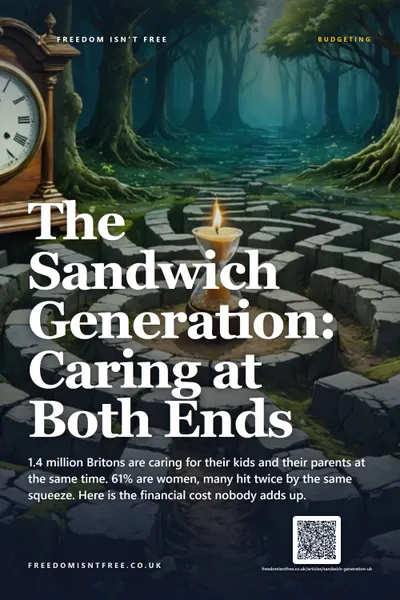
1.4 million Britons are caring for their kids and their parents at the same time. 61% are women, many hit twice by the same squeeze. Here is the financial cost nobody adds up.
Cite this article
Freedom Isn't Free (2026) The Sandwich Generation: Caring at Both Ends. Available at: https://freedomisntfree.co.uk/articles/sandwich-generation-uk (Accessed: 21 September 2026).
Italicise the article title in your bibliography. Accessed date set to today.
TLDR
- An estimated 1.4 million UK adults are sandwich carers, supporting both children and ageing parents at the same time (ONS, 2021 to 2023).
- 61% are women, and over half cannot work as much as they would like because of caring, which hits earnings and pensions directly.
- 43% live in a household earning £20,000 or less, and 16% find it quite or very difficult to manage financially, almost double the rate for all adults.
- The financial defence is unglamorous: a larger cash buffer, claiming what you are entitled to, and sorting power of attorney and a will before a crisis, not during one.
| Sandwich carers aged 16 to 64 | 1.4 million |
| Who are women | 61% |
| Unable to work as much as they want | 53% |
| On household income of £20,000 or less | 43% |
| Showing signs of depression or anxiety | 31% |
The UK sandwich generation in numbers (ONS, 2021 to 2023)
The Sandwich Generation: Caring at Both Ends
The sandwich generation is the growing group of people caring for their own children and their ageing parents at the same time, and the UK now has around 1.4 million of them. The label sounds almost cosy, like a lifestyle stage. The reality is a financial and emotional squeeze that the people living it rarely get credit for, because most of the work is invisible and almost none of it is paid.
The coverage you will find tends to focus on the guilt and the exhaustion, which are real. What gets left out is the money. Caring at both ends does measurable damage to your earnings, your pension and your own financial security, and because 61% of sandwich carers are women, it often lands on people the system has already short-changed once.
Contents
- Who the sandwich generation is
- The financial squeeze nobody counts
- Caught twice: the motherhood penalty connection
- How to protect your own finances
Who the sandwich generation is
The ONS counted around 1.4 million sandwich carers aged 16 to 64 in the UK between 2021 and 2023. The profile is consistent: 61% are women, and 51% are aged 45 to 64, the years that should be peak earning and peak pension-building. Instead, a large share are using those years to look after a parent's care needs and a child's at once.
That timing is the cruelty of it. The mid-40s to mid-60s are when salaries usually top out and pension contributions have the best shot at compounding before retirement. Spending them stretched across two sets of caring responsibilities means the damage lands exactly where it costs the most.
The financial squeeze nobody counts
The maths is stark once you look. Around 53% of sandwich carers say they cannot work at all, or as much as they would like, because of their caring responsibilities. For those caring 20 or more hours a week, that rises to 74%. Every hour pulled away from paid work is an hour off the payslip and, downstream, off the pension.
It shows up in income. Around 43% of sandwich carers live in a household with a gross income of £20,000 or less. And 16% find it quite or very difficult to manage financially, almost double the 9% rate across all adults. The mental load tracks the money: 31% show signs of depression or anxiety, and a fifth are diagnosed with depression, against 13% of all adults.
The official support is thin. Carer's Allowance is £86.45 a week in 2026/27, and only if you care for at least 35 hours a week and earn under the weekly limit. That works out below £2.50 an hour for the minimum qualifying care, which tells you how the state actually values this work. For most sandwich carers the real cost is not the meagre allowance they might claim but the salary and pension they quietly give up.
Caught twice: the motherhood penalty connection
Here is the connection the support sites miss. The same 61% of sandwich carers who are women are, in many cases, the same people who took the earlier hit from the motherhood penalty. The structural default that says caring is primarily women's work does not retire when the children grow up. It simply repoints at the ageing parents.
So a woman can be hit twice by the same mechanism: once in her thirties when a child arrives and she steps back, and again in her fifties when a parent needs care and she steps back a second time. Two career interruptions, two dents in lifetime earnings, two holes in the pension, both produced by the same assumption about whose job this is. By the time she reaches her own retirement, the pension she should have built has been undermined twice over, through work that benefited everyone but paid her nothing.
How to protect your own finances
You cannot single-handedly fix a social-care system that runs on unpaid labour. You can stop it quietly wrecking your own finances. A few moves matter more than the rest.
Claim everything you are entitled to. Carer's Allowance is small, but it can come with National Insurance credits that protect your own State Pension, which is often worth more than the cash. Check Attendance Allowance or Pension Credit for the parent too, because money into their household can ease the pressure on yours.
That boring admin is the highest-value thing you can do, and almost nobody does it until it is too late. Sort a lasting power of attorney for your parent while they still have capacity, because without one, managing their money when they no longer can means a slow, expensive trip through the Court of Protection. Make sure there is a will in place, so an inheritance does not turn into a family dispute on top of a bereavement. And keep your own emergency fund deliberately larger than the textbook three to six months, because a care crisis is exactly the kind of shock that lands with no notice and no budget line. Protecting yourself is not selfish here. A carer who runs their own finances into the ground helps no one in the end.
Die With Zero - Bill Perkins - Perkins on giving and spending while it still does some good, which reframes the awkward conversation about an ageing parent's money as something to plan early rather than inherit late. (Affiliate link - we may earn a small commission at no extra cost to you.)
Frequently Asked Questions
What is the sandwich generation?
The sandwich generation is people who are simultaneously caring for their own dependent children and for ageing parents or older relatives. The ONS estimates there are around 1.4 million sandwich carers aged 16 to 64 in the UK, of whom 61% are women.
What age is the sandwich generation?
Most are in midlife. ONS data shows 51% of UK sandwich carers are aged 45 to 64, the years that are usually peak earning and pension-building, which is part of why the financial impact is so large.
Why is it called the sandwich generation?
Because the carer is "sandwiched" between two generations who both depend on them: their children below and their parents above. A "club sandwich" variant describes people supporting three generations, for example grandchildren, adult children and elderly parents.
Is it my responsibility to look after my parents?
There is no legal obligation in the UK to provide personal care for a parent, though many people choose to. What matters financially is doing it with your eyes open: claiming any support available, protecting your own pension and emergency fund, and getting a power of attorney and will in place early so a crisis does not become a legal and financial mess on top of an emotional one.
What financial help can sandwich carers get?
Carer's Allowance is £86.45 a week in 2026/27 if you care at least 35 hours a week and earn under the limit, and it can carry valuable National Insurance credits. The person you care for may qualify for Attendance Allowance or Pension Credit. It is worth a benefits check, because the cash is modest but the linked entitlements can be significant.
Sources
Prefer to watch?
We turn these money breakdowns into short videos
A few a week, plain-English UK money. If you would sooner watch than read, follow along:
Enjoying the content?
If this site has been useful, a coffee goes a long way.
Browse more articles
Browse all