





Off-Grid Finance: Reducing Dependency on the System
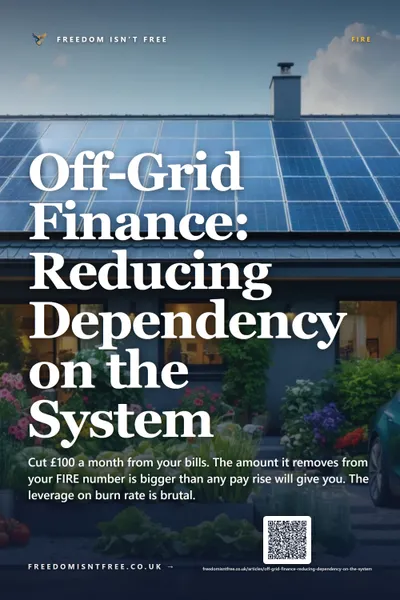
Cutting £100 a month from your bills shrinks your FIRE number more than most pay rises ever will.
Cite this article
Freedom Isn't Free (2026) Off-Grid Finance: Reducing Dependency on the System. Available at: https://freedomisntfree.co.uk/articles/off-grid-finance-reducing-dependency-on-the-system (Accessed: 21 September 2026).
Italicise the article title in your bibliography. Accessed date set to today.
TLDR
- Lowering your burn rate can lead to more savings and a reduced FIRE number.
- Solar panels can lower electricity bills and generate additional income through the Smart Export Guarantee.
- Growing your own food offers tax-free savings and fresh, pesticide-free produce.
- Water conservation methods like rainwater harvesting reduce water bills and provide resilience.
- Self-sufficiency measures offer a stable financial hedge against UK inflation.
Self-sufficiency ROI for UK households
| Measure | Setup cost | Annual saving | Payback |
|---|---|---|---|
| Solar panels (3-4kW) | £5,000-£8,000 | £600-£1,200 | 6-10 years |
| Growing your own food | £100-£300 | £300-£800 | First season |
| Rainwater harvesting | £500-£1,500 | £50-£150 | 5-10 years |
| Insulation upgrades | £500-£2,000 | £200-£400 | 1-3 years |
£100/month off the bills cuts roughly £30,000 off your FIRE number.
Off-Grid Finance: Reducing Dependency on the System
With utility prices swinging and inflation stubbornly persistent, true financial freedom comes partly from lowering your burn rate - the amount you spend each month to maintain your lifestyle.
Reducing dependency on centralised infrastructure does not just provide a sense of autonomy. It can also offer significant long-term savings, provide a meaningful hedge against UK inflation, and reduce the FIRE number you need to achieve financial independence.
This article explores the return on investment of self-sufficiency measures available to UK households.
Understanding Your Burn Rate
Your burn rate is the minimum monthly spend required to maintain your lifestyle. Every pound you remove from your burn rate does two things:
- It reduces your current expenses, increasing your monthly surplus for saving and investing
- It reduces your required FIRE number (since your annual expenses are lower)
A £100 monthly reduction in utility bills reduces your required FIRE number by £30,000 at the 4% rule (£1,200/year x 25). You can model this yourself with the FI number calculator. The leverage is significant.
Solar Energy: Powering Your Home
Installing solar panels is one of the most effective ways to reduce dependency on the grid. The UK government's Smart Export Guarantee (SEG) allows you to sell excess electricity back to the grid, providing an additional income stream.
ROI breakdown (approximate figures for 2024-25):
- Initial cost: £5,000 - £8,000 for a typical 3-4kW residential installation
- Annual savings on electricity bills: £600 - £1,200 (depending on consumption and local sunlight)
- SEG income: £100 - £300 per year on exported electricity
- Payback period: approximately 6-10 years
- Effective annual return after payback: 8-15% on the initial capital (free of income tax)
After the payback period, the savings are ongoing and inflation-protected - your electricity bills stay low regardless of what happens to energy prices nationally.
Solar also complements an electric vehicle if you charge at home, extending the savings further.
Growing Your Own Food
Growing vegetables and fruit offers tax-free financial gains at minimal initial cost. With UK food inflation running at elevated levels in recent years, the savings from home growing compound year on year.
ROI breakdown:
- Initial cost: £100 - £300 for raised beds, tools, and seeds
- Annual savings: £300 - £800 on groceries (depending on scale and what you grow)
- Payback period: typically within the first growing season
High-value crops - tomatoes, salad leaves, herbs, courgettes - provide the best return per square metre and are well-suited to UK growing conditions. Even a small garden or a few containers on a balcony can produce meaningful savings.
The additional benefits are non-financial but real: fresh food with no pesticides, physical activity, and a degree of food security that is independent of supply chains.
Water Conservation: Reducing Utility Bills
Investing in rainwater harvesting and greywater recycling reduces water bills and provides resilience against hosepipe bans and water shortages.
ROI breakdown:
- Rainwater harvesting: £500 - £1,500 for a basic system; annual savings of £50 - £150 on water bills
- Payback period: approximately 5-10 years
- Water butts (simpler option): £30 - £80; immediate savings on garden watering
The UK receives sufficient rainfall to make rainwater harvesting a viable option for garden irrigation and (with appropriate filtration) some household uses. The financial return is modest compared to solar, but the installation is simpler and the resilience benefit is real.
The Financial Hedge Against Inflation
Self-sufficiency measures act as a structural hedge against UK inflation by providing a stable source of essential resources regardless of market fluctuations.
When energy prices spike (as they did significantly in 2021-23), households with solar panels were insulated. When food prices rise, households growing their own are partially protected. This is genuine financial resilience - not just a lifestyle choice.
For FIRE practitioners, every pound permanently removed from the burn rate extends the safety margin. A lower burn rate means a smaller required portfolio, faster accumulation, and greater flexibility during market downturns.
Diversifying Income Alongside Reducing Costs
Reducing your burn rate works on the expense side of the equation. Complementing it with income diversification strengthens the position further:
- ISA and SIPP contributions: Tax-efficient saving that compounds over time
- Rental income: For those with the capital and capacity to become landlords
- Freelance or consulting work: A second income stream that does not depend on a single employer
The combination of a reduced burn rate and diversified income is what makes genuine financial independence resilient rather than fragile.
Frequently Asked Questions
Does solar power make financial sense in the UK?
For most UK homeowners, yes. The payback period has shortened significantly as solar panel costs have fallen and electricity prices have risen. A typical installation pays back in 6-10 years and then provides free electricity for 20+ years. The effective annual return on the capital invested is comparable to or better than many investment returns. The Smart Export Guarantee adds a small income stream for exported electricity.
How much can you realistically save by growing your own food?
A committed kitchen garden can produce £500-£1,000 worth of food per year for a family of four. Focusing on high-value crops (tomatoes, courgettes, beans, salad leaves, herbs) maximises the financial return per square metre. The initial setup costs are typically under £200. The first growing season usually covers the setup cost.
Is reducing your burn rate as important as investing?
In terms of impact on your FIRE timeline, they work together. Every £100 reduction in monthly expenses reduces your required FIRE number by £30,000 (at 25x multiplier) and increases your monthly surplus for investing simultaneously. At median UK earnings, reducing the burn rate often has a larger proportional impact on the path to financial independence than optimising investment returns.
What self-sufficiency measures have the best financial ROI?
Solar panels typically offer the best financial return for UK homeowners with suitable roofs (south-facing, minimal shading). Growing food has an excellent return on a small capital base. Insulation and draught-proofing - often overlooked - can reduce heating bills by 15-30% and typically pay back in 1-3 years. Energy-efficient appliances pay back more slowly but reduce ongoing bills. Start with the measures that match your property and circumstances.
Does self-sufficiency conflict with FIRE investing?
No - they are complementary. Reducing your burn rate lowers the FIRE number you are targeting and increases the surplus available to invest. The most powerful FIRE strategies combine a high savings rate, ongoing investment in low-cost index funds, and a lower baseline cost of living. Self-sufficiency measures contribute directly to both.
Further Reading:
Solar Panel Starter Kit - A portable solar panel kit for those who want to start small before committing to a full roof installation - useful for garden outbuildings, caravans, or testing whether solar suits your setup. (Affiliate link - we may earn a small commission at no extra cost to you.)
The Self-Sufficient Life and How to Live It - John Seymour - The classic reference on self-sufficiency, covering everything from growing food to generating energy. More comprehensive than any online guide. (Affiliate link - we may earn a small commission at no extra cost to you.)
Read next:
Prefer to watch?
We turn these money breakdowns into short videos
A few a week, plain-English UK money. If you would sooner watch than read, follow along:
Enjoying the content?
If this site has been useful, a coffee goes a long way.
Browse more articles
Browse all