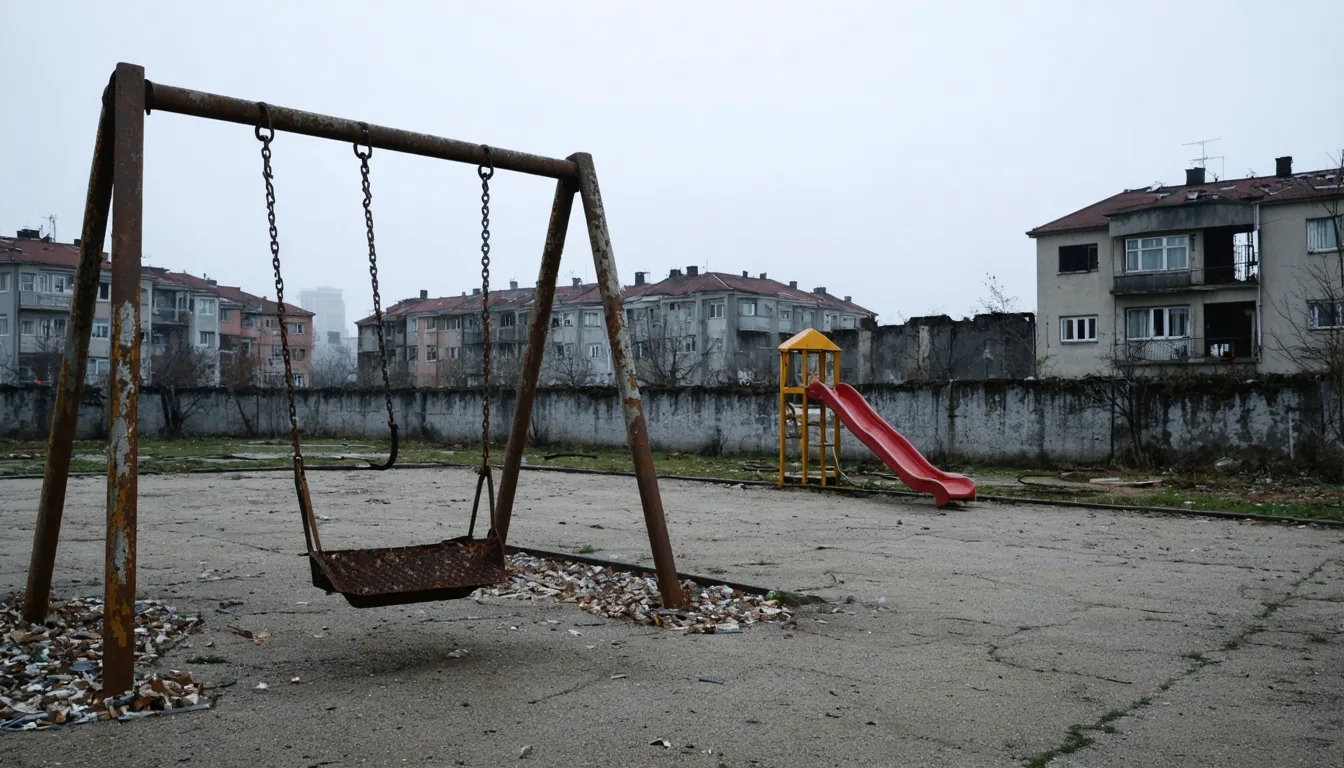
UK Child Poverty: How Britain Is Failing Its Children
Cite this article
Freedom Isn't Free (2026) UK Child Poverty: How Britain Is Failing Its Children. Available at: https://freedomisntfree.co.uk/articles/uk-failing-its-children (Accessed: 10 May 2026).
Italicise the article title in your bibliography. Accessed date set to today.
TLDR
- Around 4.5 million UK children live in relative poverty after housing costs. That is roughly 1 in 3, the highest rate of any major developed economy outside the US.
- The structural drivers are concentrated: housing costs, the two-child benefit limit, the loss of Sure Start centres, real-terms cuts to child benefit, and the slow attrition of free school meal eligibility relative to inflation.
- The cost is not just moral. Children who grow up in poverty have measurably worse health, education and earnings outcomes for the rest of their lives, which feeds directly back into UK productivity and tax base.
- A sensible society would not treat this as either inevitable or affordable to ignore. The countries with the best child outcomes (Nordic, Dutch) make a deliberate political choice to invest early and consistently. The UK, repeatedly, has chosen otherwise.
UK Child Poverty: How Britain Is Failing Its Children
Around 4.5 million UK children, roughly 1 in 3, live in relative poverty after housing costs - the highest rate of any major developed economy outside the US. UK child poverty has risen by approximately 800,000 since 2010 because of specific, traceable policy choices: the two-child benefit limit, the dismantling of Sure Start, frozen working-age benefits, and a Local Housing Allowance that has not kept up with rents.
This is not a story of insufficient national wealth. The UK is among the top 25 countries in the world by GDP per capita. The country can afford to look after its children better than it does. It has chosen not to, and the cost of that choice compounds through every measurable outcome that follows: education, health, lifetime earnings, and the productivity of the future tax base.
Most personal finance writing skips past the part of the economy that actually matters most: the children growing up inside it. They cannot vote, cannot organise, cannot quit their household, and cannot opt out of the consequences of decisions made decades before they were born. Whether their parents can afford the bus fare to a hospital appointment, whether their primary school has a breakfast club, whether the local children's centre still exists, whether their family qualifies for free school meals - all of these are policy outcomes that compound through their lives in ways that are largely invisible to anyone not in the same boat.
UK women, mothers in particular, do extraordinary work bringing children into the world and trying to protect them through the years that shape everything that follows. The economic and social system around them has, increasingly, decided that this work is theirs alone to carry. The result is a country that produces some of the worst child poverty outcomes in the developed world while quietly telling itself that this is just how things are. It is not. It is a choice.
Contents
- How many UK children live in poverty?
- What UK child poverty looks like in practice
- Why Sure Start mattered and what its closure cost
- The two-child benefit limit and other policy cuts
- Foodbanks as infrastructure for working families
- Opportunity gaps that compound for life
- Why mothers carry the cost
- The economic case for investing in children
- What a sensible society would do
- What you can do as an individual
- Frequently Asked Questions
How many UK children live in poverty?
The headline UK child poverty figures, from the Department for Work and Pensions Households Below Average Income data and the Joseph Rowntree Foundation:
- Around 4.5 million UK children live in relative poverty after housing costs.
- That is roughly 30% of all UK children, or about 1 in 3.
- 70% of children in poverty live in households where at least one adult is in work.
- Around 1.4 million children live in households experiencing food insecurity at some point each year.
- The UK child poverty rate is among the highest in Western Europe and significantly above Germany, the Netherlands, the Nordic countries, France, and Ireland.
The trend is the part that matters most. UK child poverty fell substantially between 1997 and 2010 thanks to deliberate policy investment (tax credits, Sure Start, increases in child benefit). It has risen consistently since 2012, with sharp acceleration after 2020. Roughly 800,000 more UK children are in poverty today than were in 2010.
This is not a story of insufficient national wealth. UK GDP per capita is among the top 25 in the world. The country can afford to look after its children better than it does. It has chosen not to.
What UK child poverty looks like in practice
Child poverty as a category sounds abstract. The lived reality is concrete:
- A primary-age child who has not had breakfast and cannot concentrate before lunch, and whose family cannot afford the £15 monthly cost for breakfast club.
- A teenager whose school uniform is three sizes wrong because the family can only afford one set of clothes per growth cycle.
- A child who has never been to the seaside, never been on a plane, never been to a museum that charges for entry, never had a birthday party, never owned a new pair of shoes that fit properly.
- A baby in a damp flat where mould is visible on three walls because the landlord has not responded to four reports and the local authority has been told to deprioritise enforcement.
- A primary school where 60% of pupils qualify for the pupil premium and the school is rationing pencils and exercise books across the term.
These are not extreme edge cases. They are routine in many UK postcodes. Every primary school teacher in a deprived area has lived through some version of all of them this week.
The most corrosive part of routine deprivation is its normalisation. Children growing up inside it experience it as how life is. The expectations they form of what is normal, what they can ask for, what they can aspire to, are shaped by the available reality. The narrowing happens silently and is hard to undo.
Why Sure Start mattered and what its closure cost
Sure Start was a Labour government programme launched in 1998-1999, eventually opening around 3,500 children's centres in disadvantaged areas. The model offered integrated early-years support: health visitor outreach, parenting classes, free childcare hours, family services, social work referrals, and informal community space. The evidence base for it was strong: peer-reviewed studies found measurable improvements in maternal mental health, child development outcomes, and even hospital admission rates in covered areas.
After 2010, the network was systematically dismantled. Local authority budget cuts forced closures, mergers and downscaling. By 2024, the number of Sure Start centres in England had fallen by over 1,400, with around 60% of those that remained operating with reduced services. The Institute for Fiscal Studies has estimated that the closures meaningfully worsened health outcomes in affected areas, particularly hospital admissions for under-5s in the most disadvantaged communities.
The Sure Start retreat is the textbook case of disinvestment in early years. The investment was working. The political decision was to defund it anyway. The cost of that decision is now being paid by children who would otherwise have had a different start.
The current government has signalled some restoration of early-years funding through a slightly different model (Family Hubs), but the scale remains far below the 2010 peak and the rebuilding will take a decade if it happens at all.
The two-child benefit limit and other policy cuts
Several specific policy changes since 2010 have directly raised UK child poverty:
- The two-child limit on Universal Credit and tax credits. Introduced in 2017, this restricts means-tested family support to the first two children in a household. A third or fourth child receives no additional support. The Child Poverty Action Group estimates this single policy has pushed approximately 1.5 million children into poverty.
- The benefit cap. A flat cap on the total household benefit award, set at levels that fail to cover rent in many parts of the country.
- The four-year benefit freeze (2016-2020). Real-terms cuts of around 6-8% to most working-age benefits, including elements that support families with children.
- Local Housing Allowance freezes. Housing benefit rates set far below actual rents in many areas, particularly affecting families.
- Free School Meal eligibility erosion. The earnings threshold for free school meals (£7,400 in England) has been frozen for years while inflation eroded its real value, narrowing eligibility silently.
Each of these decisions made the system less supportive of families with children. Their cumulative effect is the rise in UK child poverty over the past 15 years.
Foodbanks as infrastructure for working families
The Trussell Trust foodbank network distributed over 3 million emergency food parcels in the most recent reporting year, more than triple the figure from a decade earlier. Around 1.1 million of those parcels were specifically for children. There are independent foodbanks alongside Trussell, and primary schools across the country now run their own food cupboards for families.
Foodbanks have been the canary in the coal mine for over a decade. They started as exceptional emergency provision for families hit by acute crises (job loss, benefit sanctions, domestic emergencies). They have become routine infrastructure for hundreds of thousands of working families whose income simply does not stretch to cover food in months when energy bills, rent, or school costs spike.
The framing this country has settled on - that foodbanks are a triumph of community charity - misses the point. Foodbanks are evidence of a system that does not provide a sustainable income floor for families with children. Treating their growth as anything other than a structural failure is a way of looking away from what is actually happening.
Opportunity gaps that compound for life
The cost of child poverty is not just contemporaneous. It compounds across decades. The UK longitudinal evidence on this is large and uncomfortable:
- Educational outcomes: Children from the lowest-income quintile arrive at primary school already approximately 11 months behind their peers in language development. The gap rarely closes.
- Health outcomes: Children in deprivation have higher rates of asthma, obesity, dental decay, mental health problems, and accidents. The differences are large enough to show up in 30-year longitudinal mortality data.
- Earnings outcomes: The Sutton Trust and OECD studies on UK social mobility find that family income at age 16 is one of the strongest predictors of lifetime earnings, more so than in most comparable economies.
- Housing outcomes: Children who grow up renting typically enter adulthood with no inherited housing wealth, no parental help on a deposit, and a much higher probability of remaining renters themselves. The intergenerational divide on this is part of why boomers had it easier than the cohorts following them.
- Mental health: The Institute of Psychiatry's longitudinal cohort studies show that adverse childhood experiences (which correlate strongly with poverty) increase the lifetime risk of depression, anxiety, addiction, and suicide.
Every one of these effects represents lost human potential and, downstream, lost national income. UK productivity stagnation is partly a direct consequence of decades of underinvestment in the children who would otherwise become the productive workers of today.
Why mothers carry the cost
The labour of getting children through this system is overwhelmingly carried by mothers. UK time-use data, family income data, and child outcome data all converge on the same picture: when families face economic stress, mothers absorb most of the unpaid labour, most of the dietary sacrifice, most of the mental load, and most of the time spent navigating benefits systems, school administration, GP appointments, and housing services.
This is structural, not voluntary. Single parents are overwhelmingly female (around 90% of UK lone parents are mothers). Women working part-time to fit around school hours pay a permanent earnings penalty that compounds into lifetime pension shortfalls. Women in dual-earner households with children consistently report higher levels of stress, worse sleep, and less leisure time than their partners.
The result is that the cost of underinvestment in children is paid disproportionately by mothers. They carry the daily grind of compensating for what the broader system has stopped providing: the school uniform that should have been affordable, the breakfast club that should have existed, the after-school activity that should have been free, the children's centre that closed. Every closed service is, in practice, a transfer of work onto unpaid female labour.
A society that genuinely valued mothers' work would invest in the infrastructure that supports it. The UK has been doing the opposite for over a decade.
The economic case for investing in children
There is a moral argument and an economic argument for investing in children. The moral argument is obvious. The economic argument is the one usually missing from public debate, which is strange because it is unambiguous.
Several decades of academic research, particularly James Heckman's work on early childhood investment, find that money spent on early years interventions has the highest economic return of any public spending. Heckman's estimates put the return on rigorous early childhood programmes at 7-13% per year over the lifetime of the children involved, through:
- Higher educational attainment and lifetime earnings
- Lower healthcare costs
- Lower criminal justice costs
- Higher tax revenue
- Lower welfare receipt across the lifecycle
The investment pays back many times over. UK Treasury analysis on Sure Start has reached similar conclusions: the programme generated enough downstream savings (in NHS use, education catch-up costs, social services) to broadly self-fund within 15-20 years. The decision to defund it was therefore not even fiscally rational over a medium-term horizon. It was a short-term saving paid for by long-term loss.
A country with a structural productivity problem, a stretched tax base, and an ageing population should be doing more, not less, to ensure that every child reaches adulthood with the cognitive, emotional, and physical capacity to be a productive adult. That is not a left-wing or right-wing position. It is arithmetic.
What a sensible society would do
The countries with the best child outcomes (Denmark, Finland, the Netherlands, Sweden, Norway) have made a series of deliberate choices that, taken together, produce dramatically lower child poverty:
- Generous child benefit that is not means-tested or capped by family size
- Universal subsidised childcare from infancy, with quality monitored
- Long, well-paid parental leave for both parents
- Strong child-focused labour market policy (flexible hours, return-to-work support)
- High-quality public early years education that is genuinely free
- Effective housing policy that keeps families out of insecure private renting
- Income floors through social security that meet the actual cost of children
These countries are not utopias. They have their own problems. But they spend roughly 3-4% of GDP on family policy, against the UK's 1.5-2%. The outcomes they produce in child poverty, health, education, and adult earnings are visibly better, and the cost is affordable.
A sensible UK political programme would reverse the two-child limit, restore Sure Start at scale, raise child benefit in real terms, fix Local Housing Allowance, and build the universal early years system that countries with better child outcomes already have. None of this is fantasy. The cost is large but the return is larger.
The reason it does not happen is political, not economic. Children do not vote. Their parents are diffuse and disorganised. The pensioner electorate is large and concentrated, and policy responds accordingly.
What you can do as an individual
For most readers, the structural picture above is depressingly outside individual control. The personal-finance moves that still matter:
- Vote. Local elections, by-elections, general elections. Child policy is determined politically, and turnout among voters who prioritise it shapes what parties offer.
- Donate to organisations doing the work. Trussell Trust, Action for Children, Child Poverty Action Group, Save the Children UK, Magic Breakfast, Citizens Advice. Small amounts compound.
- Volunteer at scale where you have time. School breakfast clubs, foodbanks, befriending schemes, mentoring programmes.
- Within your own family, do not let inherited poverty narrate your children's expectations. Investing small amounts monthly into a Junior ISA from birth produces a meaningfully different financial starting position at 18 even on modest contributions. The same is true of building any asset wealth at all from a low base.
None of this fixes the structural problem. But neither does silence.
Frequently Asked Questions
How many UK children live in poverty?
Around 4.5 million children, or roughly 1 in 3, live in relative poverty after housing costs in the UK. About 70% of them live in households where at least one adult is in work, which is one of the clearest indicators that the issue is structural rather than about parental willingness to work.
What was Sure Start and why does it matter?
Sure Start was a Labour government programme that opened around 3,500 children's centres in disadvantaged areas, providing integrated early-years support. The evidence base showed measurable improvements in child outcomes. After 2010, the programme was largely dismantled through local authority budget cuts. The closures have been linked to worsening health and developmental outcomes in affected areas.
What is the two-child benefit limit?
A policy introduced in 2017 that restricts Universal Credit and tax credit support to the first two children in a household, with limited exceptions. Subsequent children receive no additional support. The Child Poverty Action Group estimates the policy has pushed roughly 1.5 million children into poverty, making it the single largest driver of the rise in UK child poverty over the past decade.
Why has UK child poverty risen since 2010?
A combination of policy choices: the two-child limit, the benefit cap, four years of benefit freezes during 2016-2020, frozen Local Housing Allowance rates, eroded Free School Meal eligibility, and the dismantling of Sure Start. Real wages stagnated over the same period, and housing costs rose sharply. The compound effect has been to reduce the income floor for families with children.
Does investing in children pay off economically?
Yes, unambiguously. James Heckman's research, replicated across multiple countries, finds that money spent on early years interventions returns 7-13% per year over the lifetime of the children involved, through higher earnings, lower healthcare costs, and lower welfare receipt. UK Treasury analysis of Sure Start reached similar conclusions. Underinvestment in children is not a fiscal saving over the long run; it is a long-term loss.
Read Next
- UK productivity stagnation: why output per worker has flatlined - the macro consequence of underinvesting in the people who become the workforce.
- Why boomers had it easier - the intergenerational housing and earnings gap that shapes which children inherit a leg-up and which do not.
- UK male suicide rates and economic pressure - the other end of the same story: what economic pressure does to the adults raising the next generation.
- What is poverty FIRE? - what financial independence looks like when you are starting from a low base.
- Junior ISA: UK guide - the practical mechanics of giving a child an asset start, even on modest contributions.
Enjoying the content?
If this site has been useful, a coffee goes a long way.