







FSCS vs Global Deposit Insurance: Why the UK Wins
FSCS deposit protection went from £85k to £120k on 1 December 2025 and most UK savers still don't know. The £1.4m life-event window FDIC and EU DGS don't have is the bigger story.
Cite this article
Freedom Isn't Free (2026) FSCS vs Global Deposit Insurance: Why the UK Wins. Available at: https://freedomisntfree.co.uk/articles/fscs-vs-global-deposit-insurance (Accessed: 10 October 2026).
Italicise the article title in your bibliography. Accessed date set to today.
TLDR
- The UK's FSCS deposit cap rose from £85,000 to £120,000 on 1 December 2025, lifting it past the EU and Switzerland and putting it third behind the US ($250,000) and Australia (AUD $250,000)
- FSCS protects more product types than any major scheme - cash, investments, pensions, insurance, mortgage advice - most schemes only cover bank deposits
- The £1.4 million Temporary High Balance rule (house sale, inheritance, redundancy) is unique to FSCS with no equivalent in any other developed economy
- FSCS is industry-funded with no taxpayer dependency, has a 7-day payout target for cash, and has paid out reliably on every major UK failure since 2001
Deposit insurance caps compared (GBP equivalent)
UK moved from mid-table to third place after the December 2025 uplift from £85k.
FSCS vs FDIC at a glance
| Dimension | UK FSCS | US FDIC |
|---|---|---|
| Cash cap | £120,000 per licence | $250,000 per ownership category |
| Investments covered | Yes, £85,000 cap | Separate scheme (SIPC) |
| Pensions and insurance | Yes, 100% no cap | Separate state schemes |
| Life-event window | £1.4m for 6 months | None |
| Payout target | 7 days | 7 days |
FSCS pulls ahead on breadth, not headline cap.
FSCS vs Global Deposit Insurance: Why the UK Wins
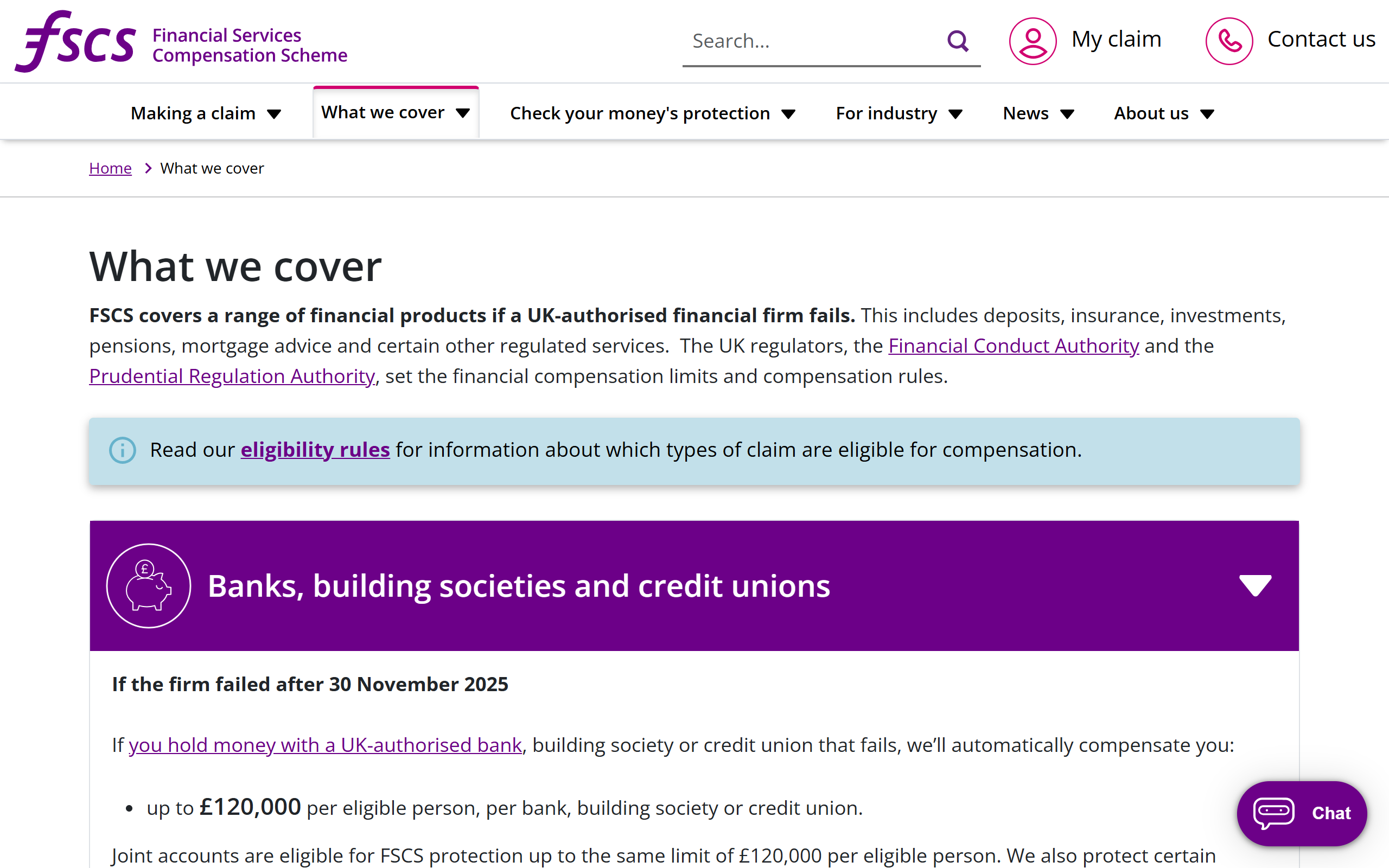
The Financial Services Compensation Scheme (FSCS) is the UK's lifeboat for when banks, investment platforms, insurers and pension providers fail. The headline cash cap rose from £85,000 to £120,000 per eligible person, per banking licence on 1 December 2025, which most UK savers have not yet noticed. The United States still has a higher headline number with FDIC's $250,000 limit, but the cash cap is one variable of seven and tells you almost nothing about how the schemes actually compare in practice.
Look at the seven things deposit insurance schemes are actually judged on - cash cap, breadth of products, special-circumstance protection, speed of payout, funding model, track record, and what happens to the bits that are not covered - and the FSCS comes out at the top of the table on five of them and is now in the top three on the sixth. Here is why the UK's safety net is genuinely one of the strongest in the developed world.
Contents
- How the £120,000 FSCS limit compares globally
- What FSCS covers beyond bank deposits
- The £1.4 million Temporary High Balance rule
- Why FSCS actually pays out: speed and track record
- FSCS vs FDIC and global peers at a glance
- Frequently asked questions
How the £120,000 FSCS Limit Compares Globally
The raw cash cap, side by side:
- UK FSCS: £120,000 per eligible person, per banking licence (raised from £85,000 on 1 December 2025)
- US FDIC: $250,000 per depositor, per insured bank, per ownership category (~£200,000 at current rates)
- Australia FCS: AUD $250,000 per account holder per institution (~£127,000)
- Switzerland esisuisse: CHF 100,000 (~£90,000)
- EU Deposit Guarantee Scheme: €100,000 standardised across member states (~£85,000)
- Canada CDIC: $100,000 per insured category (~£58,000)
The US and Australia have higher headline cash caps. The UK now sits clearly in third place after the December 2025 uplift, ahead of Switzerland, the EU, and Canada by a meaningful margin. On the pre-uplift figure of £85,000 the UK was mid-table; today it is a top-three scheme on the variable that gets all the attention.
This is also the variable that matters least for most households. UK personal cash deposit balances above £120,000 are concentrated in a small minority of households. For the vast majority of UK adults, the £120,000 cap is academic - their entire cash position fits inside the protected envelope at a single bank. The interesting comparison is what each scheme does for the things FDIC and EU DGS do not touch.
What FSCS Covers Beyond Bank Deposits
This is where the UK pulls ahead. The FSCS is one of a small number of consolidated schemes that covers all categories of authorised financial firm failure under one roof:
- Cash deposits: £120,000 per banking licence (raised from £85,000 in December 2025)
- Investments: £85,000 for failures of UK-authorised investment platforms and stockbrokers (admin and custody failure, not market losses; this cap was not part of the December 2025 uplift)
- Long-term insurance (life policies, annuities): 100% of the value with no cap
- General insurance: 90% of the value with no cap on most claims, 100% for compulsory cover like third-party motor
- Pensions: 100% of the pension annuity income with no cap, plus the same investment protection on contract-based pensions
- Mortgage advice and arrangement: £85,000 per firm
The FDIC, despite the higher cash cap, covers only bank and savings-institution deposits. Investments, pensions and insurance are handled by separate US schemes with much narrower scope (SIPC covers brokerage failure to $500k but excludes a lot of products; state-by-state insurance guaranty funds vary wildly). The EU DGS is bank deposits only. Australia's FCS is bank deposits only. Most developed economies treat deposit insurance as a banking-sector tool. The UK treats it as financial-sector protection.
If you have a £40,000 ISA at a UK platform, a private pension with a UK-authorised insurer, and £20,000 in a UK current account, FSCS covers all three with separate caps - £85,000 on the investment side, £120,000 on the cash side, 100% on the long-term insurance side. The equivalent US household has three different schemes to navigate, each with different rules, different funding models, and in some cases no guarantee at all.
The £1.4 Million Temporary High Balance Rule
This is the FSCS feature that has no real equivalent anywhere else. For up to six months, FSCS will protect cash deposits up to £1,400,000 (raised from £1,000,000 alongside the December 2025 uplift) if the money arrived from one of these life-event sources:
- Sale of your main residence
- Lump-sum redundancy
- Inheritance or proceeds of a will
- Divorce settlement (capital element)
- Personal injury compensation
- Lottery wins or similar
- Lump-sum pension drawdown
The logic is obvious once you see it. There are moments in a normal life when £120,000 is not enough, and forcing someone to split a house-sale lump sum across twelve different banks the day completion happens is absurd. So FSCS gives you six months of breathing room to deploy the money - pay off the mortgage on a new home, invest into a pension or ISA, buy a property, whatever the next step is.
FDIC has nothing equivalent. EU DGS has nothing equivalent. Australia, Canada, Switzerland - all silent on this. The £1.4m temporary cap is one of the most generous single features in deposit insurance globally.
Why FSCS Actually Pays Out: Speed and Track Record
A safety net only matters if it deploys when needed. The FSCS has a 7-day payout target for the most common cases (cash deposits at failed banks) and a 12-month cap for complex cases. Real-world performance lives up to it. The 2008-09 wave of failures was the modern test:
- Bradford & Bingley (September 2008): nationalised; depositors fully covered
- Icesave, Heritable and Kaupthing Singer & Friedlander (October 2008): Icelandic and UK-resident depositors received FSCS protection while diplomatic recovery proceeded
- London Scottish Bank (November 2008): retail depositors paid out within weeks
Since 2008, every major UK-authorised bank failure has produced timely FSCS payouts. Smaller fintech and credit-union failures since 2018 have typically cleared within the 7-day target window.
FSCS is also funded by industry levies rather than the taxpayer. Banks, investment firms and insurers pay annual contributions sized to their FSCS-protected liabilities. The compensation pool sits at FSCS, not at the Treasury, so there is no political negotiation when a failure happens. The cheque writes itself. Contrast this with the US, where FDIC has a similar pre-funded model but lifeboat extensions (such as the protection of "uninsured deposits" during the 2023 Silicon Valley Bank failure) required emergency Treasury authorisation.
FSCS vs FDIC and Global Peers at a Glance
The combined picture across the seven dimensions:
| Dimension | UK FSCS | Notes |
|---|---|---|
| Cash cap | Top three at £120k | US and Australia still higher; ahead of EU, Switzerland, Canada after Dec 2025 uplift |
| Product breadth | Best in class | Cash, investments, pensions, insurance under one roof |
| Special-circumstance cap | £1.4m for 6 months | Unique globally |
| Payout speed | 7-day target | On par with FDIC, faster than EU minimum |
| Funding model | Industry levies | No taxpayer-bailout politics |
| Track record | Reliable since 2001 | Every major authorised failure paid out |
| What is not covered | Crypto, unregulated firms | Cleanly defined |
The conclusion is not that £120,000 is a generous cash cap, although the December 2025 uplift from £85,000 made it materially more competitive. It is that the FSCS treats the cash cap as the floor of a comprehensive safety net rather than the whole thing. The breadth, the temporary high balance rule, the speed and the funding independence add up to a scheme that is harder to find a real-world failure mode for than any of the headline-grabbing higher-cap alternatives.
The wider point is worth saying outright. A deposit insurance scheme that covers cash but not investments, that needs a Treasury phone call to extend in a crisis, and that quietly excludes pensions and insurance because they were not in the original 1933 statute, is a scheme designed for institutional convenience, not for the working family it claims to protect. The UK's choice to bring all of financial-firm failure under one roof, fund it from industry rather than the taxpayer, and add a £1.4 million breathing-room window for the days when normal life produces an abnormally large bank balance, is a deliberate design choice that puts the depositor first. It is one of the things the UK quietly gets right, and ordinary savers are the ones who benefit.
Frequently Asked Questions
How does FSCS compare to FDIC?
FDIC has a higher cash limit ($250,000 per depositor per insured bank), but covers only bank and savings-institution deposits. FSCS has a lower cash cap (£120,000 since 1 December 2025, raised from £85,000) but also covers investments, pensions, insurance and mortgage advice under one scheme. For most UK households the breadth matters more than the cash cap differential.
Is the £120,000 FSCS limit enough?
For the vast majority of UK households, yes. Median household cash savings sit well below the limit, and the December 2025 uplift moved another tranche of savers from "exposed" into "fully covered" at a single banking licence. Above £120,000 the answer is to either spread across separate banking licences (not just separate brand names; several "different" UK banks share licences) or to put excess cash into investments or pensions, which have their own FSCS protection at separate £85k or 100% caps.
What happens if I have more than £120,000 in cash at one bank?
If the bank fails, FSCS pays out £120,000 and you lose the excess. The fix is to keep balances below £120k per banking licence, or to use the £1.4m Temporary High Balance protection if the money is short-term (house sale, inheritance, redundancy).
Are my investments safe if my platform fails?
Yes, subject to FSCS up to £85,000 for any custody or admin failure. In practice, most UK investment platforms hold client assets in trust via a nominee account, so the underlying investments are not on the platform's balance sheet and would be transferred to a replacement provider during a failure. FSCS plugs any gap caused by the administrative collapse itself.
Does FSCS cover crypto?
No. Crypto firms are not FSCS-authorised. If a UK crypto exchange fails, your holdings are at the mercy of the administrators. The same applies to peer-to-peer lending platforms and any other firm operating outside the FCA's authorisation regime. This is a design choice - extending FSCS to unregulated activity would push levies up across the regulated sector.
Prefer to watch?
We turn these money breakdowns into short videos
A few a week, plain-English UK money. If you would sooner watch than read, follow along:
Enjoying the content?
If this site has been useful, a coffee goes a long way.
Browse more articles
Browse all