








Generational Wealth: Why £100k at 25 Beats £500k at 60
The inheritance you leave will arrive in the wrong decade. By 60 your kids have a paid-off house and a vague relief. The decade it would have changed their lives is long gone.
Cite this article
Freedom Isn't Free (2026) Generational Wealth: Why £100k at 25 Beats £500k at 60. Available at: https://freedomisntfree.co.uk/articles/generational-wealth-early-inheritance (Accessed: 21 September 2026).
Italicise the article title in your bibliography. Accessed date set to today.
TLDR
- Generational wealth in the UK is usually transferred too late. A £500k inheritance arriving at 60 changes far fewer life outcomes than £100k arriving at 25.
- Early money compounds beyond the spreadsheet. It buys optionality, risk tolerance, and years of escaping rent. The compound interest calculator captures none of this.
- The risk is gifting before the recipient understands the value of money. Early adult financial pressure is the formation that makes the later gift productive rather than corrosive.
- UK rules give givers real headroom: a £3,000 annual exemption, the seven-year rule on larger gifts, and wrappers (ISA, SIPP, Junior ISA) that keep the compounding tax-free.
A workable £100k early gift at 25
| Bucket | Amount | Why it matters |
|---|---|---|
| House deposit | £60,000 | Escapes rent during the highest-outflow decade |
| Stocks and Shares ISA | £20,000 | Tax-free compounding for 35+ years |
| Cash buffer | £17,120 | 6 to 12 months of expenses for optionality |
| SIPP top-up | £2,880 | Grossed up to £3,600 with basic-rate relief |
UK gift rules: £3,000 annual exemption, plus 7-year PET rule on the rest.
Generational Wealth: Why £100k at 25 Beats £500k at 60
Generational wealth in Britain is usually transferred across the wrong decade. Most inheritances arrive when the recipient is between 55 and 65: their parents die, the family home is sold, and a six-figure cheque lands in the bank account of a person whose career, mortgage and major life decisions are already made. The money is welcome. It is also, in any honest accounting of impact, mostly wasted.
The interesting question is not how much wealth to pass on. It is when. A £100,000 transfer to a 25-year-old changes more life outcomes than £500,000 transferred to the same person at 60. That sounds counterintuitive until you sit with it.
The default British inheritance is wealth landing on top of wealth. By the time most parents die, their children are already in their fifties or sixties, with a house, a pension, and a career largely built on their own back. The inheritance arrives as another pile on top of an existing pile. It compounds nicely on a spreadsheet. It changes almost nothing about the life the recipient is now stuck living.
The compounded financial return on the early money is the obvious part. The non-financial compounding (optionality, risk tolerance, years not spent paying somebody else's mortgage in rent) is the much larger effect, and it is the part the compound interest calculator does not show.
Contents
- The £100k that changes a life vs the £500k that does not
- Why early money compounds beyond the spreadsheet
- The trap of giving too early
- How to know when your child is ready
- A rough framework for the transfer
- Frequently Asked Questions
The £100k that changes a life vs the £500k that does not
Take two identical adults. Call them Alex and Sam. Both leave university at 22 with the same degree, the same job offer, the same starting salary of £32,000. The only difference is that Alex's parents give him £100,000 at 25, and Sam's parents leave him £500,000 in their will, which arrives at 60.
Run the numbers on Sam first. He inherits £500,000 with twelve working years remaining. He has owned a house for fifteen years. His pension is largely built. His career trajectory is fixed. The realistic deployment of that £500k is to top up the pension, perhaps buy a holiday home, give some to his own children, and shore up retirement. Useful. Not transformational.
Now Alex. At 25 he puts £60,000 toward a deposit on a £300,000 home. The remaining £40,000 sits in a Stocks and Shares ISA, fully invested. By his late thirties his mortgage is half paid down and the ISA, compounding at 7% real, has roughly doubled. By 60 his housing wealth alone, on conservative assumptions, exceeds the £500k Sam received. His investment portfolio is larger again. He has been paying himself, not a landlord, for thirty-five years.
That is the obvious calculation. It already produces a wider gap than most parents realise. The non-obvious calculation is bigger.
Why early money compounds beyond the spreadsheet
A spreadsheet treats £100,000 as £100,000. The lived experience of receiving it at 25 is nothing like the lived experience of receiving it at 60. Three forms of non-financial compounding kick in.
Optionality. Early money is permission. Alex can leave a job he hates without six months of savings stress. He can take a 30% pay cut to join an early-stage company. He can spend two years writing a book, training as a midwife, or starting a business with real runway. Sam at 60 has the same money, but the optionality has already collapsed. His career path is set, his family obligations are fixed, his identity is calcified around the choices he already made. The same pounds buy radically less life.
Risk tolerance. A 25-year-old with savings can take career risks that a 25-year-old in overdraft cannot. The ability to walk away from a bad job is the single most valuable negotiating tool a worker has. Without it, you accept the salary you are given. With it, you negotiate. Over a forty-year career, a marginal £5k a year of additional bargaining power compounds into hundreds of thousands of pounds in lifetime earnings.
Time not spent renting. UK renters in their twenties typically pay between £900 and £1,500 a month for a one-bedroom flat, depending on the city. Across a decade in their late twenties and thirties, the typical British professional hands £150,000 to £200,000 to a landlord that they will never see again. None of that money builds equity. None of it compounds. A child who is given a deposit in their mid-twenties escapes that wealth drain at the moment it is largest, and redirects the same outgoings into their own asset.
The compound interest calculator captures none of this. The £100k that arrives at 25 doubles, triples and quadruples through life decisions that the £500k at 60 cannot make happen.
The trap of giving too early
The case for early money is strong. The case for too-early money is the opposite.
Most people need the financial pressure of early adulthood to build the part of themselves that handles money well later. The young adult who has to budget, work overtime, turn down dinners they cannot afford, and watch a paycheck disappear into bills before the next one lands, is learning something that no parent can teach. They are calibrating what £1,000 actually feels like. They are learning that work produces money and that money is finite. They are forming the relationship with earning and saving that will run for the next sixty years.
Hand a teenager £100,000 and you risk skipping that formation entirely. The money becomes notional. Spending it does not feel like spending real money because it never felt earned. The child who has never sweated through an empty bank account at the end of a month does not learn to fear one. By the time the money is gone, the skill of building it back is also missing.
The same gift, given five years later, produces the opposite outcome. The 25-year-old who has worked for three years, paid their own rent, sweated through a couple of difficult months and finally got their salary above what they need to live, has done the formation work. They know what money is. The gift becomes leverage on a skill they already have, not a replacement for a skill they never developed.
This is the central tension in giving generational wealth. Too late and the money is wasted on a life already built. Too early and the recipient never builds the life at all. The window is narrow and worth thinking about carefully.
How to know when your child is ready
There is no exact age. There are signals. The signal is not "they finished university" or "they got a job". The signal is competence with their own money, sustained over time, when nobody was watching.
Useful evidence that the formation has happened:
- They have lived independently for at least two years and paid all their own bills without help.
- They have saved a meaningful sum from their own income, even if small, without being prompted.
- They understand the difference between a salary and take-home pay, and they can tell you their rough monthly outgoings.
- They have made at least one real financial decision under pressure (a flat move, a car purchase, a career change) and lived with the consequences.
- They do not ask you for money. When they have, it has been rare and explained.
A child clearing this bar at 24 is more ready than another child at 32 who has been quietly subsidised the whole time. Age is a proxy for the underlying signal, not the signal itself. The first £100,000 is the hardest to build, and once a young adult has shown they can take any step toward it on their own, additional money lands on a working foundation rather than replacing one.
A rough framework for the transfer
Once the readiness is confirmed, the structure of the transfer matters. UK rules and ordinary human behaviour push in the same direction: split the gift, give it for a specific purpose, and put part of it inside tax-protected wrappers.
A workable shape for a £100,000 transfer might look like this:
- A house deposit. The largest single useful purpose for early gifted money in the UK is escaping rent. Match the deposit to a sensible property purchase in a place the child actually wants to live. Do not gift toward a home that requires them to take on a mortgage they cannot comfortably service alone.
- A Stocks and Shares ISA top-up. Up to £20,000 a year can sit in an ISA growing tax-free indefinitely. Funding this for a few consecutive years is one of the highest-leverage ways to compound wealth across decades, because the wrapper itself adds compounding by removing tax drag.
- A small SIPP contribution. Paying £2,880 a year into a child's pension before age 75 gets grossed up to £3,600 by basic-rate tax relief. Forty years of compounding on that is meaningful, and the money is genuinely locked away until at least their late fifties.
- A cash buffer. Six to twelve months of expenses in an easy-access savings account. This is what produces the optionality effect. Without a cash buffer there is no negotiating power, no risk tolerance, no permission to quit.
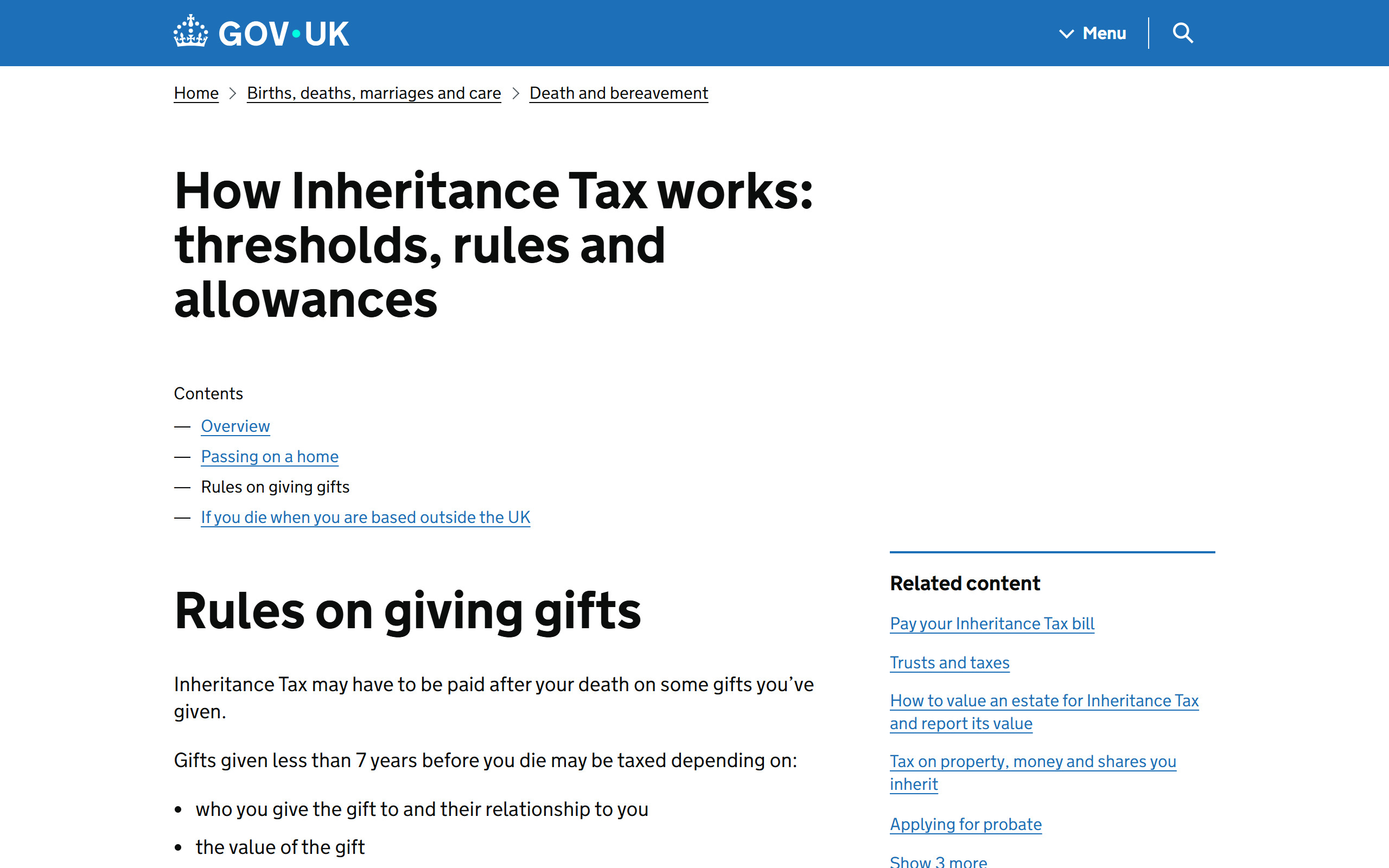
UK tax rules give the giver some headroom. Every adult can gift £3,000 a year free of inheritance tax under the annual exemption, with the previous year's unused allowance carried forward once. Larger gifts are potentially exempt from IHT if the giver survives seven years, with tapered relief between three and seven years. Wedding gifts of up to £5,000 to a child are also exempt. None of this changes the strategic point about timing, but it shapes how the gift is structured so HMRC does not eat a chunk of it. Our UK inheritance tax guide walks through the full mechanics if you want to plan a larger transfer.
The deeper principle is the one the spreadsheet hides. The first £100,000 a young adult holds is harder to accumulate than every subsequent £100,000 they will ever build, because the first one has to be saved out of a paycheck that is competing with rent, student loans and the cost of life starting up. Giving them that first £100,000 is not just a financial transfer. It is the removal of the single hardest step in the whole compounding journey. Everything after it is materially easier.
Frequently Asked Questions
How much money should I give my child as an early inheritance?
There is no fixed answer, but the practical floor in the UK is whatever covers a sensible house deposit in the area the child wants to live, plus a modest cash buffer. That number is around £60,000 to £100,000 in most of England, higher in London. Above that level the marginal impact starts to fall off, because the early-life unlocks (property, optionality, cash buffer) are mostly bought. Anything beyond that point is usually best held back, invested, and given later.
What is the UK inheritance tax position on early gifting?
Each individual can give £3,000 a year free of inheritance tax. Larger gifts are potentially exempt transfers, meaning they fall outside the estate if the giver survives seven years. Gifts that fall between three and seven years before death receive partial relief on a tapered scale. Wedding gifts up to £5,000 to a child are exempt. Anything above £325,000 (the nil-rate band) given in the seven years before death is taxable at 40% on the recipient's share.
Is it better to give money in life or leave it in a will?
For most families with enough wealth to be inheritance-tax exposed, giving in life is more efficient on both counts. The recipient gets the money during the years it changes their life most. The giver shrinks the estate that HMRC will tax at 40%. The combined effect is meaningfully higher net wealth transferred. The trade-off is irreversibility: once the money is gone, the giver has to be certain their own retirement is funded first.
What if my child is not financially mature enough yet?
Wait. The money does not depreciate in your account. The recipient does, in the sense that their window for early-life optionality narrows every year. Use the waiting time to fund a Junior ISA (£9,000 a year, tax-free, the child takes control at 18), make use of the £3,000 annual gift allowance for small transfers that test their behaviour, and use the period as a calibration on whether they are ready.
Does giving early money to a child remove their motivation to work?
It can. The risk is highest when the gift arrives before the child has built a working relationship with their own money. The same gift, given after they have sustained a career and supported themselves for several years, almost never has this effect. The fix is timing, not amount. A £100k gift to a self-sufficient 25-year-old is leverage on a working life. The same gift to a 19-year-old who has never paid rent is a replacement for one.
Further Reading:
Die With Zero - Bill Perkins - The single best treatment of the argument that money has a sell-by date and that giving while you are alive (and your children are young enough to use it) produces more lifetime utility than leaving a large inheritance. (Affiliate link - we may earn a small commission at no extra cost to you.)
Prefer to watch?
We turn these money breakdowns into short videos
A few a week, plain-English UK money. If you would sooner watch than read, follow along:
Enjoying the content?
If this site has been useful, a coffee goes a long way.
Browse more articles
Browse all