





LISA vs SIPP: When the Lifetime ISA Wins
Every UK forum tells basic rate taxpayers to use a SIPP. The maths the forums skip says otherwise for a specific group of savers, and the LISA quietly wins by thousands.
Cite this article
Freedom Isn't Free (2026) LISA vs SIPP: When the Lifetime ISA Wins. Available at: https://freedomisntfree.co.uk/articles/lisa-vs-sipp-when-it-wins (Accessed: 23 August 2026).
Italicise the article title in your bibliography. Accessed date set to today.
TLDR
- For a basic rate taxpayer with no employer match, a LISA often returns more pound-for-pound than a SIPP, because the 25% bonus matches basic rate relief and withdrawals are fully tax-free.
- A non-earning partner can only get pension relief on £2,880 a year. The LISA lets them shelter up to £4,000 with a £1,000 bonus, which is the better deal under 40.
- LISA money is useful in drawdown for keeping taxable income below thresholds, since the withdrawal does not eat into the personal allowance.
- The SIPP still wins for higher rate taxpayers, anyone with an employer match, and anyone who needs access between 55 and 60.
£80 in: what reaches you at withdrawal
| Wrapper | After top-up | Tax-free portion | Net to you |
|---|---|---|---|
| SIPP (basic-rate in retirement) | £100 | 25% (£25) | £85 |
| LISA (age 60+) | £100 | 100% (£100) | £100 |
| Non-earner pension (capped £2,880) | £3,600 | 25% tax-free | Most taxed |
| Non-earner LISA (full £4,000) | £5,000 | 100% at 60 | £5,000 |
For a basic-rate saver with no employer match, the LISA's exit treatment beats the SIPP.
LISA vs SIPP: When the Lifetime ISA Wins
The LISA vs SIPP question usually gets a one-line answer on most personal finance forums: "use the SIPP, it's better." That's right about 80% of the time. The other 20% is where things get interesting, and where the Lifetime ISA quietly does a job no other UK wrapper can match.
This guide is about those niches. If you're a basic rate taxpayer with no employer match, a non-earning partner, or someone planning a drawdown that needs to dodge the personal allowance taper, the Lifetime ISA isn't a consolation prize. It's the right tool. The SIPP still wins most of the time, but knowing the cases where it doesn't can save you tens of thousands over a working life.
Contents
- The basic rate maths: why a LISA quietly beats a SIPP
- The non-earning partner trick
- Drawdown scenarios where LISA money is the cleanest pound
- Other niches where the LISA wins
- Where the SIPP still wins (most of the time)
- Frequently Asked Questions
The basic rate maths: why a LISA quietly beats a SIPP
The headline trick people miss is that the 25% LISA bonus and 20% basic rate pension relief are exactly the same number, just expressed from a different starting point.
- Pension relief: every £80 of net contribution becomes £100 in the pension. That's a 25% uplift on what you put in (£20 added on £80).
- LISA bonus: every £80 of contribution becomes £100 in the LISA (£20 bonus on £80, capped at £1,000 a year).
Identical going in. The difference is what happens when you take the money out.
A basic rate pension withdrawal at retirement gets 25% tax-free and the remaining 75% taxed as income at your marginal rate. If you're still a basic rate taxpayer in retirement (which most people are), that's 20% tax on three quarters of the pot.
Walk the £100 through the gate at 60:
- SIPP: £25 tax-free + (£75 × 80%) = £25 + £60 = £85.
- LISA: £100 tax-free = £100.
Same £80 in. The LISA gives you £15 more out, a 17.6% bigger pot at the point of withdrawal. That's not a rounding error. Run it through a compound interest calculator across thirty years of £4,000 annual contributions and the LISA pulls ahead by tens of thousands.
The catch is well known: no employer match, no salary sacrifice National Insurance saving, and the £4,000 annual cap. But if you don't have access to those things, the LISA wins on pure tax efficiency for a basic rate saver.
Where the SIPP claws it back for basic rate
The SIPP wins back ground if any of the following apply:
- Employer match. A 5% match on a £30,000 salary is £1,500 of free money a year. No LISA bonus comes close.
- Salary sacrifice. Knocks 8% NI off your contribution before tax. Worth roughly another 8% on top of the headline relief.
- You expect to drop below the personal allowance in retirement. Then your pension withdrawal is 25% tax-free plus 75% × 0% = effectively 100% tax-free, matching the LISA. Few people manage this in practice once the State Pension is added in.
If none of those apply (self-employed, on a basic rate income, no workplace pension, contributing from after-tax savings), the LISA is the better wrapper for that £4,000. When that is your situation, the next decision is which provider to use: our Stocks and Shares Lifetime ISA comparison covers the handful that offer an investing LISA and what they charge.
The non-earning partner trick
This is the niche almost nobody talks about, and it's worth real money in households with one earner.
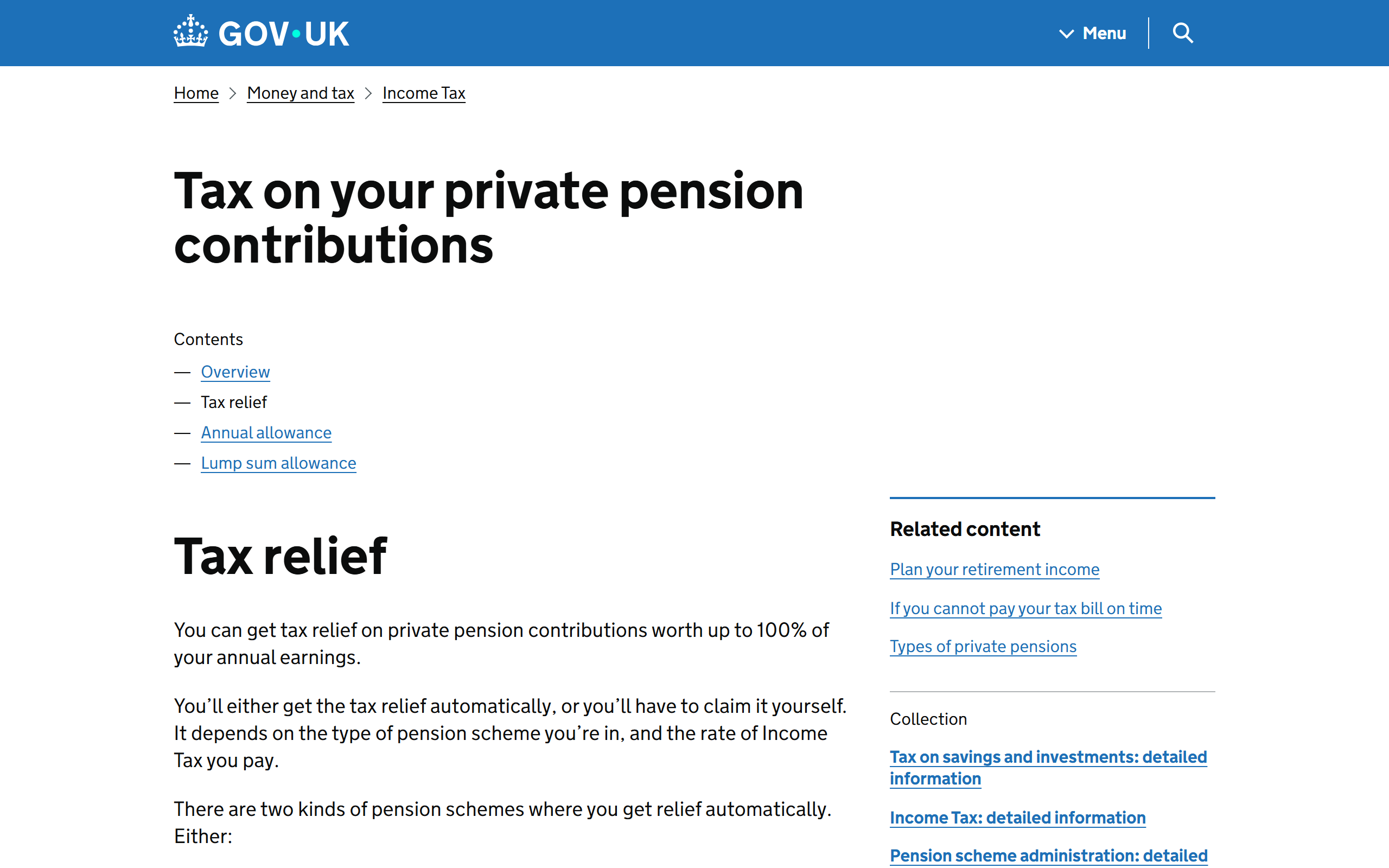
A non-earning partner (a stay-at-home parent, a carer, anyone with no taxable income) can still contribute to a pension. HMRC will gross up contributions as if the person paid basic rate tax, even though they don't. The cap on this relief is £2,880 net per tax year, which becomes £3,600 in the pension.
That's a useful loophole, but the LISA does better:
| Wrapper | Net contribution | Government top-up | Total in account |
|---|---|---|---|
| Pension (non-earner) | £2,880 | £720 | £3,600 |
| LISA | £4,000 | £1,000 | £5,000 |
The LISA lets the non-earning partner shelter £1,400 more per year, with £280 more in free top-up money. Both grow tax-free. The LISA is fully tax-free on withdrawal at 60. The pension portion will mostly be taxable at withdrawal, although for a small pot held by a low-income retiree it may still come out below the personal allowance.
The mechanics work because LISA bonuses don't depend on earnings or tax paid. The Treasury hands them out based on contributions, full stop. For a household where one partner earns and one doesn't, the optimal play under 40 is often:
- The earner uses their workplace pension up to any employer match (free money first).
- The non-earning partner opens a LISA and contributes up to £4,000.
- The earner then tops up either their SIPP or a Stocks and Shares ISA depending on tax band.
This shifts £4,000 of household savings into a wrapper that wouldn't have been available if both partners earned, and it gets a bonus the high-earning partner could never claim.
Drawdown scenarios where LISA money is the cleanest pound
Tax-free withdrawals look identical to ISA withdrawals on paper. The reason LISA money is special in retirement is that it doesn't appear on your tax return at all.
Several common drawdown problems get easier when part of your retirement income comes out of a LISA:
Staying under the higher rate threshold. A chunky DB pension or rental income already pushing you toward £50,270 means SIPP drawdowns can tip you into 40% territory. LISA withdrawals don't count, so you can top up spending without crossing a band.
Preserving the personal allowance. From State Pension age, your State Pension uses up most of the £12,570 personal allowance. SIPP drawdowns above that get taxed at 20%. LISA withdrawals don't touch the allowance.
Avoiding the 60% tax trap. Anyone earning between £100,000 and £125,140 loses their personal allowance at a 60% effective rate. If you've maxed your pension annual allowance, LISA contributions at least build a tax-free pot to draw on later without adding to the problem.
Bridging between 60 and State Pension age. From 60 you can draw the LISA tax-free; the State Pension doesn't kick in until 67. That seven-year gap is exactly when most people want low-tax income, and the LISA delivers it without touching the SIPP or burning through ISA capital. Complements the standard ISA-pension bridge strategy.
Other niches where the LISA wins
A few other spots where a LISA quietly outperforms a SIPP for the right person:
- You've maxed your pension annual allowance. High earners using carry-forward eventually run out of pension headroom. The LISA's £4,000 sits outside that cap.
- Pension rules get tinkered with at every Budget. Pension access age has moved from 50 to 55 to 57. The lifetime allowance was abolished then partially replaced. Pensions become part of your estate for inheritance tax from April 2027. The LISA's rules haven't shifted meaningfully since launch in 2017. (Caveat: the political risk to the LISA itself runs the other way, covered below.)
- Pensions get clunky in drawdown and at death. Flexi-access drawdown, UFPLS, annuities, lifetime allowance protection, the lump sum split, post-75 inherited-drawdown rules: genuinely complicated. A LISA is one button: withdraw, tax-free, done. For a portion of your retirement money your future spouse or executor can handle on a bad day, that simplicity has real value.
- The double-bubble play if you're still earning at 60. From 60 the LISA pays out tax-free. If you're still earning above the higher-rate threshold and have pension annual allowance left, you can recycle that LISA money into a SIPP and pick up another round of 40% relief. £100 withdrawn becomes £125 in the pension via basic-rate relief at source, with another £25 reclaimed through self-assessment. Only relevant for the small group still earning at higher rate at 60-plus (consultants, NEDs, business owners), but for them it's close to free money.
- You expect your tax bracket to be the same in retirement as today. The standard pension argument depends on retiring in a lower bracket. If you expect a DB pension, rental income or business profits to keep you at the same band, the LISA's flat tax-free withdrawal looks much better.
- You want a clean, simple wrapper without lifetime allowance complexity. No lifetime cap, no allowance taper. What you put in, plus growth, comes out tax-free at 60.
- It's reachable in a true emergency. If your life falls apart and you've burned through every other option, you can pull money out of a LISA. The 25% withdrawal penalty claws back the bonus and takes a 6.25% bite out of your own contributions, so £4,000 in returns about £3,750. Painful, but not zero. A SIPP is fully locked until 55. This shouldn't replace a proper emergency fund, but it's a tiebreaker over a SIPP if you're choosing between locking money in one of the two.
None of these are universal wins. They're situational, which is exactly why the LISA gets dismissed too quickly.
Where the SIPP still wins (most of the time)
For the average UK earner, the SIPP is still the better default. It wins clearly if any of these apply:
- You're a higher or additional rate taxpayer. 40% relief on the way in beats 25% bonus, even after exit tax. At 45%, it's not close.
- You have an employer match. Free money trumps everything else. Always take the full match first.
- You need access between 55 and 60. The SIPP is accessible from 55 (rising to 57 in 2028); the LISA is locked until 60 unless you're buying a first home.
- You want to contribute more than £4,000 a year. The LISA cap is hard. The pension annual allowance is £60,000.
- You're over 40. You can't open a new LISA after your 40th birthday.
- Pension wealth is invisible to means-tested benefits. Your pension pot doesn't count toward the £16,000 capital limit for Universal Credit or council tax support. ISA assets, including your LISA, do. For anyone whose career path includes a real risk of a forced break (illness, redundancy, caring), this is a genuine structural advantage.
- Pension death benefits are better, especially before 75. Die before 75 and beneficiaries inherit the pension tax-free; after 75 they pay income tax at their marginal rate but keep the wrapper. A LISA passes like any other ISA: a surviving spouse can use the Additional Permitted Subscription, but on the second death assets lose all ISA shelter. For multi-generational planning, the pension wins comfortably.
- Behavioural lock-in stops you raiding the pot. The LISA's 25% penalty hurts but can be paid. The SIPP can't be touched until 55. For anyone who'd raid the money in a weak moment, the harder lock is a feature.
- Easier route to an annuity. The pension annuity market is large and well-understood. There's no equivalent for LISA money.
- More providers, more support, often lower fees. Pensions are mainstream; LISAs are niche. Dozens of low-cost SIPP platforms compete on price. The LISA market is much thinner.
- Political risk runs the other way for the LISA itself. Pension rules change at the margins every Budget, but pensions are politically untouchable: tens of millions of voters hold one. The LISA's constituency is much smaller, and several Treasury reviews have questioned whether it's value for money. A future Budget could quietly close the LISA to new contributions, leaving you with a stranded balance.
The right answer for most people is "both, in the right order." Match first, then LISA up to £4,000 if you qualify, then SIPP top-up, then ordinary ISA. The LISA isn't a SIPP replacement. It's a precision tool for the gaps the SIPP can't cover.
Frequently Asked Questions
Is a LISA better than a SIPP for a basic rate taxpayer?
For a basic rate taxpayer with no employer match, the LISA usually returns more pound-for-pound than a SIPP. The 25% bonus matches basic rate relief on the way in, and the LISA pays out fully tax-free at 60 while the SIPP pays out 25% tax-free with the rest taxed as income. Where the SIPP claws it back is employer matching and salary sacrifice National Insurance savings. If neither applies, the LISA wins.
Can a non-earning spouse open a LISA?
Yes, provided they're aged 18 to 39 and a UK resident. There's no earnings requirement. This is the LISA's biggest advantage over a pension for a non-earner: the £4,000 annual cap and £1,000 bonus apply regardless of income, while pension relief for non-earners is capped at £2,880 net (£3,600 gross).
Can I use a LISA if I'm self-employed?
Yes, and this is one of the strongest LISA use cases. Self-employed workers don't get an employer match, which removes the SIPP's biggest advantage. A self-employed basic rate taxpayer under 40 should usually max the LISA every year before adding to a SIPP, then use the SIPP for any contributions above £4,000.
What happens to LISA money I don't use for a house?
If you keep it past your 60th birthday, you can withdraw the full balance, including all bonuses and growth, completely tax-free, for any reason. That's the underrated retirement angle. The LISA isn't only for first-time buyers, even though that's how it gets marketed.
Could the government scrap the LISA?
Plausibly. The LISA is a niche product with a small political constituency, and several Treasury reviews have questioned whether it's value for money. A future Budget could close it to new contributions, leaving you with a stranded pot. The risk isn't huge but it's real, and it's part of why the standard advice is to use the pension as the main retirement vehicle and the LISA as a complement.
Read Next
- Lifetime ISA UK Guide: Bonus, Rules and Pitfalls
- ISA vs Pension: Which Is Better for UK Investors?
- SIPP vs Workplace Pension
- The ISA-Pension Bridge for Early Retirees
- The 60% Tax Trap and How to Avoid It
Further Reading:
Quit Like a Millionaire - Kristy Shen - A FIRE playbook with a sharp focus on tax-efficient drawdown, exactly the kind of thinking that makes the LISA's tax-free retirement angle worth using. (Affiliate link - we may earn a small commission at no extra cost to you.)
Prefer to watch?
We turn these money breakdowns into short videos
A few a week, plain-English UK money. If you would sooner watch than read, follow along:
Enjoying the content?
If this site has been useful, a coffee goes a long way.
Browse more articles
Browse all