
The Hidden Tax on Silence: The Cost of Convenience
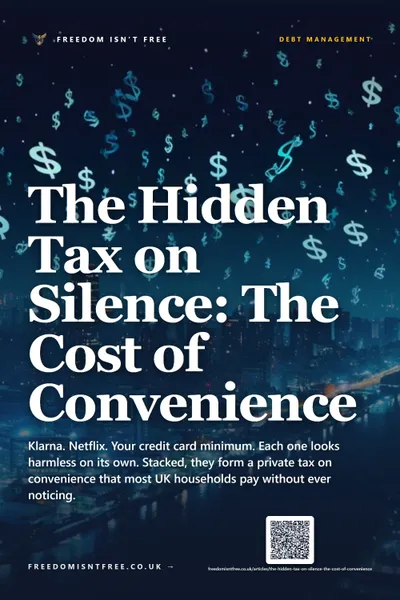
Klarna. Netflix. Your credit card minimum. Each one looks harmless on its own. Stacked, they form a private tax on convenience that most UK households pay without ever noticing.
Cite this article
Freedom Isn't Free (2026) The Hidden Tax on Silence: The Cost of Convenience. Available at: https://freedomisntfree.co.uk/articles/the-hidden-tax-on-silence-the-cost-of-convenience (Accessed: 21 September 2026).
Italicise the article title in your bibliography. Accessed date set to today.
TLDR
- Modern consumer credit designs to extract money quietly through manageable payments, obscuring the total cost.
- BNPL schemes, subscription models, and credit cards exploit the gap between immediate satisfaction and later cost.
- Over time, BNPL can result in significant hidden liabilities and costs, including late fees and interest.
- Credit cards with high APRs become expensive if not paid off monthly, functioning as a private tax on purchases.
- Subscription services can hide significant costs; auditing and canceling unused subscriptions can lead to substantial long-term savings.
True cost of carrying a £1,000 credit card balance at 20% APR
Minimum payments on a 20% APR card roughly double the cost of every purchase.
The Hidden Tax on Silence: The Cost of Convenience
Modern consumer credit has a design philosophy. It is not designed to help you - it is designed to extract money from you quietly, one manageable payment at a time.
Buy Now Pay Later (BNPL) schemes, subscription models, and credit cards all share the same mechanism: they reduce the friction of spending now while obscuring the total cost. The psychological exploitation is not accidental. It is the product.
This article exposes how these traps work, calculates what they actually cost, and provides a roadmap to breaking free.
The Psychology of Instant Gratification
Humans are wired for immediate reward. The satisfaction of a purchase arrives instantly. The cost - the debt, the interest, the monthly deduction - arrives later, when the emotional reward has faded.
BNPL services and subscription models are built entirely on this gap. They reduce the perceived cost of a purchase to a small, manageable-sounding instalment. But the total cost is identical to buying outright - often higher, once fees are included.
The additional risk is that fragmented payments make overspending invisible. You may have four separate BNPL agreements running simultaneously, each with its own due date and fee structure, collectively representing a significant liability that never appeared as a single alarming number.
The BNPL Trap: A Case Study
Consider a £100 purchase split into four payments over three months. Each payment is £25 - psychologically trivial.
Now consider the reality: you make this kind of purchase every month. Four different products, each "just £25 a month." Within three months you have 12 separate payment obligations totalling £300 per month in BNPL repayments on items you have already consumed.
Late fees are common. Some BNPL providers charge interest on missed payments at rates comparable to credit cards. The FCA has expressed significant concern about the BNPL sector's harm to consumers, and regulation was extended to cover major BNPL providers in 2024.
The convenience is real. The financial cost is also real - and harder to see.
Credit Cards: The Private Tax on Your Labour
A credit card with a 20% Annual Percentage Rate (APR) is effectively a private tax on everything you buy with it and do not pay off monthly.
If you carry a £1,000 balance at 20% APR and make only minimum payments (typically 1-3% of the balance), you will:
- Take approximately 9 years to pay off the balance
- Pay approximately £1,000 in interest alone - doubling the cost of the original purchases
The credit card company profits from your minimum payments. The product is designed to keep you making minimum payments for as long as possible.
Used correctly - paid in full every month, benefiting from cashback or rewards - a credit card is a useful tool. Used as the industry prefers - revolving balance, minimum payments, occasional missed due dates - it is one of the most expensive financial products available to ordinary consumers.
The Subscription Audit: What Are You Actually Paying?
Subscription services exploit the "set and forget" psychology. Once a monthly debit is established, it becomes invisible - background noise in your bank statement.
The average UK household has multiple active subscriptions, representing significant monthly expenditure on services many households no longer use or barely use.
Conduct a subscription audit:
- Review your bank statement for every recurring payment
- List each one with the monthly cost
- For each one, ask: did I use this in the last month? Does it cost less than replacing it manually when needed?
- Cancel anything that fails both tests
Redirecting cancelled subscription costs to investments compounds over time. £60 per month freed from unused subscriptions, invested at 7% annual growth, becomes approximately £75,000 over 30 years. Try it yourself with our compound interest calculator.
Roadmap to Debt Liquidation
Step 1: Map Your Debt
List every debt: credit cards, BNPL agreements, personal loans, overdrafts. Note the balance, interest rate, and minimum payment for each. Most people find this process uncomfortable - which is exactly why it is the essential first step.
Step 2: The Debt Avalanche
Focus extra payments on the highest-interest debt first, while making minimum payments on all others. Once the highest-rate debt is cleared, redirect that payment to the next highest. This is the debt avalanche method - mathematically optimal for minimising total interest paid.
Step 3: Eliminate BNPL
Pay off all current BNPL agreements as quickly as possible and stop using new ones. The fragmented payment model is specifically designed to obscure total debt levels. Eliminating BNPL restores a clear picture of your financial position.
Step 4: Cut Subscriptions, Cancel Credit Facilities
After clearing consumer debt, cancel any credit facilities that create temptation. Keep one credit card if you use it correctly (paid in full monthly). Remove the others.
Step 5: Build an Emergency Fund Before Investing
Before allocating money to investments, build a buffer of one to three months of essential expenses in cash. Without this buffer, an unexpected cost becomes new debt - resetting the cycle. The emergency fund breaks the cycle by giving you somewhere to turn besides credit.
Frequently Asked Questions
How does BNPL affect my credit score?
This varies by provider. Some BNPL providers do not conduct hard credit checks and do not report to credit reference agencies. Others do both. As FCA regulation of the sector has expanded, more providers now report payment history. Missed BNPL payments can affect your credit score in the same way as missed credit card payments. Using multiple BNPL agreements simultaneously may also affect affordability assessments for mortgages and other credit products.
Is all debt bad?
No. Debt is a tool, and like any tool it depends on how it is used. A mortgage enabling homeownership at a manageable rate, or a student loan funding a qualification that significantly increases earning power, can be rational. Consumer credit at high interest rates funding depreciating goods is structurally different. The key distinction is whether the debt funds an asset that holds or grows in value, or funds consumption that is already complete.
What is the debt snowball method?
The debt snowball method pays off the smallest balance first, regardless of interest rate. This provides the psychological satisfaction of eliminating an account quickly, which can help build momentum. The debt avalanche (highest interest first) minimises total interest paid; the snowball may produce better results for people who struggle with motivation. Both are valid - the best method is the one you will actually stick to.
How much does subscription creep typically cost UK households?
Estimates suggest average UK households spend £50-£100 per month on subscriptions across streaming services, gym memberships, software, and similar recurring costs. Many of these services go unused or significantly underused. A subscription audit typically identifies £20-£50 per month in clearly redundant spending.
Should I pay off debt before starting to invest?
For high-interest debt (above 6-7%), yes. The guaranteed return from eliminating a 20% APR credit card exceeds any plausible investment return. See our guide on investing vs paying off your mortgage for the same logic applied to lower-rate debt. The exception is employer pension matching - always contribute enough to capture any employer match, as this is an immediate 50-100% return on the contribution. Once high-interest debt is cleared, regular investing can begin in earnest.
Further Reading:
The Total Money Makeover - Dave Ramsey - The most accessible and motivating debt-clearance programme available. Ramsey's Baby Steps system provides a clear sequence for eliminating consumer debt and building financial security. (Affiliate link - we may earn a small commission at no extra cost to you.)
Read next:
Prefer to watch?
We turn these money breakdowns into short videos
A few a week, plain-English UK money. If you would sooner watch than read, follow along:
Enjoying the content?
If this site has been useful, a coffee goes a long way.
Browse more articles
Browse all