






Do I Need a Financial Advisor in the UK?
Most UK savers don't need an IFA. But five specific situations turn 1% a year into the cheapest money you ever spend. The trick is knowing which side of the line you're on.
Cite this article
Freedom Isn't Free (2026) Do I Need a Financial Advisor in the UK?. Available at: https://freedomisntfree.co.uk/articles/do-i-need-a-financial-advisor-uk (Accessed: 23 August 2026).
Italicise the article title in your bibliography. Accessed date set to today.
TLDR
- Most UK savers do not need a financial advisor: an ISA, a pension, a global tracker and the discipline to leave them alone beats most paid advice
- An IFA earns their fee on specific moving parts: defined benefit transfers, inheritance tax planning, decumulation, business sales, and cross-border tax
- Typical 2026 fees are 1-3% upfront and 0.5-1% per year on assets, which compounds into six-figure drag over a working life
- The only adviser label that matters under FCA rules is independent vs restricted - ask the question at the first meeting and walk if the answer is fudged
Do I Need a Financial Advisor in the UK?
For most UK savers, the answer to do I need a financial advisor is no. If your finances are salary, ISA, pension, and a global tracker, an Independent Financial Adviser charging 1% a year on £200,000 takes £2,000 every year and chews through roughly £100,000 of compounded growth over thirty years. Pay for regulated advice only when your situation has a moving part you cannot model in a spreadsheet.
The vast majority of households are better served by a Stocks and Shares ISA, a SIPP, a global tracker, and the discipline to leave them alone for thirty years. There are real situations where a good adviser is worth every penny they charge - defined benefit pension transfers, inheritance tax planning, decumulation, business sales, cross-border tax - but most ordinary savers do not face those. The rest of this article walks through which side of the line you sit on.
Contents
- The short verdict
- When you do not need a financial advisor
- When an IFA actually earns their fee
- What financial advisors actually cost
- Independent vs restricted: the only label that matters
- How to find a good UK financial advisor
- Frequently asked questions
The short verdict
Skip the financial adviser if all of these are true:
- Your finances are mostly salary, ISA, pension, mortgage, and the goal of mortgage-free retirement.
- You are willing to spend a few weekends learning the basics yourself.
- Your investment plan is "global tracker, monthly contributions, leave alone".
- You have no immediate inheritance, business sale, divorce, or complex tax angle.
Get an adviser if any of these are true:
- You are about to inherit, sell a business, divorce, or face a non-UK tax position.
- You have a defined benefit pension worth more than £30,000 that you are considering transferring (regulated advice is legally required).
- You are within five years of retirement and unsure how to convert a pot into income.
- Your estate is above the inheritance tax thresholds (£325,000 nil-rate band, or up to £500,000 with the residence nil-rate band).
- You genuinely cannot bring yourself to invest because of fear or behavioural paralysis, even with the best free resources.
For the people in the middle, an honest IFA will tell you they cannot add value above what an index fund plus a paid tax tool already does for you. The dishonest ones will not.
When you do not need a financial advisor
The classic case for skipping advice: you earn a salary, contribute to your workplace pension up to the employer match, fill an ISA, and invest in a global equity tracker. That stack is mathematically hard to beat. The Vanguard FTSE Global All Cap, the HSBC FTSE All-World Index, and Vanguard LifeStrategy 80% all do the heavy lifting for an ongoing fee between 0.12% and 0.23% a year.
Compare that with an IFA charging 1% a year ongoing on top of underlying fund costs of around 0.3%. You are paying roughly 1.3% a year for "advice" that an index fund does not need. Over thirty years, that 1% drag converts £400,000 of growth into about £290,000 (run your own numbers in our compound interest calculator). The difference is larger than most people earn in salary rises over the same period.
The other reason to skip advice is that most "advice" aimed at ordinary savers is not advice at all. It is product placement. A salaried saver does not need a clever wrapper, a structured product, or a "sophisticated" portfolio. They need to fill an ISA, fill a SIPP, hold a global tracker, and walk away.
When an IFA actually earns their fee
Some situations have moving parts that genuinely benefit from professional advice. In 2026/27 the headline ones are these.
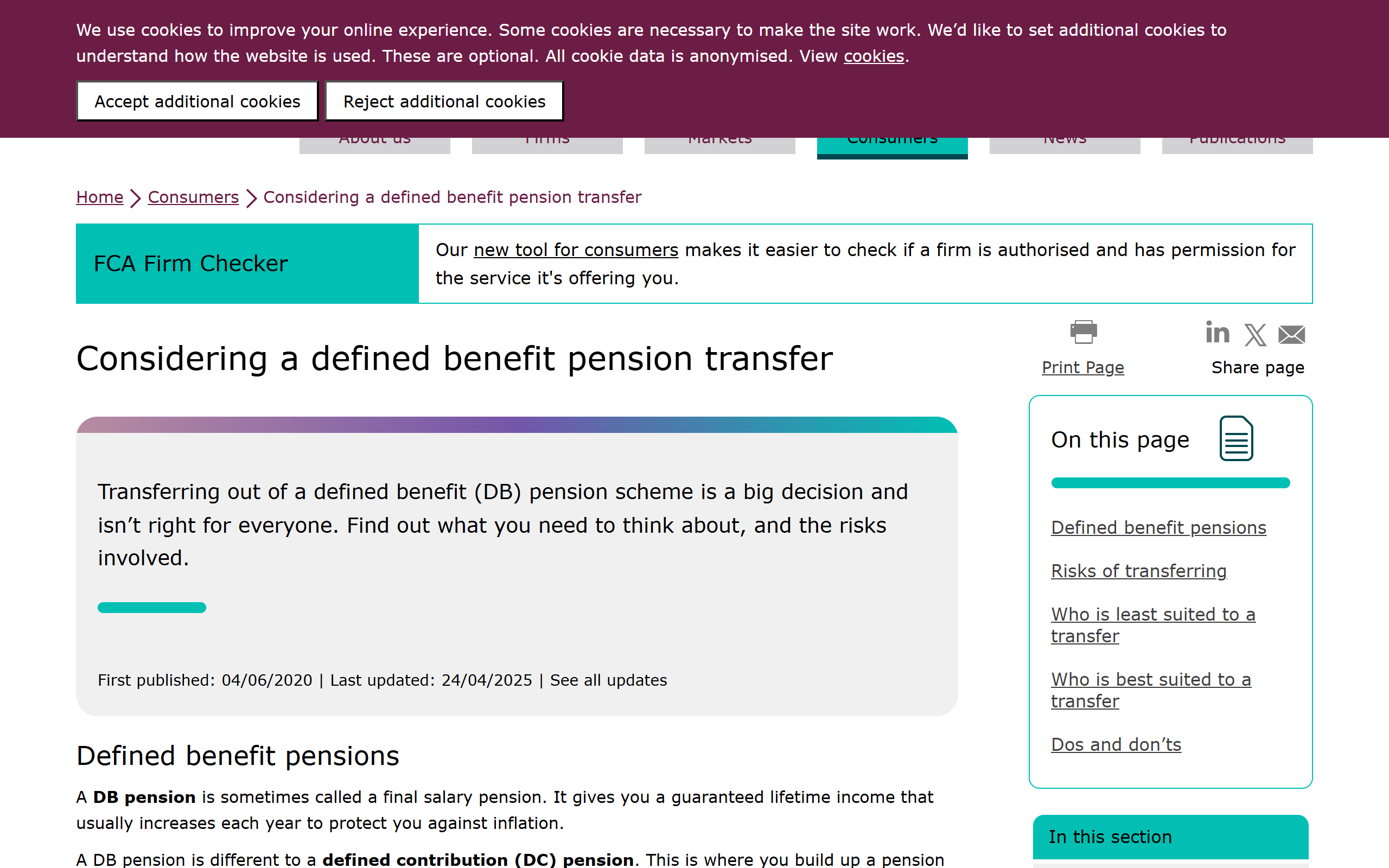
Defined benefit pension transfers. If you have a final-salary pension with a transfer value above £30,000, the FCA requires regulated advice from a Pension Transfer Specialist before transferring. This is not optional. The advice usually concludes "do not transfer" because DB pensions are valuable, but the analysis is real work and the sign-off cannot be replaced by a spreadsheet.
Inheritance tax planning above the nil-rate bands. Estates above £325,000 (or £500,000 with the residence nil-rate band when a home passes to direct descendants) face 40% inheritance tax on the excess. Trust structures, gifting strategies, and the seven-year taper are properly fiddly. A specialist IFA or chartered tax planner can save your beneficiaries five and six-figure sums for a one-off fee that looks tiny next to the saving.
Decumulation in early retirement. Drawing £40,000 a year from a £1 million pot spread across an ISA, a SIPP, and a GIA is mechanically more complex than most people realise. Order of withdrawals, tax band management, and sequence-of-returns risk all matter. A good adviser models your specific position and can save you tens of thousands in tax across a thirty-year retirement.
Business owners exiting via a sale. Business Asset Disposal Relief, pre-sale planning, and the year-by-year extraction strategy after a sale are not problems most accountants are trained for, let alone DIY savers. Get specialist advice at least eighteen months before the sale.
Cross-border situations. Inbound expats with US 401(k)s, Britons returning home with overseas pensions, anyone with non-UK domicile or residency angles. The combination of HMRC and a foreign tax authority is not territory to wing.
In each case, the value is the specific, expensive-to-research knowledge the IFA brings. Pay for the brain, not the badge.
What financial advisors actually cost
The standard UK IFA fee model in 2026/27 has two parts.
Initial fee. Typically 1% to 3% of the assets being advised on, or a fixed fee from £1,500 to £5,000 for a one-off plan. A pension consolidation of £300,000 at a 2% initial fee is £6,000. A one-off financial plan from a fee-only planner usually runs £2,000 to £4,000.
Ongoing fee. Typically 0.5% to 1% per year on assets under management. On a £500,000 portfolio at 0.75%, that is £3,750 every year, on top of the underlying fund costs. Stop paying and the "ongoing service" stops.
Watch for hidden costs underneath. Some advisers route clients into platform-and-fund stacks where they receive a kickback, or where a discretionary manager runs a portfolio with a 0.4% to 0.6% Ongoing Charge Figure. All-in costs of 1.5% to 2% a year are not unusual at the wrong end of the market.
A back-of-envelope test before you sign anything: divide what they want to charge per year by the value they claim to add. If you cannot describe the added value in plain English, the answer is no.
£500,000 invested for 30 years - the IFA fee fan
DIY tracker at 0.13%, advised stack at 1%, wealth manager at 1.5%, restricted SJP-style stack at 2%.
Source: Compound at 7% gross minus all-in fee, single lump sum, no further contributions.
Independent vs restricted: the only label that matters
Since the Retail Distribution Review in 2013, every UK adviser has had to declare themselves either independent or restricted. This is a legal label, not a marketing one.
An independent adviser must consider the whole market when recommending products. They are paid by you on a fee basis and are required to look at every relevant option.
A restricted adviser can only recommend from a limited list, often the products of the firm they work for. St James's Place advisers are the most well-known example: they sell SJP-branded funds and structures, and all-in costs are regularly reported above 2%. The FCA has fined SJP repeatedly. Restricted is not always bad, but you should know what you are buying.
The single most useful question you can ask an adviser at the first meeting is this: "Are you independent or restricted, and if restricted, who restricts you?" If the answer is fudged, leave.
How to find a good UK financial advisor
The lowest-friction routes:
VouchedFor and Unbiased are search engines for FCA-authorised advisers, with reviews and specialism filters. Look for chartered status, Pension Transfer Specialist credentials where relevant, and reviews that mention fees in pounds rather than percentages.
Fee-only planners are increasingly common. They charge a flat fee for a defined piece of work and do not take a percentage of your assets. Excellent for one-off plans, lump-sum decisions, or annual reviews.
MoneyHelper (the government-funded service that replaced the Money Advice Service) gives free generic guidance, and Pension Wise gives free pension guidance for the over 50s with defined contribution pots. Neither offers regulated advice, but both are decent first stops before paying anyone.
What to avoid: anyone who leads with a product, anyone who refuses to quote fees in pounds rather than percentages, anyone offering "free" reviews paid for by commission, and anyone who pressures a decision in the first meeting.
Frequently asked questions
How much does a UK financial advisor cost in 2026?
Typical IFA fees in 2026 are 1% to 3% of assets for an initial plan, plus 0.5% to 1% per year ongoing. A one-off plan from a fee-only planner costs £1,500 to £5,000. On a £500,000 portfolio, ongoing advice costs £2,500 to £5,000 per year, every year, with underlying fund and platform costs sitting on top.
Is a financial advisor worth it for someone with £100,000 invested?
Usually not, if the situation is straightforward. £100,000 in a Stocks and Shares ISA holding a global tracker at 0.2% all-in costs £200 per year. Add an IFA at 1% and the total drag jumps to £1,200 per year, six times more. Over twenty years, that compounds into a meaningful chunk of your retirement. The case for advice at this level is usually behavioural (you cannot bring yourself to invest) or specific (a DB transfer, an inheritance), not generic financial planning.
Do I need a financial advisor to transfer a defined benefit pension?
Yes, by law, if the transfer value is over £30,000. The FCA requires regulated advice from a Pension Transfer Specialist before any transfer can be processed. The advice itself usually concludes "do not transfer" because DB pensions are valuable. If you are determined to transfer despite that advice, a small number of providers will accept "insistent client" cases, but most will not.
Can I get free financial advice in the UK?
You can get free generic guidance, not advice. MoneyHelper is the government-funded service for general personal-finance questions. Pension Wise offers free pension guidance for those aged 50+ with defined contribution pots. Citizens Advice covers debt and benefits. None of these can recommend specific investments or products. For that, you need regulated advice and a fee.
What is the difference between a financial advisor and a financial planner in the UK?
The terms are used loosely. Most regulated UK advisers go by financial adviser, which is the title used in FCA rules. Financial planner is often used by professionals focused on long-term goal setting, cash-flow modelling, and life planning rather than product selection. Many fee-only planners use the term to signal that they are not selling products. Under FCA regulation, both roles must hold the same baseline qualifications.
Further Reading:
The Behavior Gap - Carl Richards - A working financial planner explains, with hand-drawn diagrams, why the value an adviser adds is mostly behavioural rather than tactical. Useful for figuring out whether you need that behavioural backstop or whether discipline is enough on its own. (Affiliate link - we may earn a small commission at no extra cost to you.)
I Will Teach You To Be Rich - Ramit Sethi - Sethi's whole thesis is that 90% of personal finance is automation plus a few good defaults, no adviser required. Direct, opinionated, and aligned with the DIY case made above. (Affiliate link - we may earn a small commission at no extra cost to you.)
Prefer to watch?
We turn these money breakdowns into short videos
A few a week, plain-English UK money. If you would sooner watch than read, follow along:
Enjoying the content?
If this site has been useful, a coffee goes a long way.
Browse more articles
Browse all