






Take-Home Pay Calculator UK: What You Actually Earn
The salary on your offer letter is a fiction. Four deductions chew it down before the money lands. Budgeting from the headline is why so many UK households feel poor on good pay.
Cite this article
Freedom Isn't Free (2026) Take-Home Pay Calculator UK: What You Actually Earn. Available at: https://freedomisntfree.co.uk/articles/take-home-pay-calculator-guide (Accessed: 11 June 2026).
Italicise the article title in your bibliography. Accessed date set to today.
TLDR
- Take-home pay is what lands in your account after income tax, National Insurance, student loan, and pension contributions are deducted.
- The calculator breaks down each deduction so you can see exactly where your gross salary goes every month.
- Pension contributions reduce your taxable income, often saving more in tax than they cost in net pay.
- Use the net figure as your real budget baseline rather than the headline salary you see on a job offer.
Take-Home Pay Calculator UK: What You Actually Earn
Your take-home pay is the only number that matters for budgeting, yet most people only ever talk about gross salary. The figure on your offer letter is a fiction. By the time HMRC takes income tax and National Insurance, your student loan provider takes its cut, and your pension contribution is whisked away, you might be looking at a third less than the headline number.
Our take-home pay calculator shows you exactly what hits your bank account after every standard UK deduction. Plug in your salary, your student loan plan, and your pension contribution percentage, and you get the real figure in seconds.
Contents
- What Is Take-Home Pay?
- How to Use the Take-Home Pay Calculator
- What Each Deduction Means
- The Full Marginal Rate Picture (2025/26)
- Why Pension Contributions Are Often Free Money
- Scottish Tax Bands and Sole Trader Mode
- Common Use Cases
- Frequently Asked Questions
What Is Take-Home Pay?
Take-home pay is your gross salary minus every compulsory and elective deduction made before the money reaches your account. For a typical UK PAYE employee that means four things: income tax, National Insurance, student loan repayments, and pension contributions.
If you earn £50,000 a year, your gross monthly salary is £4,167. But after a basic-rate tax bill, employee NI, a Plan 2 student loan, and a 5% pension contribution, you might see closer to £2,950 land in your account. That is a 29% gap between the salary you negotiated and the salary you actually live on.
The reason this gap matters is that everything you plan around in your financial life - rent, groceries, savings, holidays, investing - has to come out of net pay, not gross. If you build a budget around the gross figure, you will overshoot every single month.
How to Use the Take-Home Pay Calculator
The calculator needs three pieces of information. None of them require digging out a payslip. Most people can complete it in under a minute.
1. Enter Your Annual Gross Salary
Use your contracted base salary before any deductions. If you have a guaranteed bonus, add it to the annual figure. If your bonus is variable, leave it out and run the calculator again with and without to see the swing.
2. Pick Your Student Loan Plan
The calculator covers all five UK plans:
- Plan 1 - Pre-2012 English and Welsh undergraduate, all Northern Irish, all Scottish loans. Repayment threshold around £24,990.
- Plan 2 - 2012 to 2022 English and Welsh undergraduate. Threshold around £27,295.
- Plan 4 - Scottish loans taken out from 2007. Threshold around £31,395.
- Plan 5 - English and Welsh undergraduate from August 2023 onwards. Threshold £25,000.
- None - You have no loan or have already repaid it.
You repay 9% of everything you earn above the threshold for whichever plan you are on. Two plans (e.g. Plan 1 plus a postgraduate loan) stack and the calculator handles that correctly.
3. Set Your Pension Contribution
Drag the slider to the percentage of gross salary you contribute. The UK auto-enrolment minimum is 5% from you and 3% from your employer, but most workplace schemes let you go higher.
If you are not sure what to set, look at your most recent payslip. The figure next to "Pension" on the deductions side will show your current contribution. To see the long-term impact of changing it, the pension match calculator shows how every extra pound you contribute compounds over decades.
What Each Deduction Means
Income Tax
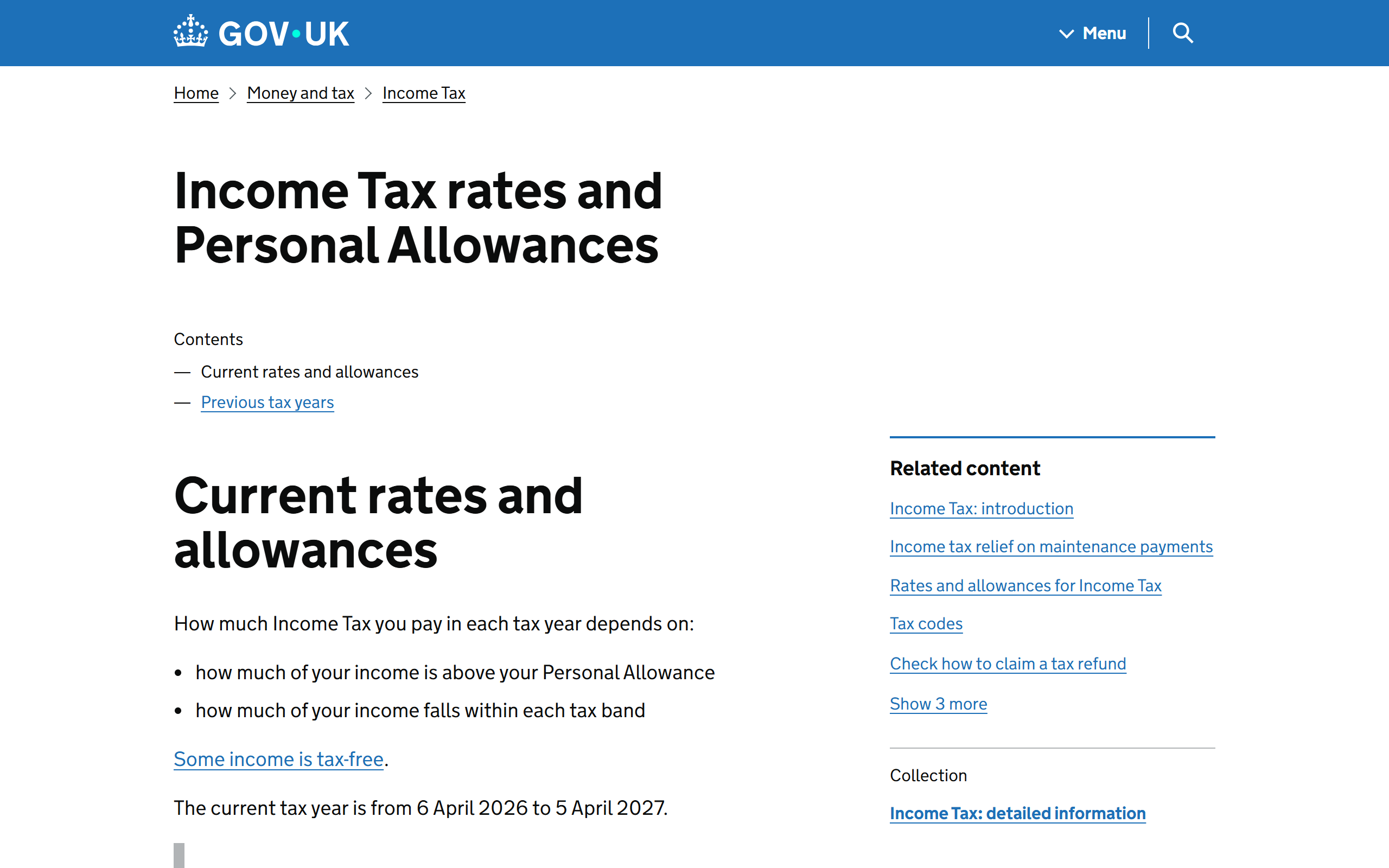
The first £12,570 of your salary is your personal allowance - tax-free. Anything between £12,570 and £50,270 is taxed at 20%. £50,270 to £125,140 is taxed at 40%. Above £125,140 is 45%. The full breakdown is published on HMRC's income tax bands page.
UK marginal tax rate by gross income, 2026/27
Combined income tax + employee NI. Each extra £1 of pay is taxed at the rate shown.
Source: HMRC income tax rates 2026/27. NI primary threshold £12,570, upper earnings limit £50,270.
There is also a stealth trap between £100,000 and £125,140 where your personal allowance is withdrawn at £1 for every £2 earned. The marginal rate in this band is effectively 60%, and salary sacrifice into a pension is the only sensible way out of it.
National Insurance
Employee NI is a flat 8% on earnings between £12,570 and £50,270, then 2% on anything above £50,270. Self-employed NI works differently and the calculator does not currently model it. If you are self-employed, your accountant or HMRC's own tools will give you a tighter answer.
Student Loan Repayments
You pay 9% of every pound earned above your plan's threshold, deducted automatically through PAYE. Gov.uk publishes the current repayment thresholds for every plan. The repayment is technically a debt, but in practice it works like an extra tax that disappears after 25 to 40 years depending on your plan.
For a deeper look at whether you should ever overpay your student loan, our analysis on should I pay off my student loan walks through the maths for each plan.
Pension Contributions
Most workplace pension contributions are taken from your gross salary before tax is calculated. This is called net pay arrangement, and it means you get full income tax relief automatically. A 5% contribution on a £40,000 salary costs you £160 per month in net pay rather than the £200 you might expect, because that £40 you would otherwise have paid in tax has gone into your pension instead.
If your scheme uses relief at source instead, contributions are taken after tax but the pension provider adds back basic rate tax relief inside the scheme. Either way you end up with the same money in your pension, but the headline net pay figure looks different. The calculator assumes net pay arrangement, which is the most common default.
The Full Marginal Rate Picture (2025/26)
A single "marginal rate" number combines income tax with National Insurance, because both are deducted from each next pound of gross earnings. The calculator surfaces this combined figure. The table below shows where it comes from for an England/Wales/NI PAYE employee.
| Gross earnings | Band | Income tax | NI | Marginal |
|---|---|---|---|---|
| £0 - £12,570 | Personal allowance | 0% | 0% | 0% |
| £12,570 - £50,270 | Basic rate | 20% | 8% | 28% |
| £50,270 - £100,000 | Higher rate | 40% | 2% | 42% |
| £100,000 - £125,140 | 60% trap (PA taper) | 60%* | 2% | 62% |
| £125,140+ | Additional rate | 45% | 2% | 47% |
*The 60% comes from 40% income tax on the extra £1 plus the effective 20% from losing 50p of personal allowance, which itself was untaxed and is now taxed at 40%.
The £100k-£125,140 window is the one place where the marginal rate is higher than the band above. This is why pension salary sacrifice between £100k and £125,140 is the single most valuable tax move in UK personal finance: every £1 you sacrifice into a pension gives you 60p of income tax relief plus 2p of NI relief = 62p, with the remaining 38p going into your pension.
Scotland's six income-tax bands plus the same PA taper produce a different progression with a 67.5% trap (because the advanced rate is 45%, not 40%). The calculator handles both regions automatically when you switch the toggle.
Employee vs Sole Trader National Insurance
| Earnings band | Employee (Class 1) | Sole trader (Class 4) | Difference |
|---|---|---|---|
| Up to £12,570 | 0% | 0% | - |
| £12,570 - £50,270 | 8% | 6% | 2pp less for sole traders |
| Above £50,270 | 2% | 2% | - |
Sole traders pay 2 percentage points less personal NI on profits up to £50,270 (£348/year saving at £30k profit). The differential exists because an employee's earnings also attract employer NI at 15% above £5,000, which the employer pays on top of the salary - sole traders have no employer paying that contribution, so the lower Class 4 rate is a partial offset.
Above £50,270 the rates are identical at 2%, so the differential disappears entirely on the higher-earner portion of income. The lower NI is not a free win: sole traders give up statutory sick pay, holiday pay, redundancy pay, and workplace pension auto-enrolment with employer match - all of which are funded by the higher employed-NI structure.
For the full mechanics of the workplace pension minimums, see what qualifying earnings are and how they work.
Why Pension Contributions Are Often Free Money
Increasing your pension contribution feels like it should reduce your take-home pay one-for-one, but it does not. Two effects make pension contributions cheaper than they look.
First, you avoid paying income tax on the contribution. A higher-rate taxpayer who contributes an extra £100 only sees £60 disappear from their net pay because they would have paid £40 in tax on that £100 anyway.
Second, many employers operate salary sacrifice, where the contribution comes out of your gross salary before NI is calculated. That saves you another 8% (basic rate) or 2% (higher rate) on top.
For a basic-rate taxpayer using salary sacrifice, every £100 contributed only costs around £68 in net pay, with the remaining £32 coming back as tax and NI savings you would otherwise have lost. Run the calculator twice with two different pension percentages and you will see the effect immediately. Our piece on salary sacrifice pensions covers the rules and the 60% trap in more depth.
Scottish Tax Bands and Sole Trader Mode
The calculator now has two extra toggles that change the tax maths. Use them when your situation actually matches.
Tax region: Eng / Wales / NI vs Scotland. Income tax is devolved to Scotland, so a Scottish resident pays a different schedule. 2025/26 Scottish bands run 19% starter (up to £14,876), 20% basic (to £26,561), 21% intermediate (to £43,662), 42% higher (to £75,000), 45% advanced (to £125,140), and 48% top (above). Six bands instead of three, and the higher rate kicks in at £43,662 rather than £50,270, so middle-income Scottish residents pay slightly more income tax than their English counterparts. National Insurance is UK-wide and unchanged. If you live in Scotland, switch the region toggle and the calculator applies the correct tables.
Income type: PAYE vs Sole trader. Self-employed sole traders pay Class 4 National Insurance (6% on profits between £12,570 and £50,270, 2% above) instead of Class 1 Employee NI (8% / 2%). Income tax bands are identical. Switching the toggle changes the NI line on the breakdown without affecting income tax. For a £50,000 profit, a sole trader pays around £750 less in NI than a PAYE employee on the same gross.
You can combine both: a Scottish-resident sole trader gets Scottish income tax bands and Class 4 NI in a single calculation. The URL syncs both selections (?r=sc&it=st) so you can share the right scenario with someone.
A few other employment structures (IR35 deemed payment, Limited Company with salary + dividends + corp tax, umbrella with employer NI) are common in UK self-employment and aren't yet modelled. We're planning these for a future update.
Common Use Cases
Comparing two job offers - A £55,000 role with a 3% pension match against a £52,000 role with an 8% match looks like a £3,000 gap on paper. Run them both through the calculator and the higher-pension role often wins on net pay alone, before you even count the bigger pension pot.
Negotiating a pay rise - If you know your current take-home and the salary you would need to clear an extra £200 a month after deductions, you can frame the negotiation in real money rather than gross numbers.
Planning a budget - The net monthly figure is what your spending plan should be built on. Multiply by 12, subtract your annual fixed costs, and what is left is your discretionary spending and savings capacity.
Maximising your savings rate - Your savings rate is savings divided by net income, not gross. Use the calculator's net figure as the denominator when working out how aggressive you really are.
Frequently Asked Questions
Why is my take-home pay different from what the calculator shows?
The calculator assumes a standard tax code (1257L), no benefits in kind, no marriage allowance, and a net pay pension arrangement. If you have a company car, private medical insurance, or a non-standard tax code, your actual figure will differ. The calculator gives you a reliable baseline for the typical UK PAYE employee.
Does the calculator include the apprenticeship levy or employer NI?
No. Those are employer costs, not deductions from your salary. They do not affect your take-home pay.
How does pension contribution affect my tax?
A pension contribution made via net pay or salary sacrifice reduces the salary on which income tax is calculated. So contributing 10% of a £50,000 salary means tax is calculated on £45,000, saving you £1,000 in tax that goes into your pension instead. Higher-rate taxpayers gain even more.
Does the calculator handle Scottish income tax?
Not currently. Scottish residents pay different income tax bands while National Insurance and student loans are the same. The calculator's NI and student loan figures are accurate for Scotland, but the income tax estimate will be slightly off if you live in Scotland.
What if I am paid weekly or fortnightly?
Enter your annual gross salary regardless of pay frequency. The calculator returns annual and monthly figures. Divide the monthly number by 4.33 for a weekly equivalent or 2.17 for a fortnightly one.
Further Reading:
I Will Teach You To Be Rich - Ramit Sethi - The definitive playbook for what to do with your take-home pay once you know the number. Conscious spending, automated savings, and the bucket system for every pound that lands in your account. (Affiliate link - we may earn a small commission at no extra cost to you.)
Enjoying the content?
If this site has been useful, a coffee goes a long way.
Browse more articles
Browse all